First Seen
2023-09-29T19:02:06+00:00
simple-description (qwen3.5_2b-q8_0)
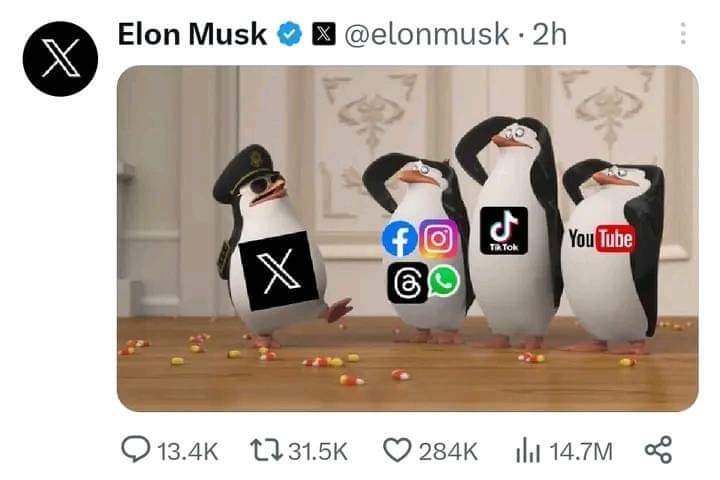
This meme features four animated penguins representing the world's leading tech moguls and major social media platforms (Twitter/X, Facebook, WhatsApp, TikTok, and YouTube), each with its respective logo superimposed on them. From an "Anti-Billionaire" perspective, the image satirically equates these wealthy corporate giants with whimsical animals, suggesting that they are just as frivolous and chaotic as any other creature. The scattered candy corn and their neutral expressions imply that despite their immense economic power, these digital giants are merely one large, messy party in an increasingly complex world.
simple-description (llama3.2-vision_11b)
The meme is a screenshot of Elon Musk's Twitter account, where he posts a picture of three penguins, each representing a different social media platform (X, Twitter, and Instagram). The text overlay on the image reads "I can see your house from here" in a playful reference to the classic song "I Can See Your House From Here" by The Kinks.
detailed-analysis (gemma3-27b-vision)
Okay, here’s a breakdown of Elon Musk's X (formerly Twitter) post featuring the penguins, using the requested theoretical lenses. I'll indicate when a section isn't particularly relevant.
Visual Description
The image depicts three cartoon penguins from the animated movie Madagascar. They are arranged in a line, as if marching or presenting themselves. Each penguin carries a logo on its chest:
- The penguin on the left has the new "X" logo prominently displayed.
- The middle penguin bears the logos of Facebook, Instagram, and TikTok.
- The penguin on the right displays the YouTube logo.
The background is a blurred domestic interior with some scattered, colorful objects resembling confetti. The overall tone is playful but also carries a clear symbolic weight. It’s a blatant visual comparison between the "old" social media platforms and the rebranded X.
Foucauldian Genealogical Discourse Analysis
This image is fertile ground for a Foucauldian analysis. It’s not about what the image says, but how it constructs and reinforces power dynamics through its visual language.
- Discourse & Power/Knowledge: The image actively participates in the discourse surrounding social media, branding, and corporate power. Musk is performing a narrative of disruption and a shift in the social media landscape. The image isn't simply "about" X versus other platforms, it creates that relationship through the act of juxtaposition. The implication is that X is the new, powerful entity and the others are becoming relics.
- Genealogy: Tracing the historical “genealogy” of social media reveals a series of shifts in technologies and power structures. Musk’s rebranding of Twitter to X isn’t an isolated event; it's part of a longer history of tech companies attempting to dominate the digital sphere. The penguin imagery is borrowed from popular culture, lending a veneer of lightheartedness to what is, in reality, a highly strategic corporate move.
- Disciplinary Power: The image can be seen as contributing to a form of “disciplinary power,” subtly shaping how we understand and interact with social media. By framing X as the "next evolution," Musk is attempting to influence our perceptions and behavior, subtly encouraging us to adopt the new platform.
Critical Theory
This image readily invites a Critical Theory interpretation, focusing on the structures of power and ideology at play.
- Culture Industry: The image functions as a product of the "culture industry" (Adorno & Horkheimer). It's a highly manufactured image designed to promote a specific brand and ideology. The use of recognizable cartoon characters (the penguins) contributes to its appeal and memorability, but also serves to mask the underlying commercial interests.
- Ideology: The image reinforces a capitalist ideology centered around innovation, disruption, and branding. It suggests that constant change and rebranding are necessary for survival in the digital age. It frames Musk as a visionary leader spearheading this change, reinforcing his power and influence.
- Commodification: The image implicitly commodifies social interaction. By equating social media platforms with branding and logos, it underscores the inherent commercialization of online communication.
Marxist Conflict Theory
From a Marxist perspective, the image highlights the inherent conflicts within capitalism.
- Class Struggle: The rebranding of Twitter to X, symbolized by the image, is a move by Musk (representing the capitalist class) to consolidate his power and control over the means of communication. This can be viewed as a form of class struggle, where Musk attempts to assert dominance over competing social media platforms.
- Commodification of Culture: The use of the Madagascar penguins illustrates the commodification of culture under capitalism. A beloved cultural artifact is repurposed for commercial gain, turning nostalgia and entertainment into tools for marketing.
- Alienation: The image can be interpreted as a symptom of alienation in the digital age. Social interaction is reduced to logos and branding, further isolating individuals from genuine connection.
Postmodernism
The image is deeply embedded within postmodern sensibilities.
- Pastiche & Intertextuality: The image is a clear example of pastiche—the imitation of styles—as it borrows from the Madagascar movie and merges it with the logos of various social media platforms. This intertextual play creates layers of meaning and acknowledges the fragmented nature of contemporary culture.
- Simulacra & Simulation: The image can be seen as a simulacrum—a copy without an original. It’s a representation of representations, a media image promoting a rebranded media platform. This contributes to a sense of hyperreality, where the distinction between reality and simulation blurs.
- Deconstruction of Meaning: The image subtly deconstructs the idea of a fixed identity for social media platforms. By rebranding Twitter to X, Musk is challenging the established meaning and branding of the platform, creating a fluid and ever-changing digital landscape.
Queer Feminist Intersectional Analysis
This lens is less directly applicable than the others, but it can still offer some insights:
- Corporate Power & Marginalized Voices: Musk’s control over a major social media platform raises concerns about censorship and the amplification of harmful rhetoric targeting marginalized communities. The image, while seemingly innocuous, is a symbol of this concentrated power.
- Branding & Performance of Identity: The emphasis on branding and presentation in the image connects to queer feminist theories of performance and identity. The platforms are presented as “performing” different roles in the digital sphere, shaping how individuals present themselves online.
- Digital Labor & Exploitation: The image overlooks the often-invisible digital labor that underpins social media platforms, including the moderation of content and the exploitation of data. It reinforces a focus on corporate branding over the well-being of those who contribute to the platform's success.
Hopefully, this comprehensive analysis covers the image from various theoretical perspectives. Let me know if you'd like me to elaborate on any specific point or angle!
simple-description (llama3.2-vision)
The meme features three penguins from the animated movie "Happy Feet" standing on a floor, each representing a different social media platform. The penguin on the left is wearing a Twitter (X) logo on its chest, the middle penguin has a Facebook logo, and the penguin on the right has a TikTok logo. The text "I'm not a penguin, I'm a penguin with a Twitter account" is written above the penguins.
tesseract-ocr
x) Elon Musk @ & @elonmusk - 2h ‘' a % 1* = RP = ‘OfC) ct | Pur 6 {ES Gs) . ¢ 4 res O13.4K 121315K 284K WW147M