First Seen
2023-11-11T21:34:53+00:00
simple-description (qwen3.5_2b-q8_0)
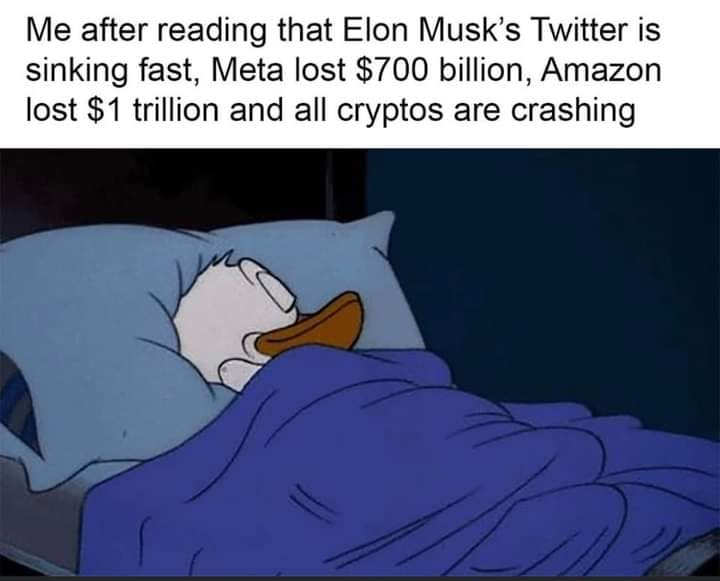
The text reads 'Me after reading that Elon Musk's Twitter is sinking fast, Meta lost $700 billion, Amazon lost $1 trillion and all cryptos are crashing.' This text lists financial disasters and expresses anger at the financial ruin of billionaires, while the sleeping Donald Duck represents a desire to sleep off the chaos caused by these figures. The author panics about the economic crash and uses a sleeping Donald Duck to represent a desire to sleep off the economic ruin.
simple-description (llama3.2-vision_11b)
The meme is a humorous take on the financial struggles of billionaires. The image shows a cartoon character, likely a parody of Elon Musk, lying in bed with a worried expression, surrounded by financial news headlines. The text above the character reads: "I lost $200B in one day, but I still have my Tesla, so I'm good."
detailed-analysis (gemma3-27b-vision)
Okay, here's an analysis of the meme, broken down into sections as requested. I'll only include sections where the topic genuinely applies and offers a meaningful lens for interpretation.
Visual Description
The image features a cartoon depiction of Scrooge McDuck, famously known for his immense wealth, lying in bed, completely covered by a blue blanket. Only his head and beak are visible, suggesting a state of distress or overwhelming sadness. The background is a simple bedroom setting, with a pillow and a dark wall. The text overlay states, “Me after reading that Elon Musk’s Twitter is sinking fast, Meta lost $700 billion, Amazon lost $1 trillion and all cryptos are crashing.” The image effectively portrays a sense of emotional reaction to significant financial loss, using a character synonymous with wealth to create irony and comedic effect.
Foucauldian Genealogical Discourse Analysis
This meme can be examined through a Foucauldian lens by considering the discourse surrounding wealth, value, and financial markets.
- Power/Knowledge: The meme highlights how our understanding of 'success' and 'failure' is constructed through discourse around financial performance. The extreme reactions to these crashes—expressed through the image of Scrooge McDuck—demonstrate the power these discourses hold over us, even if we are not directly impacted. The value of these companies is produced through discourse—reporting, speculation, etc. – and isn't an inherent quality.
- Genealogy of Value: Looking historically, the meme implicitly critiques the relatively recent prioritization of these tech companies and cryptocurrencies as markers of wealth and societal progress. The "crashing" of these entities reveals the fragility of the constructed values around them. It suggests a shift in what is considered “valuable.”
- Subjectivation: The meme positions "me" (the implied viewer) as subjected to the narrative of economic success and failure. Our emotional response is produced through this discourse, even if abstract. We are made to feel something through a process of normalisation of economic fluctuations.
Critical Theory
This meme is ripe for a critical theory analysis, particularly concerning commodity fetishism and the spectacle.
- Commodity Fetishism (Horkheimer & Adorno): The meme implicitly critiques the tendency to ascribe inherent value to companies like Twitter, Meta, and Amazon. The meme’s humor relies on the absurdity of a character who defines himself by wealth being upset by the market fluctuations of these companies. These companies are not valued for their production of use value (actual goods/services that meet human needs), but rather for their exchange value (their worth in the stock market).
- The Spectacle (Debord): The losses of these companies become part of a spectacular performance, endlessly reported and circulated in the media. The meme acknowledges this by reacting to the news of the losses, rather than the actual impact on human life. It is a meta-commentary on the way economic events are presented as dramatic spectacles.
- Commodification of Attention: The context of these companies (Twitter, Meta, Amazon) is significant. They are the giants of the attention economy. The meme indirectly critiques how our attention and data have been commodified, and how the financial success of these companies is linked to our digital engagement.
Marxist Conflict Theory
The meme, while comedic, touches on underlying class tensions and the inherent instability of capitalism.
- Exploitation & Capital Accumulation: The financial losses of these companies, though seemingly abstract to the meme’s viewer, have real-world consequences for workers (layoffs, decreased wages, precarity). The meme’s humor belies the underlying exploitation that fuels the growth of these corporations.
- The Cycle of Boom and Bust: The crashing of these companies is a manifestation of the cyclical nature of capitalism. Marxist theory would see these crashes not as accidental failures, but as an inevitable outcome of the system's inherent contradictions and tendencies towards overproduction and crisis.
- Class Representation: The image of Scrooge McDuck, a symbol of extreme wealth, underscores the disparity between the owners of capital and the working class. His distress highlights how even those at the very top are vulnerable to the risks of capitalism.
Let me know if you'd like me to elaborate on any of these points or explore additional angles!
simple-description (llama3.2-vision)
This meme is a humorous take on the financial losses of major companies. The text above a cartoon of Donald Duck sleeping reads: "Me after reading that Elon Musk's Twitter is sinking fast, Meta lost $700 billion, Amazon lost $1 trillion, and all cryptos are crashing." The meme pokes fun at the financial struggles of these companies, using a sleeping duck to represent the author's reaction to the news.
tesseract-ocr
Me after reading that Elon Musk’s Twitter is sinking fast, Meta lost $700 billion, Amazon lost $1 trillion and all cryptos are crashing ol C4