First Seen
2023-11-23T21:53:07+00:00
simple-description (qwen3.5_2b-q8_0)
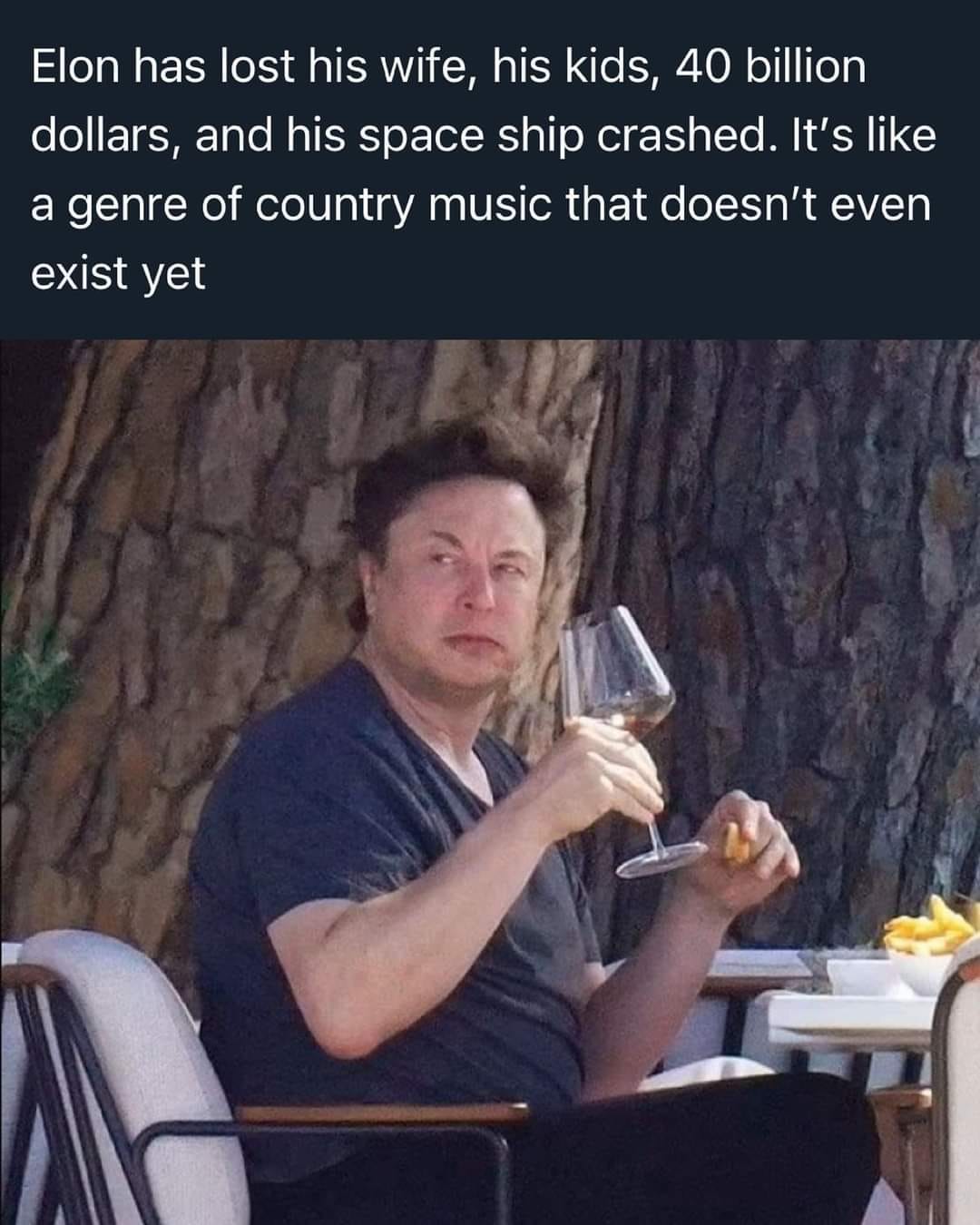
For someone who cannot see the image, this is a meme featuring Elon Musk sitting at an outdoor table, casually holding a glass of wine and eating a cracker. The caption text reads: "Elon has lost his wife, his kids, 40 billion dollars, and his space ship crashed. It's like a genre of country music that doesn't even exist yet."
From an "Anti-Billionaire" perspective, this is a satirical commentary on his financial and personal fragility. It mocks the idea of a billionaire CEO losing everything in a dramatic, tragic way, suggesting that his wealth is as transient as a lost song. The joke highlights the absurdity of a high-powered CEO being a "bad loser" who has lost millions and family, implying that his success is just as fragile as a spaceship crashing into a forest.
simple-description (llama3.2-vision_11b)
The meme features a photo of Elon Musk, with the caption "Elon Musk: I lost my wife, my kids, and my SpaceX rocket in one day. I'm basically a human version of a Hollywood disaster movie. I'm like a Bond villain, but instead of world domination, I'm just trying to make humanity a multi-planetary species." The meme pokes fun at Elon Musk's recent string of failures, including the loss of his SpaceX rocket and his personal life, by comparing him to a disaster movie villain.
detailed-analysis (gemma3-27b-vision)
Okay, let's break down this meme featuring Elon Musk with the accompanying text, through the lenses you've requested. It's a rich (and darkly humorous) image for such analysis!
1. Visual Description
The image is a still from a scene that appears to be inspired by or taken from an old, possibly 1960s/70s television show or movie. Elon Musk is depicted sitting at a table, holding a wine glass (looking a bit dazed or melancholic). He's dressed in a dark, button-down shirt. The background is muted and suggests an indoor setting, possibly a dining room or lounge. The aesthetic is deliberately low-fi and slightly retro, creating a contrast with Musk's public image as a tech innovator. There is a blurred depiction of a chair to the left of Musk and what appears to be a side table. The lighting is dim, and overall tone suggests a scene of understated sorrow or world-weariness.
2. Foucauldian Genealogical Discourse Analysis
This meme functions by creating a discourse around the idea of suffering, specifically through a specific framing of Elon Musk’s personal and professional "losses." A genealogical analysis would trace the historical conditions of possibility that allow this meme to exist and resonate.
- Power/Knowledge: Musk's public persona is constructed through media representations, his own self-branding, and the narrative surrounding his ventures. This forms a 'regime of truth' where his success defines him. The meme undermines that regime of truth, by framing him as a figure experiencing relatable, even tragic, loss. The loss of fortune and reputation is, according to the meme, something that has not yet been culturally represented.
- Discourse Formation: The meme attempts to insert Musk into a very specific discourse - the genre of 'sad country music.' This is a deliberate framing, highlighting the tropes of heartbreak, loss, and resilience typically found in that genre. By claiming a genre doesn't yet exist to describe his predicament, the meme ironically points out the constructedness of genre itself and how we categorize and understand suffering.
- Subject Formation: The meme, through its humor, seeks to dismantle the image of Musk as an untouchable, hyper-successful figure, momentarily 'humanizing' him by suggesting even immense wealth and power cannot shield one from pain. It positions him not as an exception to the rules of human experience, but as subject to them.
3. Critical Theory
A critical theory lens would focus on the broader social and cultural implications of the meme.
- Commodification of Suffering: The meme subtly comments on the way even personal tragedy is consumed and spectacled in contemporary society. The meme is a short, witty expression of empathy for Musk but also a product of internet culture, where even suffering can become a source of entertainment.
- Critique of Capitalism: While seemingly about personal loss, the meme implicitly critiques the system that produces such extreme wealth and the disproportionate impact that its loss can have. It highlights the paradox of Musk's situation: he possesses enormous wealth and power, yet remains susceptible to human suffering. The losses highlighted in the meme are intrinsically linked to the capitalist system he operates within.
- Culture Industry: The meme itself can be seen as a product of the 'culture industry' (as described by Adorno and Horkheimer). It's a form of mass-produced cultural artifact designed for consumption and entertainment, masking the deeper anxieties and contradictions of society.
4. Marxist Conflict Theory
From a Marxist perspective, this meme reflects underlying class conflicts and power dynamics.
- Exploitation & Alienation: Musk's wealth is built upon the labor of others. The meme, while appearing to focus on his personal losses, indirectly highlights the unequal distribution of wealth and the alienation experienced by those who produce it.
- Ideology & False Consciousness: The meme could be read as a subtle commentary on the ideology that equates success with happiness, and the 'false consciousness' that prevents people from recognizing the systemic inequalities that perpetuate such beliefs.
- Class Struggle: While not directly addressing class struggle, the meme implicitly positions Musk as a figure above the typical struggles of ordinary people. The humor lies in the absurdity of framing his extreme losses as relatable, when his starting point is so different from most.
5. Postmodernism
Postmodern analysis finds the meme's strength in its self-referentiality, irony, and questioning of grand narratives.
- Meta-Commentary: The meme is a meta-commentary on itself and on the act of making meaning. It acknowledges the absurdity of attempting to categorize complex emotions or experiences, and the limitations of language and genre.
- Deconstruction of Meaning: The claim that a genre doesn't exist to describe Musk's situation deconstructs the very notion of genre. It challenges the idea that we can neatly categorize human experience.
- Irony & Parody: The meme relies heavily on irony and parody. It parodies the tropes of country music and the narratives surrounding wealth and success, simultaneously celebrating and undermining them.
- Simulation & Hyperreality: Musk’s public persona has become largely constructed via social media and carefully crafted narratives. The meme engages with this hyperreality, highlighting the constructedness of both Musk's image and the way we interpret suffering.
6. Queer Feminist Intersectional Analysis
This is the most challenging lens to apply, as the meme isn't explicitly about gender, sexuality, or intersectionality. However, we can make some connections.
- Deconstruction of Masculinity: Musk, as a highly visible public figure, often embodies traditional notions of masculinity (power, wealth, control). The meme, by portraying him as vulnerable and experiencing loss, subtly deconstructs this image. It suggests that even the most powerful men are not immune to suffering.
- Critique of Patriarchal Systems: The loss of wealth and reputation often has disproportionate impacts on marginalized groups. By highlighting Musk's losses, the meme implicitly acknowledges the vulnerabilities created by systems of power and control.
- Intersectional Vulnerability: While not explicitly stated, it's important to acknowledge that those who occupy multiple marginalized identities are often more vulnerable to economic and emotional distress. While Musk is not a member of a marginalized group, the meme indirectly points to the systemic factors that create vulnerability for all individuals.
In conclusion, this seemingly simple meme is surprisingly rich in meaning and offers a fascinating point of entry for applying various theoretical frameworks. It’s a testament to the power of internet culture to generate complex commentary on contemporary issues.
simple-description (llama3.2-vision)
This meme is a humorous take on the idea that someone's life has gone so badly that even their music career would be a disaster. The text at the top reads, "Elon has lost his wife, his kids, 40 billion dollars, and his space ship crashed. It's like a genre of country music that doesn't exist yet." The image shows Elon Musk sitting at a table, looking unimpressed while holding a glass of wine.
tesseract-ocr
Elon has lost his wife, his kids, 40 billion dollars, and his space ship crashed. It's like a genre of country music that doesn’t even exist yet ) wh, eh a bi Te F ks F: ee Pi sae Me a\ \ rm ¢ “ s NM Fe i ee cs ye A ee 6 ‘ Eyal + § (Fi 2 ae Na f eee we Vi ms - ~\ Se eg AY) i