First Seen
2023-11-24T03:21:54+00:00
simple-description (qwen3.5_2b-q8_0)
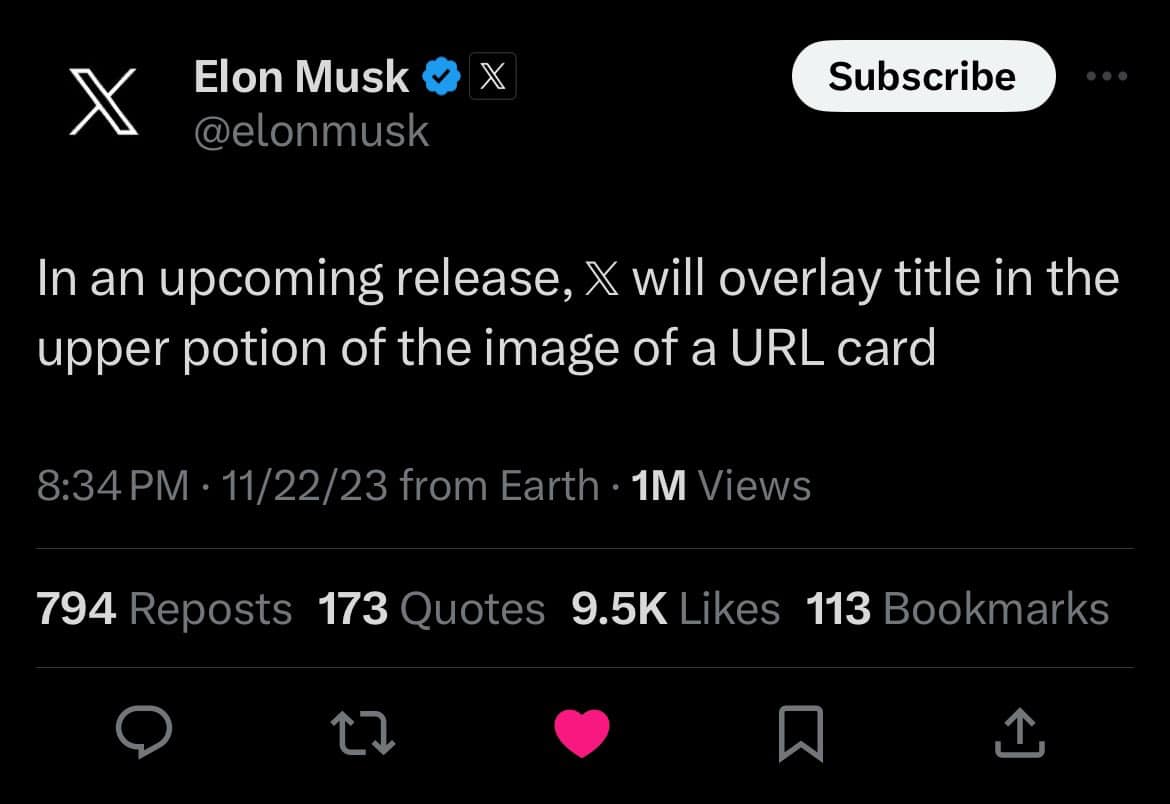
The meme is a satirical take on the irony of a billionaire proposing a trivial design update to his own platform. The tweet text includes a play on words with the word "potion" and "pot," describing how the app X will soon automatically place the website link at the very top of the URL card. This highlights the contrast between Elon Musk's immense wealth and the mundane, self-deprecating nature of his corporate announcements.
Although the category label is "Anti-Billionaire," this specific meme is actually a joke about that very thing. It mocks the irony of a billionaire making a tiny, almost pointless change to a platform's interface, suggesting that his wealth doesn't come with the attention to detail a billionaire should care about.
simple-description (llama3.2-vision_11b)
The meme is a screenshot of a tweet from Elon Musk's Twitter account, where he announces the launch of X, a new platform that will replace Twitter. The tweet reads: "And that's why it's called X". This is a tongue-in-cheek reference to the fact that the platform is now called "X" and is a play on the idea that the platform is now the new "X" that will replace Twitter.
detailed-analysis (gemma3-27b-vision)
Okay, let's break down this X (formerly Twitter) post from Elon Musk through several theoretical lenses. Since some lenses won't be applicable, I'll skip those sections.
Visual Description
The image is a screenshot of a post on X (formerly Twitter). The background is a very dark grey/black. At the top, we see Elon Musk's username "@elonmusk" with a blue checkmark confirming his verification status, and a "Subscribe" button with a gold border. Beside this, there is a stylized "X" logo. The main text of the post announces a feature update: “In an upcoming release, X will overlay title in the upper potion of the image of a URL card”. The timestamp reads "8:34 PM · 11/22/23 from Earth · 1M Views". Below that, there is a row of numeric displays of interaction statistics: "794 Reposts 173 Quotes 9.5K Likes 113 Bookmarks". At the bottom of the image is a row of clickable icons, from left to right: a circular arrow (Repost), a double headed arrow (Quote Post), a heart (Like), a square (Bookmark), and an arrow pointing upwards (Share).
Foucauldian Genealogical Discourse Analysis
This post can be examined through a Foucauldian lens by looking at how it functions as part of a discourse around platform changes, branding, and control.
- Power/Knowledge: Musk’s post isn't just an announcement; it performs authority. The clear, direct language (“X will overlay…”) implies a top-down, authoritative decision-making process. This is embedded within the broader discourse of platform ownership and algorithmic control. The “knowledge” being disseminated isn’t simply information about the feature but reinforces Musk’s position as the key architect of X.
- Genealogy of Control: We can trace a genealogy of “control” from earlier social media platforms (Facebook, Twitter) to X. Each iteration presents a different logic of user experience, algorithmic curation, and monetization. Musk’s post is a node in this lineage, illustrating a shift towards a more heavily controlled or branded user experience.
- Disciplinary Power: The changes announced (overlaying titles on URL cards) might seem minor, but they contribute to the overall shaping of user behaviour. It subtly guides attention, prioritizes certain information, and thus contributes to the normalization of a specific way of interacting with the platform.
Critical Theory
This post can be analyzed through the lens of Critical Theory, specifically focusing on the commodification of communication and the culture industry.
- Commodification of Attention: The announcement, while seemingly about a UI/UX detail, is fundamentally about capturing and directing user attention. The focus on "URL cards" hints at a drive to keep users within the X ecosystem rather than directing them to external websites. Attention is becoming a key commodity, and X is actively shaping the platform to maximize its capture.
- Culture Industry & Branding: The relentless branding of “X” and Musk’s personal investment in it, demonstrates the principles of the culture industry. The change isn't necessarily about user benefit; it's about cementing the “X” brand identity and projecting an image of innovation and control. The platform is being molded into a consumable "product" that needs constant rebranding and updates to maintain its value.
- One-Way Communication: The post is unidirectional: Musk announcing a change. There's minimal opportunity for user feedback or dialogue. This reinforces the power imbalance between platform owner and users, reflecting a broader trend in digital communication.
Postmodernism
We can examine this post through a postmodern lens by considering its self-referentiality, simulacra, and the erosion of authenticity.
- Simulacra & Hyperreality: The rebranding of Twitter to “X” can be seen as a prime example of a simulacrum. The new brand has little inherent meaning beyond its surface aesthetic. It is a signifier detached from a concrete referent. The constant rebranding contributes to a hyperreality where the line between reality and representation becomes increasingly blurred.
- Erosion of Authenticity: Musk's persona and his constant online presence (including posts like this) contribute to a blurring of the lines between the "real" Elon Musk and his constructed online image. The focus on branding and spectacle overshadows any genuine engagement with users or substantive platform improvements.
- Fragmentation & Pastiche: The platform itself is becoming increasingly fragmented and layered. This post is just one small element in a complex web of features, updates, and branding initiatives. The platform is becoming a pastiche of ideas and technologies.
Let me know if you'd like me to elaborate on any of these points or explore additional theoretical frameworks.
simple-description (llama3.2-vision)
The meme is a screenshot of a Twitter post from Elon Musk, where he is announcing that he will be adding a new feature to the X platform, which will allow users to add a title to their link when sharing it on the platform. The title will be displayed in a "mystical" font, and will be written in a way that makes it look like it's being written in a "mystical" font, with words like "magical" and "mysterious" in it.
tesseract-ocr
xX Elon Musk @ xX @elonmusk In an upcoming release, X will overlay title in the upper potion of the image of a URL card 8:34 PM - 11/22/23 from Earth - 1M Views 794 Reposts 173 Quotes 9.5K Likes 113 Bookmarks ‘) yan . Wl pu