First Seen
2024-11-14T00:24:52.558646+00:00
simple-description (qwen3.5_2b-q8_0)
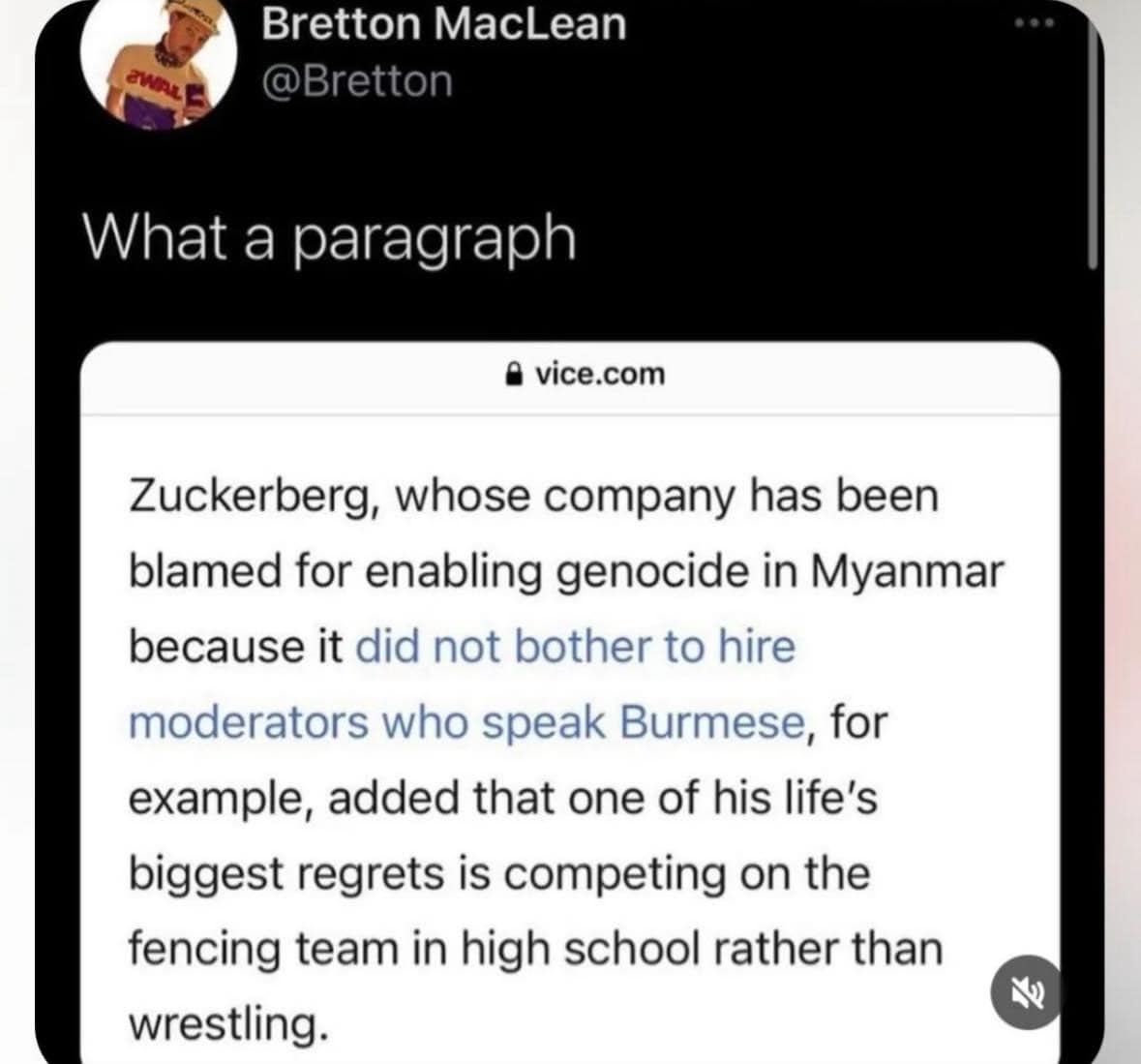
This meme serves as a satirical critique by pasting a comment from Vice.com that mocks the billionaire lifestyle. It highlights the absurdity of treating a wealthy leader like a commoner who would simply prefer basic sports like wrestling due to a lack of money. The text explicitly states Zuckerberg's regret: "competing on the fencing team in high school rather than wrestling," implying he didn't have the funds to buy the equipment needed for fencing in the first place.
detailed-analysis (gemma3_27b-it-q8_0)
Okay, let's break down this meme from an "Anti-Billionaire" category perspective, using the requested theoretical frameworks where applicable.
Meme Analysis: Zuckerberg's Regret (Anti-Billionaire Perspective)
Visual Description
The image is a screenshot of a tweet by Bretton MacLean, featuring his profile picture. The tweet itself is the core content, highlighting a quote from an article (presumably from Vice) about Mark Zuckerberg. The tweet simply reads “What a paragraph.” The content of the paragraph is the significant part, revealing a jarring juxtaposition of events and levels of concern.
Critical Theory
This meme functions as a potent critique of the priorities of billionaire class and how those priorities intersect with immense power. Critical Theory, particularly as developed by the Frankfurt School, would focus on how this scenario reveals the instrumental rationality at play. Zuckerberg's company (Meta, formerly Facebook) wields extraordinary influence over global communication and information flows. The accusation that this platform facilitated genocide in Myanmar through negligence (lack of Burmese-speaking moderators) reveals a calculated decision – a cost-benefit analysis where preventing potential violence in a distant nation was deemed less valuable than maintaining profit margins and minimizing operational costs.
The punchline, Zuckerberg regretting a high school extracurricular choice (fencing vs. wrestling), exposes the complete disconnect between the scope of his power, the magnitude of the harm his company has enabled, and his personal concerns. This is a prime example of how power insulates elites from real-world consequences and distorts their sense of scale.
Marxist Conflict Theory
From a Marxist perspective, this meme embodies the inherent contradictions of late-stage capitalism. Zuckerberg represents the bourgeoisie – the class owning the means of production (in this case, a global communication platform). The tragedy in Myanmar, and the platform’s role in enabling it, points to the prioritization of profit (accumulation of capital) over people. The meme highlights the structural violence inherent in the system. The platform's algorithmic biases, lack of resources dedicated to content moderation in critical regions, are not accidental failures but are results of the need to maximize profit.
The meme underscores the conflict between the interests of the ruling class (maximizing profits, personal indulgence) and the interests of the working class, marginalized communities, and even entire nations. The casual regret about fencing vs. wrestling serves as a clear illustration of the bourgeoisie’s lack of empathy and detachment from the suffering they enable.
Foucauldian Genealogical Discourse Analysis
A Foucauldian analysis would be interested in the discourse surrounding Zuckerberg and his company. This meme participates in a genealogy of power, tracing how the narrative of Silicon Valley entrepreneurs as benevolent innovators has been constructed. Zuckerberg is not simply a “regretful individual.” He is a figure constructed through decades of PR, branding, and a careful curation of his public image.
The meme disrupts this discourse. It exposes the dark underbelly of this narrative – the real-world consequences of algorithms, data collection, and corporate decisions. The juxtaposition of a human tragedy (Myanmar genocide) and a trivial personal regret demonstrates the power of discourse to sanitize and obscure the violence inherent in these structures. It aims to deconstruct the myth of the tech mogul as a detached, well-intentioned figure.
Postmodernism
A postmodern reading would emphasize the fragmented and chaotic nature of reality as presented in the meme. The meme thrives on the absurdity of the comparison. It challenges traditional narratives of heroism and responsibility. There is no grand narrative or overarching meaning being presented here; only a stark, unsettling juxtaposition. The meme doesn't offer solutions or explanations—it's a commentary on the simulacra (copies without originals) of modern life, where the image of a powerful CEO is detached from the real-world impact of their decisions. It is a deconstruction of meaning itself.
In Summary
From an "Anti-Billionaire" standpoint, this meme isn’t simply funny; it’s a scathing indictment of the moral bankruptcy of the ultra-wealthy, the exploitative nature of capitalism, and the dangerous disconnect between power and responsibility in the digital age. It highlights a system where human lives are devalued in the pursuit of profit and personal gratification, and where even the most egregious failures are downplayed in favor of self-serving narratives. The meme’s power lies in its brevity and shocking contrast, making it a viral tool for expressing outrage and critiquing the elite.
Let me know if you'd like a deeper dive into any of these theoretical frameworks as they relate to the meme!
simple-description (llama3.2-vision_11b)
The meme is a screenshot of a text from an article, with a quote from Elon Musk's Twitter account. The quote reads: "When you say you want to die but you have to live because of your bank account." The meme is from the "Anti-Billionaire" category, which pokes fun at the wealthy elite and their perceived sense of entitlement. The quote is a sarcastic commentary on the privileged lives of billionaires, implying that they are only alive because of their wealth.
detailed-analysis (gemma3-27b-vision)
Okay, let's break down the image of the tweet with the requested theoretical lenses. Please note that applying these theories often involves a degree of interpretation and stretching; some may be more relevant than others.
Visual Description
The image is a screenshot of a tweet from a user named "Bretton MacLean" (@Bretton). The tweet features a headline reading "What a paragraph" above a block of text from a vice.com article. The text details a statement made by Mark Zuckerberg, linking his company (presumably Facebook/Meta) to accusations of enabling genocide in Myanmar through a lack of Burmese-speaking moderators. The statement is jarringly followed by Zuckerberg’s stated regret – competing in fencing rather than wrestling in high school. The tweet itself appears on a dark background, typical for the Twitter/X interface. The visual juxtaposition of the serious accusation and the trivial regret is key to the impact.
Foucauldian Genealogical Discourse Analysis
This tweet exemplifies how discourse shapes our understanding of power, responsibility, and even “regret.” A Foucauldian analysis would examine the historical emergence of discourses around social media responsibility, genocide, and the shaping of individual identity.
- Power/Knowledge: The tweet highlights how Facebook/Meta holds significant power over the flow of information and its impact on real-world events. The lack of Burmese-speaking moderators isn't simply a business decision; it's an exercise of power with deadly consequences. This power is legitimized (or not) through discourses surrounding free speech, content moderation, and corporate responsibility.
- Genealogy of Responsibility: A genealogical analysis would trace the historical development of the idea that corporations have a responsibility for the content shared on their platforms. How did this concept emerge? What were the previous discourses around media regulation, liability, and free speech? The tweet implies a failure to assume that responsibility.
- Discursive Shift: The juxtaposition of the genocide claim with the fencing regret is a deliberate disruption of the expected discourse. It destabilizes the narrative around Zuckerberg as a tech innovator and forces a reassessment of his priorities and values.
Critical Theory
Critical theory, particularly the Frankfurt School tradition, focuses on how power structures perpetuate domination.
- Instrumental Reason: Zuckerberg's comment can be seen as an example of instrumental reason—a focus on efficiency and practical concerns (corporate growth) at the expense of ethical considerations (preventing genocide). The failure to hire moderators is a cost-benefit calculation that prioritizes profit over human life.
- Culture Industry: The tweet implicitly critiques the "culture industry"—the way mass media and technology shape public opinion and reinforce dominant ideologies. Facebook's algorithms and content moderation policies have a significant impact on what information people see, potentially contributing to polarization and violence.
- Ideology: The juxtaposition of the two statements suggests an ideological blindness. The triviality of the regret regarding fencing, when juxtaposed against the horrific implications of enabling genocide, points to a warped value system.
Marxist Conflict Theory
From a Marxist perspective, conflict arises from class struggle and the control of resources.
- Capital Accumulation: Facebook/Meta’s drive for capital accumulation (increasing profits) may have led to decisions (like limited content moderation) that had harmful consequences. Cost-cutting measures potentially prioritised profit over safety.
- Ideological Control: Social media platforms can be seen as tools used by the ruling class to maintain ideological control. By shaping the flow of information, these platforms can reinforce existing power structures and suppress dissent.
- Commodification of Information: The tweet highlights the commodification of information on social media. Information is not simply shared; it’s treated as a product to be bought and sold, potentially leading to the spread of misinformation and hate speech.
Postmodernism
Postmodernism questions grand narratives and emphasizes the relativity of truth.
- Deconstruction of Authority: The tweet deconstructs the image of Zuckerberg as a visionary leader. It reveals his vulnerabilities and flaws, undermining the authority he holds as a tech mogul.
- Fragmentation of Meaning: The juxtaposition of the two statements creates a fragmentation of meaning. It disrupts the coherence of the narrative and forces the reader to question the motives and values behind Zuckerberg’s actions.
- Simulacra and Simulation: Social media itself can be seen as a simulacrum—a copy without an original. The virtual world created on Facebook is not a direct reflection of reality; it's a constructed reality that can distort our perceptions.
Queer Feminist Intersectional Analysis
This lens is less directly applicable, but still offers insights. The absence of content moderation, particularly in a context of rising hate speech, often disproportionately impacts marginalized communities (racial, religious, gender, sexual orientation, etc.).
- Intersectional Violence: The failure to address hate speech in Myanmar can be understood as a form of intersectional violence. It exacerbates existing inequalities and increases the risk of harm for already vulnerable groups.
- Silencing of Voices: A lack of Burmese-speaking moderators can silence the voices of those who are most affected by the conflict. It denies them the ability to report hate speech and seek help.
- Disruption of Solidarity: Online spaces should be places of solidarity and support. However, when hate speech goes unchecked, it can create a hostile environment and disrupt the formation of meaningful connections.
I hope this breakdown provides a comprehensive and insightful analysis of the tweet from multiple theoretical perspectives. Let me know if you'd like me to elaborate on any of these points or explore additional theoretical frameworks.
simple-description (llama3.2-vision)
The meme is a screenshot of a tweet from a user named Bretton MacLean. The tweet says "What a paragraph" and is accompanied by a screenshot of a paragraph from a news article about Mark Zuckerberg's company's failure to enable internet access in Myanmar, which has contributed to the genocide of the Rohingya people. The paragraph is a joke about a company's lack of effort to enable internet access in Myanmar, which has led to a genocide.