First Seen
2024-12-23T00:04:13.011183+00:00
simple-description (qwen3.5_2b-q8_0)
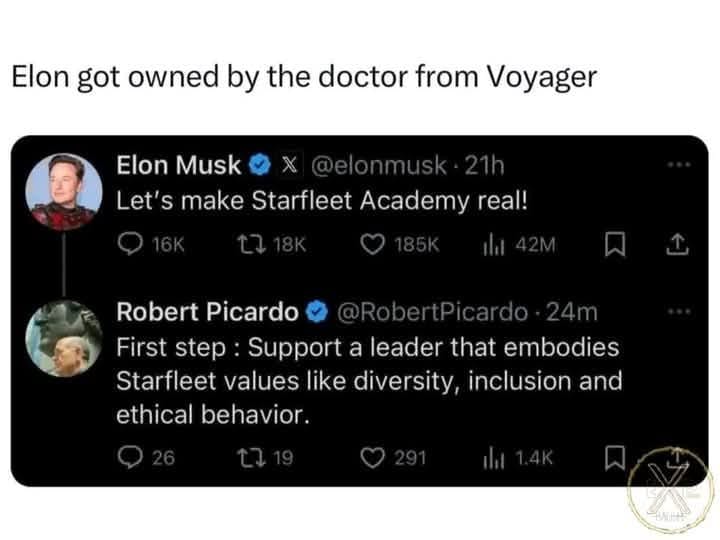
From the "Anti-Billionaire" perspective, this image satirizes the behavior of "The New Money" by depicting how wealthy figures like Elon Musk and Robert Picardo treat one another. The text establishes a scenario where Elon Musk (top tweet) has "owned" the doctor from Voyager (Picardo), while the visual layout shows them as connected members of the elite. The meme highlights how this group operates as a monolithic power, where one figure simply commands the other. When Musk tweets a directive ("Let's make Starfleet Academy real!"), Picardo simply "supports" him, treating him as an equal. This portrays the rich so far dominant that their personal brand or actions are so significant they "own" the political landscape.
detailed-analysis (gemma3_27b-it-q8_0)
Okay, let's break down this meme from the perspective of the "Anti-Billionaire" category, incorporating relevant theoretical frameworks where applicable.
Visual Description
The meme presents a screenshot of a Twitter exchange between Elon Musk (@elonmusk) and Patrick Stewart (@RobertPicardo, portraying Captain Jean-Luc Picard from Star Trek: The Next Generation). Musk tweets, “Let’s make Starfleet Academy real!” Stewart/Picard replies, “First step: Support a leader that embodies Starfleet values like diversity, inclusion and ethical behavior.” The implication is a direct and pointed response to Musk's statement. The visuals—Musk's often provocative profile picture and the iconic image of Picard—immediately signal a power dynamic and a clash of ideologies. The contrast in engagement numbers (Musk's massive likes/retweets vs. Picard's comparatively modest ones) also subtly reinforces perceptions of influence and reach.
Critical Theory
From a Critical Theory lens, the meme is a powerful example of ideological critique. Musk's proclamation to create Starfleet Academy seems to tap into a popular cultural desire for a utopian, meritocratic system. However, Stewart/Picard's response deconstructs this desire. He implicitly argues that building such an academy requires leadership embodying principles fundamentally opposed to Musk’s demonstrated behavior.
The meme highlights a tension between false consciousness (Musk's presentation of a grand vision) and critical consciousness (Picard's call for ethical leadership). Critical Theory posits that dominant ideologies obscure and legitimize power imbalances. Musk, as a billionaire, is the embodiment of those power imbalances. His tweet is seen as a shallow appropriation of a progressive, egalitarian fantasy (Starfleet) to further his brand, while ignoring the necessary foundations of ethical leadership. Picard’s reply challenges this by demanding that actions match rhetoric.
Marxist Conflict Theory
Within a Marxist framework, this meme speaks to the class conflict inherent in contemporary society. Musk represents the capitalist class, possessing enormous wealth and influence, and often using it to shape public discourse. Stewart/Picard, though successful, is ultimately acting as a voice representing values that challenge that power structure.
The exchange isn't merely about Star Trek; it’s about who has the power to define and realize ideals. Musk’s “Starfleet Academy” gesture is portrayed as a potential attempt to co-opt a progressive symbol for capitalist gain, potentially creating an institution that reinforces existing inequalities. Picard’s retort is a demand for a restructuring of leadership to reflect the interests of a broader population, not just the elite. It’s a call to redistribute not just resources, but also values—ethics, diversity, and inclusion. The implicit critique is that Musk's wealth was acquired without prioritizing those values.
Foucauldian Genealogical Discourse Analysis
Employing a Foucauldian lens, we can analyze the discourse surrounding leadership, ethics, and power. Musk's tweet initiates a specific discourse by framing leadership as achievable through technological or institutional innovation ("Let's make...real!"). Picard’s response disrupts this discourse by shifting the focus to qualities of the leader – ethics, diversity, inclusion.
Foucault argues that power is not simply repressive but also productive—it creates discourses that shape our understanding of the world. The meme challenges the dominant discourse of billionaire philanthropy/visionary leadership that often glosses over ethical shortcomings. Picard's response is a counter-discourse, re-centering the conversation around the historical and societal forces that shape ethical behavior, essentially saying that “Starfleet values” aren’t merely things you say you believe in, but something you must demonstrate through your actions and the leadership you provide.
Postmodernism
From a postmodern perspective, the meme exposes the simulacra inherent in Musk's gesture. The "Starfleet Academy" is a hyperreal representation – a copy without an original, a spectacle that has no genuine connection to the values it supposedly embodies.
The exchange also highlights the instability of meaning. Musk appropriates Star Trek imagery, but Picard reclaims it, injecting a critique that undermines Musk’s attempt at cultural capital. The meme’s humor derives from the incongruity—the billionaire attempting to claim the mantle of progressive ideals while his actions often contradict them. It’s a playful but pointed deconstruction of the narrative of the “tech savior.”
In summary: The meme, viewed through the lens of the "Anti-Billionaire" category, is a potent critique of wealth, power, and the appropriation of progressive ideals. It demonstrates how individuals with significant economic influence may try to leverage popular culture to bolster their image, while those with platforms can actively challenge that narrative and demand accountability. It draws power from the cultural cachet of Star Trek and the ethical foundations it represents to expose what is perceived as hypocrisy in Musk's pronouncements.
simple-description (llama3.2-vision_11b)
The meme is a screenshot of a Twitter conversation between Elon Musk and Robert Picardo, where they're discussing the concept of a Starfleet Academy for billionaires. The text reads: "Elon got owned by the doctor from Star Trek: Voyager."
detailed-analysis (gemma3-27b-vision)
Okay, let's break down this social media exchange between Elon Musk and Robert Picardo through various theoretical lenses.
Visual Description
The image is a screenshot of two Twitter posts.
- Elon Musk's Post: Features his verified account with a profile picture. His post states, "Let's make Starfleet Academy real!" along with statistics showing engagement (likes, retweets, etc.).
- Robert Picardo's Post: Features his verified account with a profile picture. His post states, "First step : Support a leader that embodies Starfleet values like diversity, inclusion and ethical behavior." It also includes engagement statistics.
- Overall: The image is a direct capture of social media content, indicating a public exchange. The text is clear, and the image is primarily focused on the content of the tweets.
Foucauldian Genealogical Discourse Analysis
This exchange can be read through a Foucauldian lens as a negotiation of discourse around power, knowledge, and identity.
- Power/Knowledge: Musk's statement ("Let's make Starfleet Academy real!") evokes a technologically utopian vision, suggesting power derived from innovation and the potential to create reality. It positions him as a creator/innovator. Picardo's reply subtly challenges this by linking leadership (and thus, power) to ethical frameworks, shifting the focus from technology to moral standards.
- Genealogy: The allusion to Star Trek and Starfleet Academy connects to a specific historical genealogy of sci-fi, progressive ideals, and futuristic narratives. This genealogy is important because Star Trek often depicted a utopian vision of diversity and ethical exploration. Picardo is invoking this historical "discourse" to criticize a certain trajectory of power.
- Disciplinary Power: One might argue Musk's statement is an attempt to establish a disciplinary regime of innovation. Picardo's reply tries to re-center the discussion to morality and leadership, suggesting a different kind of discipline, one based on ethical conduct rather than technological prowess.
Critical Theory
A Critical Theory lens reveals how this exchange reproduces and challenges dominant ideologies.
- Ideology: Musk’s call to "make Starfleet Academy real!" can be interpreted as promoting a techno-optimistic ideology, suggesting that technological solutions can solve societal problems. It may also subtly reinforce a capitalist ideology of innovation and disruption.
- Hegemony: Picardo’s reply challenges this hegemony by asserting that ethical behavior and diversity are essential qualities of leadership. He is attempting to disrupt the narrative that innovation alone is sufficient for progress.
- Instrumental Reason: The focus on "making" Starfleet Academy, might be seen as an expression of instrumental reason – a focus on means and ends without considering broader ethical implications. Picardo attempts to reintroduce a sense of ethical consideration.
Marxist Conflict Theory
While not a direct conflict in the traditional Marxist sense (class struggle), the exchange reveals a tension between different value systems.
- Material Conditions: Musk's wealth and power are rooted in material conditions (ownership of means of production, technology companies). His statement reflects the ability of the owning class to imagine and attempt to bring into existence visions of the future.
- Ideological Struggle: Picardo's response represents an ideological pushback against the unchecked power of capital and the prioritizing of technology over social responsibility. It’s a struggle over defining the values that should guide society.
- Superstructure: The values of diversity, inclusion, and ethical behavior can be seen as part of the superstructure (cultural and ideological elements) that attempts to regulate and shape the base (economic and material conditions).
Postmodernism
The exchange can also be analyzed through a Postmodern lens:
- Simulation and Hyperreality: Musk's statement about Starfleet Academy can be viewed as creating a simulation of a utopian future, blurring the lines between reality and representation. It’s an attempt to impose a narrative onto reality.
- Deconstruction: Picardo's reply deconstructs Musk’s vision by highlighting the importance of ethical foundations, exposing the potential for power and technological advancement to be divorced from moral responsibility.
- Meta-Narratives: Musk's vision may be seen as attempting to revive a grand narrative of technological progress, while Picardo’s response challenges this by emphasizing the importance of local, ethical considerations.
Queer Feminist Intersectional Analysis
While not explicit, there's potential for this lens, particularly in how Picardo’s statement about diversity and inclusion implies a critique of power structures:
- Intersectionality: Diversity and inclusion are core tenets of intersectional feminism, acknowledging how various social categories (gender, race, class, sexuality) intersect to create unique experiences of oppression and marginalization.
- Power Dynamics: Picardo’s call for a leader embodying these values implicitly critiques the dominant power structures that historically exclude marginalized groups. The suggestion is that true leadership involves centering ethical considerations and creating inclusive environments.
- Critique of Patriarchal Structures: A queer feminist perspective might also analyze how the pursuit of technological progress can sometimes reinforce patriarchal structures and prioritize masculine ideals of dominance and control.
It's important to note that these theoretical lenses aren't mutually exclusive. They can be used in combination to provide a more nuanced and comprehensive understanding of the exchange.
simple-description (llama3.2-vision)
This meme is a screenshot of a Twitter conversation between Elon Musk and Robert Picardo, the actor who played Captain Jan