First Seen
2025-03-07T21:53:40.538217+00:00
simple-description (qwen3.5_2b-q8_0)
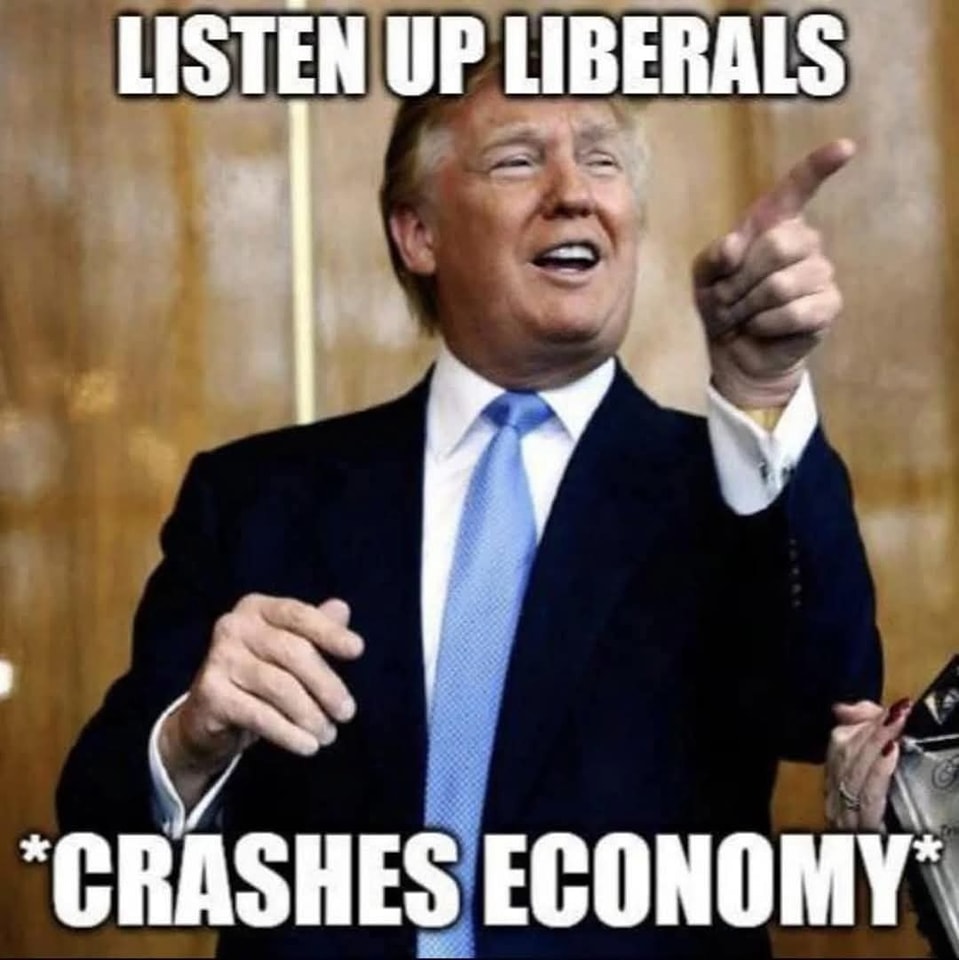
This meme features Donald Trump pointing at a Liberal figure, satirizing the economic crisis as the fault of the wealthy elite. The text at the top reads "LISTEN UP LIBERALS" while the bottom text declares "CRASHES ECONOMY," implying that the current political establishment and the rich are driving the financial decline.
detailed-analysis (gemma3_27b-it-q8_0)
Okay, let's break down this meme through the lens of an "Anti-Billionaire" category context, using the requested theoretical frameworks where applicable.
Visual Description
The meme features a picture of former US President Donald Trump with a stern, assertive expression. He's mid-gesture, pointing two fingers directly at the viewer. Overlaid text reads "LISTEN UP LIBERALS" at the top, and "CRASHES ECONOMY" at the bottom. The formatting (particularly the asterisked "CRASHES ECONOMY") suggests a sarcastic, or ironic, performative action. The image clearly positions Trump as a figure of power delivering a commanding message, while the accompanying text subverts that power by associating him with economic destruction.
Critical Theory
From a Critical Theory perspective, the meme exposes the problematic power dynamics inherent in wealth and political office. Critical Theory challenges the notion of neutrality, arguing that knowledge and institutions are often used to maintain existing power structures.
In this case, the meme implicitly criticizes the perceived impunity of the ultra-wealthy—specifically, those like Trump who were born into privilege or amassed fortunes through potentially exploitative means. The meme suggests that despite the rhetoric of leadership and authority, figures like Trump are capable of actions that harm the broader public (in this instance, the "economy," understood as the system that supports most people’s livelihoods). The framing targets "Liberals" in a way that shows a distrust of the elite.
The meme acts as a form of counter-discourse, challenging the narrative that the wealthy are inherently capable or benevolent stewards of the economy.
Marxist Conflict Theory
This meme is strongly resonant with Marxist Conflict Theory. At its core, Marxist theory centers on the idea that society is fundamentally shaped by class struggle—a conflict between those who own the means of production (the bourgeoisie) and those who labor (the proletariat).
The meme directly implicates the powerful in economic failings. "Crashing the economy" suggests a failure of the capitalist system, which, according to Marxists, is prone to crises due to its inherent contradictions (e.g., the drive for profit over the well-being of workers). Trump, representing the upper class, is presented as a prime agent of this destruction.
The targeting of "Liberals" can be interpreted as a commentary on the political forces attempting to mitigate the negative consequences of capitalism, while the meme's underlying message implies that the real problem lies with the system itself and those who benefit from it. This meme reinforces the idea that the elite are often prioritizing their own profits over the stability of the economic system and well-being of the working class.
Foucauldian Genealogical Discourse Analysis
A Foucauldian analysis would focus on how the discourse surrounding wealth and economic power has evolved over time. Michel Foucault emphasized the relationship between power, knowledge, and discourse. He argued that power is not simply top-down but is dispersed throughout society and operates through the production of knowledge and normalizing discourses.
The meme participates in a discourse of anti-elite sentiment that has been growing in recent years. By connecting Trump to economic downfall, it challenges the legitimizing narratives about the role of the wealthy in society. It's deconstructing the idea that wealth is synonymous with competence or wisdom. It rejects the traditional framing of economic success as purely a result of individual merit and highlights the possibility of systemic failures and abuses of power.
The use of irony ("CRASHES ECONOMY") points to a skepticism towards official narratives and invites a re-examination of the historical context that led to this situation. Foucault would be interested in how this association became possible—what historical events, political rhetoric, and cultural representations have shaped the understanding of Trump and his impact on the economy.
Postmodernism
From a Postmodernist perspective, the meme reflects a rejection of grand narratives—the overarching stories about how the world works. Traditional narratives often glorify economic growth and the role of powerful individuals in driving it.
The meme deconstructs this narrative by presenting a deliberately ironic juxtaposition: a figure of authority claiming to be "in charge" while simultaneously associated with economic disaster. This playful subversion challenges the idea of objective truth or a single, authoritative account of events.
The meme's use of sarcasm, and its reliance on the viewer's pre-existing knowledge of Trump's presidency and economic policies, also speaks to postmodern concepts like intertextuality (referencing other texts or cultural understandings) and the fragmentation of meaning.
Queer Feminist Intersectional Analysis (Less directly applicable, but some connections possible)
While less central than other frameworks, a Queer Feminist Intersectional Analysis can offer some insights. Intersectionality acknowledges that systems of oppression (like capitalism, patriarchy, white supremacy, etc.) are interconnected and create unique experiences of marginalization.
The meme, while not explicitly focused on gender or sexuality, highlights the unequal distribution of economic power, which disproportionately impacts marginalized groups (including women, people of color, and LGBTQ+ individuals). The "economy" isn't a neutral force; its failures affect those with less social and economic capital most severely. The meme implies that the wealthy (like Trump) are insulated from the consequences of their actions, while others bear the brunt of economic crises. Therefore, a queer feminist reading could see this as another manifestation of systemic inequalities.
In summary, this meme, viewed through the lens of an "Anti-Billionaire" context, functions as a critique of power, wealth, and the capitalist system, employing irony and subversion to challenge dominant narratives and expose the potential for economic harm caused by the elite.
simple-description (llama3.2-vision_11b)
The meme is a play on the phrase "I can see Russia from my house," which was a joke made by Sarah Palin during a 2008 presidential debate. In this meme, the phrase is modified to "I can see the economy crashing from my house," implying that the speaker is so wealthy that they can see the economic collapse from their own home. The meme is a humorous commentary on the perceived wealth and privilege of the "I can see Russia" meme's original author, Sarah Palin.
detailed-analysis (gemma3-27b-vision)
Okay, let's break down this meme using the frameworks you've requested. It's important to remember that these are interpretive lenses, and multiple readings are possible.
Visual Description
The image features a full-body shot of former U.S. President Donald Trump. He is dressed in a dark suit and blue tie, adopting a forceful, pointing gesture with his right hand. His facial expression is animated, suggesting an aggressive or commanding tone. A blurred person or object is visible on the right side. Overlaid text reads “LISTEN UP LIBERALS” in bold, white font at the top and "CRASHES ECONOMY" in a similar style at the bottom. The italics on "CRASHES ECONOMY" further emphasize the action. The composition is a classic meme format, using a recognizable figure and impactful text to convey a satirical message.
Foucauldian Genealogical Discourse Analysis
This meme demonstrates how discourse shapes our understanding of power, and how that power operates. The statement “LISTEN UP LIBERALS” establishes a power dynamic, positioning Trump as a figure of authority demanding obedience. The phrase "CRASHES ECONOMY" presents this as the implied result of his power. The meme doesn’t argue that Trump crashed the economy; it asserts it as a consequence of his action, effectively presenting it as truth.
From a Foucauldian perspective, the 'economy' isn’t a neutral, objective entity. It's a discourse constructed through historical practices, regulations, and ideologies. The way the 'economy' is defined and measured is never neutral; it always serves certain interests. This meme leverages that constructed understanding. It implies a causal relationship – "listening to Trump" leading to economic failure – which is a discursive act.
The genealogy of this meme’s power lies in the historical context of Trump's presidency. The meme draws on existing discourses surrounding his economic policies, anxieties about market fluctuations, and pre-existing political polarization.
Critical Theory
This meme aligns with key tenets of Critical Theory. It is a clear example of a critique of power structures. It critiques the exercise of political authority and its perceived consequences on economic stability. The meme actively deconstructs the image of Trump as a competent leader by juxtaposing the forceful command with the implication of economic mismanagement.
The meme challenges the dominant narrative. It suggests that economic outcomes are not simply the result of neutral market forces or inevitable global trends, but are connected to political decisions and the power wielded by individuals like Trump. It's implicitly a critique of the "rational actor" model often used in economics, suggesting that power and ideology play a significant role in economic outcomes.
The meme can be seen as an example of a 'negative dialectic.' It doesn’t offer a positive alternative, but rather exposes the inherent contradictions and failures of the existing system and those in power.
Marxist Conflict Theory
From a Marxist perspective, this meme highlights the inherent class conflict within capitalist society. It presents a scenario where the actions of those in political power (represented by Trump) negatively impact the economic wellbeing of others. While not explicitly naming classes, the implication is that Trump's actions (or the policies he enacts) disproportionately harm working-class or marginalized communities through economic downturns.
The "crashing of the economy" can be understood as a manifestation of the inherent contradictions within capitalism, such as the tendency towards crises and the unequal distribution of wealth. The meme suggests that political figures like Trump exacerbate these contradictions, benefiting certain classes at the expense of others.
The meme's targeting of "liberals" can also be interpreted within a Marxist framework. Liberals are often seen as advocating for reforms within the capitalist system, rather than challenging its fundamental structure. The meme may be subtly positioning Trump as an embodiment of the system’s inherent flaws, regardless of political affiliation.
Postmodernism
From a Postmodern viewpoint, this meme is a prime example of intertextuality and the breakdown of grand narratives. It doesn't present a straightforward argument or claim to objective truth. Instead, it relies on pre-existing cultural understandings of Trump, his political persona, and anxieties about the economy. The meme plays with these pre-existing images and fears, remixing them to create a new meaning.
The use of italics around "CRASHES ECONOMY" adds to the playful, ironic tone. It is not presented as an objective fact but as a performative claim. The meme itself is a 'simulation' – a constructed reality that reflects and distorts the complexities of economic and political life.
The meme deconstructs the idea of a singular, authoritative voice. It’s a decentralized, fragmented piece of communication that relies on audience participation and interpretation. The meme does not prove economic failure, it performs the accusation.
Queer Feminist Intersectional Analysis
While not immediately obvious, this meme can be interpreted through an intersectional lens. The economic “crash” implied by the meme disproportionately impacts vulnerable groups – particularly women, people of color, and LGBTQ+ individuals – who are often the first to suffer from economic downturns.
The meme’s implicit critique of power structures can be extended to examine how patriarchal and heteronormative systems reinforce economic inequalities. Trump's politics, often characterized by exclusionary rhetoric and policies, can be seen as contributing to these inequalities.
The meme’s aggressive tone and forceful imagery can also be connected to the ways in which dominant power structures often rely on intimidation and violence to maintain control. This can be seen as a parallel to the ways in which marginalized groups are often subjected to violence and oppression.
The meme’s targeting of “liberals” could be viewed as a way to silence progressive voices that advocate for economic justice and social equality. This can be seen as a manifestation of the ways in which dominant power structures often seek to suppress dissent and maintain the status quo.
Important Note: These are just interpretations. The meaning of a meme is always open to debate and depends on the individual viewer's background and perspective. These analyses provide a framework for understanding the meme's potential implications through various theoretical lenses.
simple-description (llama3.2-vision)
This meme is a photo of Donald Trump with a sarcastic expression. The text "LISTEN UP LIBERALS" is written above the image, and "CRASHES ECONOMY" is written below it. The meme is likely meant to be humorous or ironic, implying that the speaker is saying something that is not true or is a joke.