First Seen
2025-04-25T19:02:57.900666+00:00
simple-description (qwen3.5_2b-q8_0)
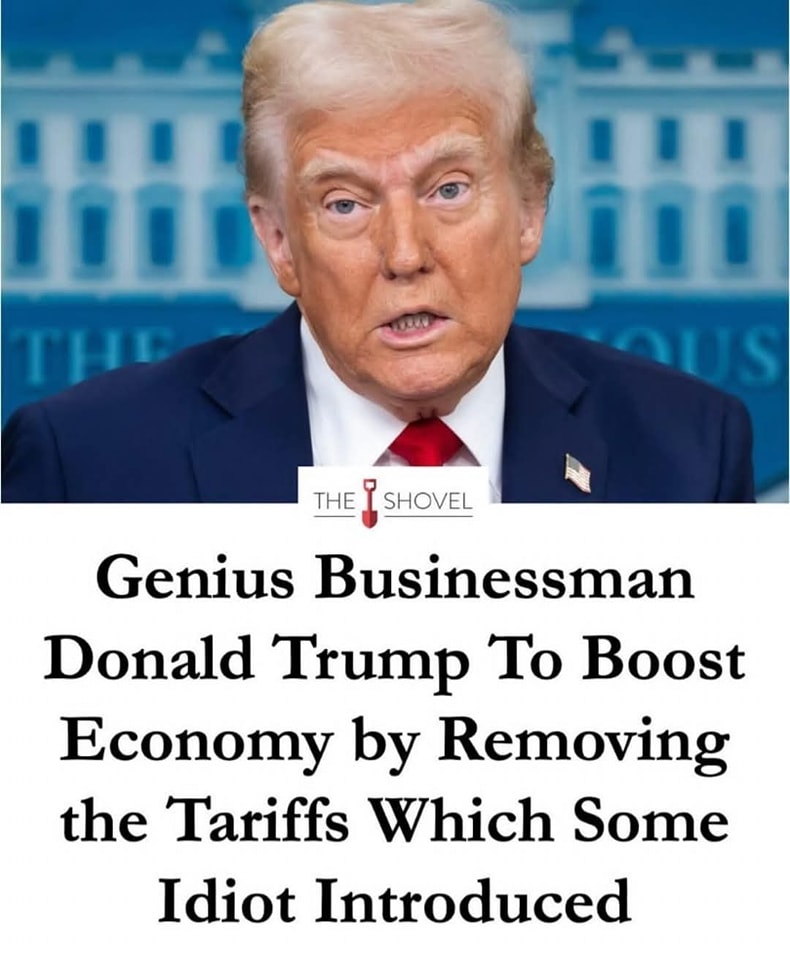
This anti-billionaire joke mocks the claim that Donald Trump's tariffs hurt the economy by portraying him as a "Genius Businessman" who invented these restrictive rules to boost the economy. It sarcastically blames the people pushing these rules—identified as "the Tariffs Which Some Idiot Introduced"—for creating the very bad policies the businessman is now trying to remove.
The text visible in the image includes the logo "The Shovel" and the headline: "Genius Businessman Donald Trump To Boost Economy by Removing the Tariffs Which Some Idiot Introduced."
detailed-analysis (gemma3_27b-it-q8_0)
Here's an analysis of the meme through the lens of an "Anti-Billionaire" category, using the requested theoretical frameworks where applicable.
Meme Analysis: Donald Trump & Tariff Removal (Anti-Billionaire Perspective)
Visual Description
The image features a close-up portrait of Donald Trump, likely taken during his presidency, positioned in front of the White House. His expression appears stern and slightly dismissive. The text overlay, from the satirical website The Shovel, announces "Genius Businessman Donald Trump To Boost Economy by Removing the Tariffs Which Some Idiot Introduced." The blatant sarcasm is key. The color palette is dominated by the grey/white of the White House and the dark tones of Trump’s suit, creating a serious, almost imposing feel that contrasts with the absurd claim.
Foucauldian Genealogical Discourse Analysis
From a Foucauldian perspective, this meme deconstructs the discourse surrounding the figure of the “successful businessman.” For decades, a powerful narrative has been constructed – reinforced by media, political rhetoric, and societal norms – that equates wealth with intelligence, competence, and benevolence. This meme genealogically traces that discourse, revealing its arbitrary foundations. The label "Genius Businessman" is not presented as a truth, but as an assertion used to legitimize power. The sarcastic framing ("Some Idiot introduced the tariffs") undermines the authority of any preceding economic decisions and positions Trump as a savior figure, implicitly reinforcing the idea that immense wealth grants inherent authority in economic matters.
The “Anti-Billionaire” perspective challenges this discourse directly. It exposes how this narrative serves to normalize and justify extreme wealth accumulation, masking the systemic inequalities that enable it. The meme uses satire to reveal the constructed nature of "business genius," highlighting that much of billionaire success isn’t based on inherent skill but on exploitation and favorable conditions.
Critical Theory
Critical Theory, concerned with power structures and ideology, sees the meme as a critique of the cult of personality surrounding figures like Trump. The “genius” label is part of an ideology that obscures the underlying power dynamics at play. The notion that a single individual, particularly a billionaire, can "boost the economy" relies on the idea that economic well-being is contingent on the actions of a select few.
The Anti-Billionaire perspective in Critical Theory would see this as a particularly insidious form of domination. It’s a narrative that prevents critical examination of the systemic problems – like wealth concentration, tax loopholes, and lack of worker protections – that contribute to economic instability. Removing tariffs, in this context, is not necessarily presented as a good economic move, but as a move designed to benefit the billionaire class.
Marxist Conflict Theory
From a Marxist standpoint, the meme exemplifies the inherent class conflict at the heart of capitalist systems. The “tariffs” (representing potentially protections for domestic industries or revenue for social programs) are positioned as an impediment to the free flow of capital, the very foundation of profit accumulation for the billionaire class. Removing them is framed as a benefit, not for the working class or the average citizen, but for the capitalist class – and Trump, as their representative.
The phrase "Some Idiot" implies that anyone who challenged or disrupted the "natural" order of capital accumulation was foolish. The Anti-Billionaire stance would highlight how tariff decisions ultimately reflect the struggle between capital (represented by Trump and his peers) and labor, and that the removal of tariffs typically benefits capital at the expense of workers. This is a reinforcement of the idea that economic policy is not neutral, but inherently class-based.
Postmodernism
The meme utilizes postmodern elements through its heavy reliance on irony and deconstruction. It doesn’t assert Trump’s brilliance, but presents the claim with a tone that signals its falsity. It relies on the viewer’s understanding of Trump’s track record and the broader political context to recognize the satire.
The Anti-Billionaire view uses this postmodern aspect to disrupt the dominant narrative. It's a challenge to the idea of objective truth, showing how even economic concepts like "boosting the economy" are constructed and used to serve particular interests. The meme isn’t necessarily making a definitive statement about the economic effects of removing tariffs; it’s making a statement about the ways in which power is exerted through language and framing.
Overall, from an Anti-Billionaire perspective, this meme is a satirical jab at the myth of the “self-made” billionaire and a pointed critique of how wealth influences political and economic decisions. It’s a deconstruction of the narratives used to justify extreme wealth accumulation and a reminder of the inherent class conflicts that shape our world.
simple-description (llama3.2-vision_11b)
The meme is a satirical image of former US President Donald Trump, with a headline that reads "Genius Businessman Donald Trump To Boost Economy By Removing Tariffs Imposed By His Predecessors." The image is a play on Trump's reputation as a "genius" businessman, but in this case, he's trying to boost the economy by removing tariffs that were imposed by his predecessors, which is a clever and ironic twist on his reputation.
detailed-analysis (gemma3-27b-vision)
Okay, let's break down this image and text through the lenses of several theoretical frameworks.
Visual Description
The image features a close-up portrait of former U.S. President Donald Trump. He is wearing a red tie and a white shirt, positioned in front of a blurred background that appears to be the White House. His expression is serious, with slightly pursed lips and a direct gaze. The lighting is somewhat stark, emphasizing the lines on his face. The text overlay reads "Genius Businessman Donald Trump To Boost Economy by Removing the Tariffs Which Some Idiot Introduced," with a logo "The Shovel" to the side. The overall aesthetic suggests a satirical, deliberately hyperbolic presentation.
Foucauldian Genealogical Discourse Analysis
This image and text actively participates in a discourse regarding economic policy and leadership. Foucault would be interested in how power operates through the construction of this discourse.
- Power/Knowledge: The statement frames Trump as a "Genius Businessman," immediately positioning him as an authority on economic matters. This asserts power through the construction of knowledge: associating him with expertise. The label "idiot" applied to the person who introduced the tariffs reinforces this by creating a binary opposition—Trump as brilliant, the other as foolish.
- Genealogy: Tracing the "genealogy" of this claim requires looking at the historical use of labeling opposition with pejoratives in political rhetoric. It is common to construct an "other" to reinforce one's own perceived superiority. The use of "idiot" isn't a neutral description; it's a tactic of delegitimization. The genealogical approach would examine the historical roots of this type of language in power dynamics.
- Discursive Formation: This statement is part of a broader discursive formation surrounding Trump's persona—a blend of business acumen, anti-establishment rhetoric, and strongman leadership. The claim about tariffs is presented not as a policy decision, but as a demonstration of Trump's inherent "genius."
Critical Theory
Drawing from the Frankfurt School, this image exemplifies the manipulation of public opinion and the construction of ideologies.
- Culture Industry: This is an example of content produced within what Adorno and Horkheimer called the "culture industry." The image is designed not to inform or educate, but to create a specific emotional response and reinforce a particular narrative—Trump as a capable leader. The satirical tone potentially masks a more insidious reinforcement of power.
- Ideology: The claim about Trump's "genius" functions as an ideological justification for his actions. It suggests that his decisions are inherently correct because of his innate abilities, rather than subject to rational debate or critique.
- Domination: The framing of Trump as a genius and the opposing figure as an "idiot" supports a system of domination. It implies that certain individuals are naturally equipped to lead, while others are incapable of understanding complex issues.
Marxist Conflict Theory
From a Marxist perspective, this image highlights the class struggle and the use of rhetoric to maintain power.
- Class Interest: The framing of Trump as a "businessman" implicitly appeals to the interests of the capitalist class. The focus on boosting the economy through tariff removal benefits those who profit from international trade.
- False Consciousness: The use of hyperbolic language ("genius," "idiot") may contribute to "false consciousness"—the acceptance of a distorted view of reality that serves the interests of the ruling class. By framing economic policy as the product of personal brilliance or incompetence, it obscures the structural forces at play.
- Ideological Apparatus: The image and text function as an “ideological apparatus” – a mechanism used by the ruling class to maintain its power through the dissemination of specific ideas and narratives.
Postmodernism
A postmodern analysis would focus on the image’s self-referentiality, irony, and challenge to grand narratives.
- Simulacra and Simulation: The image potentially operates as a "simulacrum" – a copy without an original. The claim about Trump's "genius" may be detached from any actual substance, becoming a self-perpetuating image or performance.
- Irony and Parody: The satirical tone and hyperbolic language create a sense of irony and parody. The image invites the viewer to question the sincerity of the claims being made.
- Deconstruction: Deconstructing the statement requires challenging the binary opposition between "genius" and "idiot." These labels are subjective and culturally constructed, masking the complex factors that contribute to economic policy.
Note: Some frameworks don't naturally apply. In this instance, a Queer Feminist Intersectional Analysis doesn't seem directly relevant without additional context. There's no obvious gender, sexuality, or intersectional power dynamic being addressed in the core message.
Let me know if you'd like me to elaborate on any of these analyses!
simple-description (llama3.2-vision)
This meme is a satirical image featuring a photo of former US President Donald Trump. The text at the top of the image reads "The Shovel" and below it, "Genius Businessman Donald Trump To Boost Economy by Removing the Tariffs Which Some Idiot Introduced". The image is likely meant to be humorous and ironic, poking fun at Trump's reputation for being a "genius" businessman and his often-ridiculous statements.