First Seen
2025-05-08T00:55:42.342382+00:00
simple-description (qwen3.5_2b-q8_0)
This meme mocks the behavior of wealthy figures like Elon Musk, portraying them as selfish and corrupt rather than just rich. It explains the text by describing how a billionaire like Musk abandoned a vital system (the Air Traffic Controller) simply because he wanted to take over control, implying that his massive wealth allowed him to become a "thug" who destroys infrastructure for personal gain. It serves as an anti-billionaire gag by suggesting that even with millions, a person's ambition can be villainous if they are ungrateful to the world around them.
detailed-analysis (gemma3_27b-it-q8_0)
Okay, let's break down this meme from an "Anti-Billionaire" category perspective, utilizing relevant theoretical frameworks as applicable.
Visual Description
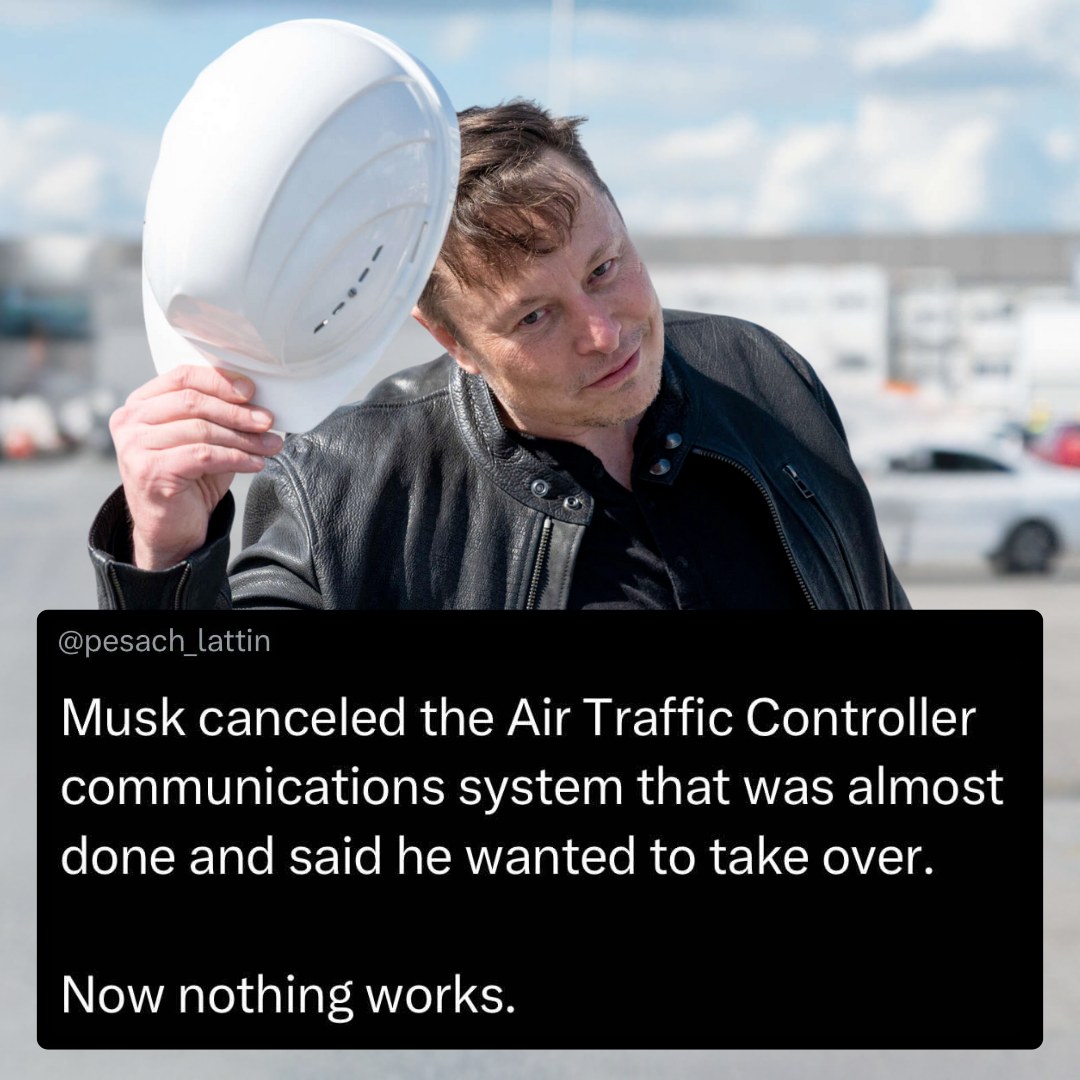
The meme features a photograph of Elon Musk, appearing slightly dishevelled, holding a white hardhat at a jaunty angle. He is outdoors, seemingly on an airfield or near planes (visible in the background). His expression is difficult to read but leans towards appearing slightly overwhelmed or even feigning competency. The overall effect is to portray him as an amateur, someone out of his depth, masquerading as an expert.
Foucauldian Genealogical Discourse Analysis
From a Foucauldian perspective, this meme engages with the discourse around expertise and authority. Historically, expertise in areas like air traffic control was held within bureaucratic structures, regulated by the state, and reliant on established institutional knowledge. Musk’s intervention disrupts this established discourse. He attempts to redefine expertise – suggesting that his wealth and "vision" are sufficient to overcome the work of trained professionals.
The genealogy would trace the history of this shift—from reliance on publicly funded, collectively developed systems to the increasing power of private actors (like Musk) to shape crucial infrastructure. The meme implicitly critiques the normalization of this power dynamic – the idea that a single individual, through sheer capital, can dismantle and attempt to replace expertly built public services. It highlights the power/knowledge relation, revealing how wealth is being used to displace and discredit established knowledge systems.
Critical Theory
The meme serves as a critique of the unchecked power of capital and the erosion of public services. Within Critical Theory, this fits into the broader pattern of “instrumental rationality” – the reduction of all things (even safety and essential infrastructure) to questions of efficiency and profit. Musk's move isn’t about improving air traffic control; it’s about potentially creating a new revenue stream, or consolidating control.
The meme argues that this form of “progress” comes at a cost—the degradation of public safety. It illustrates the alienation of workers and the increasing influence of market forces on aspects of life previously considered outside the scope of commodification. The "Now nothing works" caption functions as a direct critique of the consequence of prioritizing profit above all else.
Marxist Conflict Theory
From a Marxist perspective, the meme exemplifies class conflict. Musk embodies the capitalist class—those who own the means of production (and, increasingly, critical infrastructure). The disruption of the air traffic control system is framed not as a technical issue, but as an act of class warfare.
The pre-existing system represents the collective labor and knowledge of air traffic controllers, funded by the public. Musk's intervention represents an attempt to privatize this infrastructure, potentially leading to exploitation of labor (if he were to rebuild it), and increased costs or reduced access for the public. The “nothing works” statement underscores the consequences of allowing capitalist interests to override public safety and collective well-being. It's a symptom of the inherent contradictions within the capitalist system—the pursuit of profit leading to societal instability.
Postmodernism
The meme subtly engages with postmodern themes of the deconstruction of grand narratives. The traditional narrative surrounding air traffic control is one of safety, order, and meticulous planning. Musk's attempt to dismantle and rebuild this system, based on a self-proclaimed vision, challenges that narrative. He’s creating a new, arguably less reliable, narrative built around disruption and the power of individual innovation.
Furthermore, the meme's brevity and reliance on visual irony—Musk looking slightly out of his depth—fit with postmodern aesthetics of pastiche and skepticism towards authority. The claim of ‘almost done’ and the implication of failure directly contradict the narrative that billionaires are infallible geniuses.
Why other analyses are less relevant
- Queer Feminist Intersectional Analysis: While the meme does highlight a power imbalance, its primary focus is not on gender, sexuality, or the intersections of those identities with class. It’s more centrally concerned with economic power and its impact on public infrastructure.
In conclusion, this meme serves as a concise and pointed critique of the growing power of billionaires to disrupt vital public services, framed through the lens of anti-billionaire sentiment. It draws on theoretical frameworks like Critical Theory and Marxism to expose the inherent conflicts between capitalist interests and the public good.
simple-description (llama3.2-vision_11b)
This meme is from the "Anti-Billionaire" category, which is a humorous and satirical take on the wealthy elite. The meme features a photo of Elon Musk, with a caption that reads: "Musk cancelled the Air Traffic Controller communications system that was almost done and said he wanted to take over. Now nothing works." The meme is poking fun at Musk's reputation for being a control freak and his tendency to disrupt and take over projects. The image is likely a photo of Musk with a confused or frustrated expression, holding up a broken or malfunctioning device, implying that his attempts to take over and control have resulted in chaos and failure.
detailed-analysis (gemma3-27b-vision)
Okay, here's an analysis of the image and its accompanying text, broken down into sections as requested. I'll only include sections where the analysis genuinely applies, and I'll note if something is a weaker connection.
Visual Description
The image features Elon Musk, a well-known entrepreneur, standing outdoors in what appears to be an airport or aircraft maintenance setting. He is wearing a black leather jacket and a white hard hat, holding it somewhat awkwardly. His expression is somewhat grim, looking downward and to his right. Behind him, a portion of a large, white, dome-shaped object (potentially part of a rocket or spacecraft) is visible. The background is somewhat blurred, suggesting focus is intended on Musk himself. The lighting is bright but slightly overcast. The composition presents a sense of authority and control, but also a hint of perhaps something amiss or incomplete (implied by the incomplete spacecraft element).
Foucauldian Genealogical Discourse Analysis
This image and accompanying text present a rich opportunity for Foucauldian analysis. The central claim—Musk cancelling an almost completed air traffic control system and intending to replace it—can be viewed through the lens of power/knowledge.
- Discourse of Technological "Fixing": The narrative relies on the discourse that technology can "fix" problems. Musk's intervention positions him as a "savior" figure, suggesting the existing system was inherently flawed and needed his vision to be made functional. This is a power play through asserting expertise and establishing a need for his intervention.
- Genealogy of Air Traffic Control: Examining the historical development of air traffic control reveals a shift in power dynamics. Originally a collaborative, public service, the potential for privatization (or disruption by private entities) changes the structure. Musk’s attempt to take over can be seen as a step in reshaping this established power structure.
- Discipline and Control: Air traffic control is fundamentally a disciplinary system—it enforces rules, monitors behavior, and exerts control over movement. By attempting to replace the system, Musk isn't just changing technology; he's attempting to reshape the mechanisms of control.
- The "Expert" and Power: Musk’s authority and standing come from his perceived expertise, which grants him the power to disrupt established systems. This analysis emphasizes that knowledge isn’t neutral; it’s intertwined with power, enabling and legitimizing certain actions.
- The text "Now nothing works" is an expression of the power and disruption Musk can cause.
Critical Theory
Applying Critical Theory, we can see the image and text as representing a critique of unchecked capitalist ambition and the commodification of essential public services.
- Commodification of Infrastructure: Air traffic control is a critical piece of public infrastructure. The attempt to privatize or control it through a private entity (Musk's company) exemplifies a trend toward treating essential services as commodities to be bought and sold for profit.
- Rationalization and Control: The image suggests a drive for rationalization—imposing a new, streamlined (though potentially disruptive) system. This ties into the Frankfurt School's critique of instrumental reason, where efficiency and control take precedence over human well-being.
- Loss of Public Good: The failure of the air traffic control system as expressed in the text implies a loss of the public good—the ability to ensure safe and efficient air travel is compromised for the sake of private control.
- Ideology of Innovation: Musk’s image is often tied to an ideology of constant innovation and “disruption.” Critical Theory asks us to question this narrative—who benefits from disruption, and at what cost?
- "Now nothing works" expresses the outcome of a prioritization of capital over the public good.
Marxist Conflict Theory
From a Marxist perspective, the image illustrates class struggle and the inherent contradictions of capitalism.
- Capital vs. Public Service: The conflict is between private capital (represented by Musk) and the public service of air traffic control. Musk's intervention represents the encroachment of private interests into areas traditionally managed for the collective good.
- Means of Control: Air traffic control represents a critical means of control over a vital industry. The attempt to wrest control of this system from public hands demonstrates the ongoing struggle for control of essential resources.
- Exploitation and Profit: The underlying motivation for Musk’s intervention is likely profit. Privatizing or controlling air traffic control could create opportunities for extracting surplus value and increasing profits.
- Alienation: The failure of the system, as expressed in the text, can be seen as a form of alienation—a disconnect between the needs of society and the priorities of private capital.
- "Now nothing works" embodies the outcome of prioritizing profit over the public good.
Postmodernism
The analysis of this image through a postmodern lens focuses on the breakdown of grand narratives and the questioning of authority.
- Deconstruction of Expertise: The image implicitly challenges the notion of centralized, top-down expertise. Musk is positioned as a disruptor, someone who doesn’t necessarily follow established norms or procedures.
- Simulacra and Simulation: The image itself can be seen as a simulacrum—a copy without an original. Musk’s carefully curated public image and branding contribute to this sense of artifice.
- Fragmentation and Chaos: The text "Now nothing works" suggests a fragmentation of order and a descent into chaos—a rejection of the modernist ideal of a perfectly functioning system.
- Loss of Meta-Narratives: The image embodies a rejection of the "grand narrative" of progress and technological determinism. It suggests that technology doesn't necessarily lead to positive outcomes.
- Questioning Authority: The image positions Musk as someone challenging the status quo, but also invites the audience to question his motives and authority.
Queer Feminist Intersectional Analysis
This area is the weakest connection, but can be applied in a limited way.
- Disrupting Norms: Musk's image as a "disruptor" could be viewed as a challenge to established patriarchal norms within the engineering and aviation industries. This is a tenuous connection, as it doesn’t inherently align with feminist principles.
- Power Imbalance: The image highlights a power imbalance—a wealthy, powerful individual exerting control over a public system. This echoes feminist critiques of patriarchal power structures.
- Intersectional Concerns: While not explicitly addressed in the image, the potential consequences of a disrupted air traffic control system could disproportionately affect marginalized communities. Access to travel, safety, and economic opportunity could all be affected.
Let me know if you'd like me to expand on any of these sections, or explore another theoretical framework.
simple-description (llama3.2-vision)
The meme is a humorous image of Elon Musk, the founder of SpaceX and Tesla, holding a satellite dish that is supposed to be a satellite that he wanted to use to provide internet connectivity to Africa. The text accompanying the image reads, "Musk canceled the Air Traffic Controller communications system that was almost done and said he wanted to take over. Now nothing works." The meme is likely meant to be humorous and satirical, poking fun at Musk's tendency to cancel or abandon projects that are nearly completed.