First Seen
2023-05-10T21:03:24+00:00
simple-description (llama3.2-vision_11b)
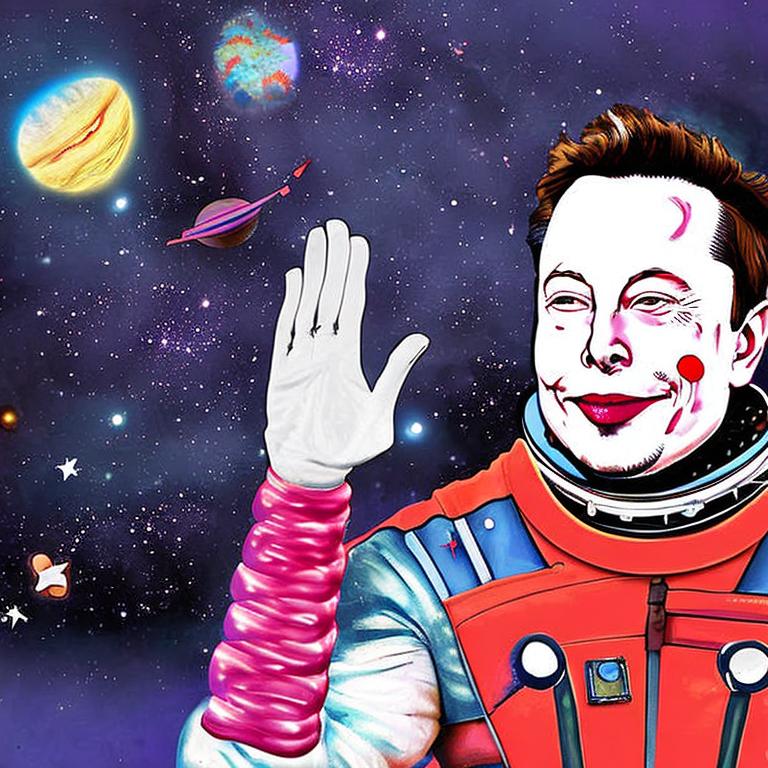
The meme features a picture of billionaire Elon Musk with a red X over his face, implying he's been banned from Twitter. The image is captioned "Elon Musk's Twitter ban" and is used to express frustration or annoyance at the billionaire's actions on the platform.
detailed-analysis (gemma3-27b-vision)
Okay, let's break down this striking image through the lenses you've requested. It's a complex piece, lending itself to multiple interpretive approaches.
Visual Description
The image depicts Elon Musk, or a very strong likeness, rendered in a highly stylized and unsettling manner. His face is made up to resemble a clown—emphasizing exaggerated red lips, blush, and a single red tear painted beneath the eye. He is clad in a vibrant red and white spacesuit, with a distinct retro-futuristic aesthetic. Musk is extending his right hand in a waving or gesturing motion, almost as if greeting onlookers, or making a pronouncement. The background is a dark, star-speckled space, with stylized planets of varying colors (orange, purple/pink) visible. The overall effect is one of dissonance, blending the authority implied by the spacesuit and space context with the absurdity and implied vulnerability of the clown makeup. The colors are bold, saturated, and the style leans toward illustrative pop art.
Foucauldian Genealogical Discourse Analysis
This image is ripe for a Foucauldian analysis. We can consider discourses relating to power, technology, and the construction of the "entrepreneurial self."
- The Discourse of Technological Utopianism: Musk is a central figure in the promotion of space exploration as a solution to earthly problems. The spacesuit signifies this discourse, promising a future beyond our current limitations. However, the clown makeup destabilizes that narrative. It suggests a discontinuity in the smooth, rational construction of this future. The "tech-bro" narrative is questioned.
- The Discourse of the "Genius" Entrepreneur: Musk is often framed as a visionary, a disruptive innovator. The composition positions him as powerful, but the clowning aspect undercuts this. It hints at the fragility of the image of the “genius” – revealing the performance, the constructed nature of this role. The tear suggests a vulnerability that is typically suppressed within these narratives.
- Genealogy of Power: We can trace the historical links between clowns, political satire, and the subversion of authority. Clowns have historically been used to challenge social norms, but also to contain dissent. Here, the clown makeup is applied to a figure of immense power, creating a paradoxical image. Is he mocking authority or becoming a form of it?
- Discipline and Biopower: The spacesuit, while suggesting exploration, also represents control – the need for life support, regulation, and control of the body. This can be linked to Foucault's concepts of biopower. The clown makeup disrupts this control, highlighting the body as a site of performance and manipulation.
Critical Theory
The image critiques the cult of personality around tech billionaires and the uncritical acceptance of their visions.
- Commodity Fetishism: Musk, as a brand, has become a commodity in himself. The image highlights the performative nature of this branding. The spacesuit and space exploration become props in a larger marketing strategy, obscuring the underlying economic and social realities.
- Ideology Critique: The image dismantles the ideology of technological solutionism. While promising a future in space, the clown makeup reveals the superficiality and potential absurdity of this promise, particularly in the context of pressing social and environmental issues on Earth. It questions whether these grand ambitions are genuinely altruistic or motivated by self-interest.
- Culture Industry: The image can be seen as a commentary on the “culture industry” – the mass production of images and narratives that reinforce existing power structures. Musk’s image is constantly being circulated and reshaped, becoming a spectacle divorced from material conditions.
Marxist Conflict Theory
From a Marxist perspective, the image highlights the inherent contradictions of late-stage capitalism and the role of individuals like Musk in perpetuating inequality.
- Class Conflict: Musk represents the extreme accumulation of wealth in the hands of a few, while many struggle with basic needs. The grand spectacle of space exploration is juxtaposed with the material conditions of inequality on Earth. The clowning could be seen as a mask concealing the exploitation inherent in his business practices.
- Alienation: The image hints at a sense of alienation. Musk, as a hyper-individualized figure, is detached from the collective struggles of humanity. The clown makeup could represent a kind of psychic fragmentation, a disconnection from genuine human connection.
- False Consciousness: The spectacle of space exploration can be seen as a distraction from the real problems facing society, perpetuating a “false consciousness” among the masses. The image challenges this illusion, forcing us to question the priorities of those in power.
Postmodernism
The image embodies many of the hallmarks of postmodern art:
- Pastiche and Irony: It combines seemingly disparate elements (spacesuit, clown makeup, stylized planets) in a deliberately jarring way, creating a sense of pastiche. The image is ironic – subverting expectations and challenging the authority of both the tech billionaire and the traditional heroic figure.
- Deconstruction of Grand Narratives: It dismantles the grand narrative of technological progress and utopian futures. The clowning suggests that these narratives are ultimately superficial and constructed.
- Simulation and Hyperreality: The image blurs the boundaries between reality and representation. Is Musk the "real" person or the image we see in the media? The clown makeup further obscures the "true" self, creating a sense of hyperreality.
- Playfulness and Parody: There's a playful and parodic quality to the image, mocking the seriousness and self-importance often associated with tech billionaires.
Queer Feminist Intersectional Analysis
While not immediately obvious, a Queer Feminist Intersectional analysis can offer some interesting insights:
- Performance of Masculinity: The image plays with the performance of hyper-masculinity often associated with tech culture. The clown makeup disrupts this performance, destabilizing traditional gender roles and power dynamics. The tear could be read as a rejection of stoicism and an embrace of vulnerability, qualities traditionally marginalized in masculine culture.
- The Gaze and Spectacle: The image is inherently about spectacle and the way we gaze upon powerful figures. Feminist analysis can examine the power dynamics embedded in this gaze. Is Musk performing for our consumption? Does the image reinforce patriarchal structures or offer a subversive critique?
- Intersectional Power Dynamics: We can consider how this image intersects with other power dynamics (class, race, etc.). A tech billionaire’s image is inherently connected to systems of power that are built on exploitation and inequality.
- Subversion of Expectations: The clowning aspect can be viewed as a subversive act, challenging the conventions and expectations surrounding power and authority. It invites us to question the norms and values of a patriarchal and capitalist society.
I hope this breakdown provides a useful and insightful analysis of the image. It's a complex piece, and these are just a few possible interpretations.
simple-description (llama3.2-vision)
The meme is an image of Elon Musk, but with his face painted like a clown, and he's wearing a red and blue astronaut suit. The image is captioned "I'm going to make humanity a multi-planet species, and I'm going to make it fun".
tesseract-ocr
oo) ee “Y 2 e. ip - PZ