First Seen
2023-05-24T22:39:08+00:00
simple-description (qwen3.5_2b-q8_0)
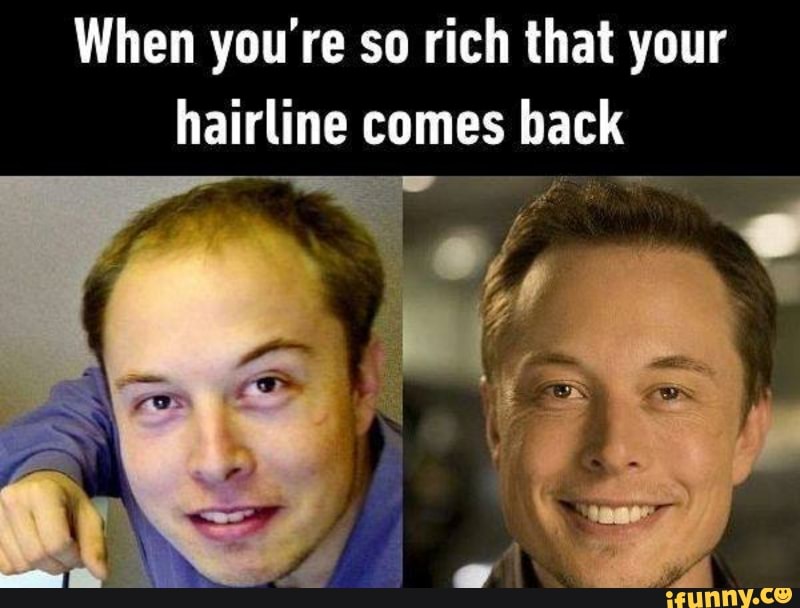
This meme presents a humorous side-by-side comparison of Elon Musk's appearance, using him as an example of the wealthy. On the left, he appears with a receding hairline, while on the right, he looks fuller and healthier. The text, "When you're so rich that your hairline comes back," is a sarcastic play on the phrase "hairline goes back" (referring to balding), suggesting that the billionaire is balding now but is using his immense wealth to fix his aging appearance. The joke implies that extreme wealth is the only thing that can afford expensive medical treatments to keep someone young.
simple-description (llama3.2-vision_11b)
The meme is a play on the phrase "I'm not a businessman, I'm a business, man" from the movie Boiler Room, but with a twist. The image shows a before-and-after comparison of a man, with the caption "When you're so rich you don't need to worry about your hairline" and "When you're so rich your hairline comes back".
detailed-analysis (gemma3-27b-vision)
Okay, let's break down this meme of Elon Musk and his hairline progression through the lens of various critical theories.
Visual Description
The meme consists of a split image. On the left is a close-up of Elon Musk with a visibly receding hairline, indicative of male pattern baldness. He appears to be smiling and leaning forward as if speaking directly to the viewer. The background is blurred. On the right, the same image of Elon Musk is presented, but with a fuller, more defined hairline achieved through what is heavily implied to be hair restoration treatments (likely a hair transplant). He maintains the same smile, creating a direct comparison between his appearance at two different points in time. The text overlay states, "When you're so rich your hairline comes back."
Foucauldian Genealogical Discourse Analysis
The meme illustrates the discourse surrounding appearance, wealth, and masculinity. Foucault's genealogical method traces the historical construction of concepts and power relations. In this case:
- Historical Construction of 'Ideal' Masculinity: Historically, full hair has been associated with youth, virility, and dominance in Western cultures, thus linking it to "ideal" masculinity. Loss of hair, conversely, is often connected to aging, decline, and loss of control.
- Power/Knowledge: The meme implies that wealth provides the power to rewrite the narrative of aging. Musk's wealth is the knowledge (or mechanism) allowing him to actively defy the natural process of hair loss, thereby maintaining a culturally valued sign of masculinity.
- Disciplinary Power: The meme subtly highlights how societal expectations about appearance operate as a form of disciplinary power. The "need" to counteract natural processes like hair loss stems from these expectations.
- Normalization: The meme normalizes the idea that those with enough resources can purchase a "better" version of themselves. It frames this as somewhat humorous and acceptable, furthering the expectation that self-improvement (even if superficial) is attainable and desirable.
Critical Theory
The meme can be analyzed through the lens of Critical Theory's exploration of culture and ideology.
- Commodity Fetishism: The meme is a subtle example of commodification, specifically the commodification of youth and attractiveness. The hairline isn't just about physical hair; it’s about the value placed on youth and vitality in capitalist culture, and the ability to buy a semblance of it.
- Culture Industry: This meme participates in the broader "culture industry" that perpetuates unrealistic beauty standards and the idea that self-worth is tied to appearance. It subtly reinforces the idea that wealth can solve even natural processes.
- Domination and Control: The meme can be interpreted as a subtle expression of domination – the ability to control one’s body and defy natural processes through wealth – reinforces the existing power structures. It suggests that some individuals are exempt from the natural limits faced by others.
Marxist Conflict Theory
This meme, viewed through a Marxist lens, highlights class differences and the power dynamics associated with wealth.
- Means of Production: The ability to undergo hair restoration treatments (or other cosmetic procedures) is a privilege accessible only to those with significant financial resources. This makes it a part of the “means” to maintain social standing and advantage.
- Class Struggle: The meme implicitly positions those with wealth (like Elon Musk) in a separate category from those who cannot afford such interventions. It emphasizes the disparity in access to resources that contribute to social capital.
- Ideology and False Consciousness: The meme potentially reinforces a “false consciousness” by implying that appearance is paramount to success and that wealth can overcome any challenge, distracting from systemic inequalities.
Postmodernism
Postmodernism can be applied to this meme in its exploration of simulacra and hyperreality.
- Simulacrum and Simulation: The restored hairline is a simulacrum – a copy without an original. It's a manufactured representation of youth, a simulation of a natural state. The meme plays on the blurring of the line between the real and the artificial.
- Deconstruction of Authenticity: The meme subtly deconstructs the idea of “authentic” appearance. It suggests that our appearance is increasingly a performance, shaped by our ability to manipulate it through technology and consumerism.
- Irony and Playfulness: The meme’s humorous tone reflects postmodernism’s embrace of irony and playful subversion. It acknowledges the absurdity of using wealth to defy natural processes.
Queer Feminist Intersectional Analysis
While the meme seems superficially about male appearance, a queer feminist intersectional analysis can highlight gendered and economic power dynamics.
- Gendered Expectations: Societal pressure to maintain a youthful appearance is particularly strong for men, reinforcing the idea that virility and strength are tied to youthful looks. While pressure exists for women too, the underlying anxieties are different (youthful looks often tied to sexual desirability for women, while youth for men is frequently equated to power and strength).
- Economic Privilege: The ability to “fix” a receding hairline is clearly linked to economic privilege. This privilege is often intertwined with gender, as men traditionally hold more economic power.
- Intersectional Critique: The meme reinforces the idea that access to beauty and self-improvement is not universally available. It highlights the ways in which wealth intersects with gender and other social categories to create advantages for some and disadvantages for others.
Let me know if you'd like a deeper dive into any of these theoretical frameworks or if you want to explore other perspectives!
simple-description (llama3.2-vision)
This meme is a humorous comparison between two photos of the same person, with the caption "When you're so rich that your hairline comes back." The meme suggests that the person's hairline has returned to a fuller state, implying that their wealth has somehow reversed the effects of aging or hair loss.
tesseract-ocr
CR UUM hairline comes back I r V3 wns be ee a 7 \ 2 ae a