First Seen
2025-03-21T19:34:15.368555+00:00
simple-description (qwen3.5_2b-q8_0)
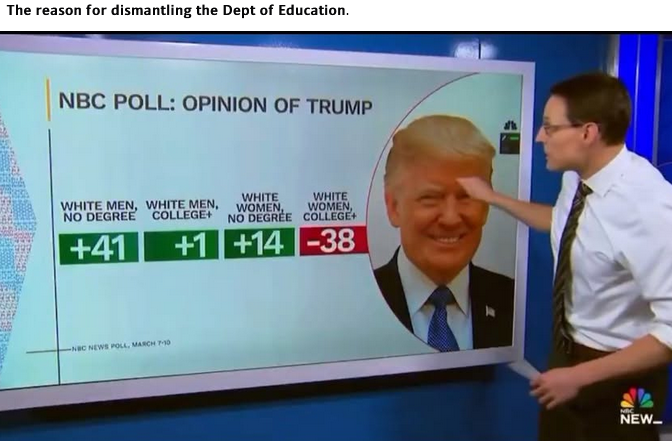
This image is a humorous political graphic titled 'NBC POLL: OPINION OF TRUMP' that presents a breakdown of survey results regarding Trump's support. On a screen to the left, specific demographic groups like 'White Men, No Degree' and 'White Women, College+' are shown with positive or negative numbers. The visual implies that this lack of support from college-educated white women is the reason the government is being 'dismantled' or cut. This meme aligns with the 'Anti-Billionaire' perspective, suggesting that government policies benefiting the wealthy are being removed because of the low approval ratings among the working class.
detailed-analysis (gemma3_27b-it-q8_0)
Okay, let's break down this image from the perspective of an "Anti-Billionaire" category, using the requested theoretical lenses where applicable. The core argument from this perspective is that the dismantling of education is often linked to the consolidation of wealth and power in the hands of the few, particularly billionaires who benefit from a less informed and less mobile populace.
Visual Description
The image depicts a news broadcast from NBC News. The focal point is a large graphic displaying poll results about opinions of Donald Trump, broken down by demographic groups: White Men (with and without college degrees) and White Women (with and without college degrees). The results show significantly positive approval numbers for Trump among white men without college degrees (+41), while white women with college degrees express highly negative opinions (-38). A large portrait of Donald Trump occupies the center of the graphic. A news anchor is gesturing towards the poll results. The news station logo, NBC News, is present in the lower right corner.
Foucauldian Genealogical Discourse Analysis
From a Foucauldian lens, this image demonstrates how power operates through the construction of discourses around education, identity, and leadership. The poll results, presented in such a starkly delineated manner, help produce those very categories and perceptions.
- Genealogy of "Education": Historically, access to education was controlled by elites (often those with wealth) to maintain their societal position. The expansion of public education was a hard-fought battle, and the present moment represents a potential regression to a system where education is less accessible or less valued—particularly by certain demographics. The anti-billionaire perspective views this as a deliberate dismantling of a hard-won social good.
- Power/Knowledge: The "knowledge" generated by this poll is not neutral. It reinforces (and perhaps exploits) existing societal divisions. It shows how, those with higher education tend to oppose the former President, and how those without tend to support him.
- Disciplinary Power: The narrative surrounding education is linked to disciplinary power. The fewer opportunities available through education, the more people are likely to rely on alternative narratives, which can be more easily controlled by those in power (the billionaires who benefit from a non-critical populace).
Critical Theory
Critical Theory, particularly stemming from the Frankfurt School, focuses on how dominant ideologies maintain systems of oppression. This image can be analyzed as follows:
- Hegemony: The presented poll data is a symptom of a larger hegemonic structure that relies on the control of narratives and the manipulation of public opinion. Billionaires, through their influence on media and politics, can actively undermine public education to create a more compliant and less empowered citizenry.
- Instrumental Reason: The emphasis on metrics (poll numbers) embodies "instrumental reason"—a focus on efficiency and control at the expense of deeper critical thought. The anti-billionaire argument is that dismantling education prioritizes short-term economic gains (for the wealthy) over the long-term intellectual and social development of society.
- Culture Industry: Media like NBC (even if ostensibly neutral) plays a role in the "culture industry," reproducing dominant ideologies. The way this data is presented can reinforce existing biases and serve the interests of those in power.
Marxist Conflict Theory
This is perhaps the most directly applicable lens.
- Class Struggle: The stark difference in opinion based on education level reflects a classic class struggle. Those without a college degree, often working-class individuals, may be more susceptible to populist rhetoric, while those with higher education tend to be more critical of the status quo.
- Base and Superstructure: Education is part of the superstructure – the social institutions (politics, media, culture) built on top of the base (the economic system). The anti-billionaire argument is that the billionaires (representing the economic base) are actively shaping the superstructure (education) to serve their interests. A less educated populace is easier to exploit.
- False Consciousness: The support of Donald Trump among white men without a college degree could be seen as a product of "false consciousness"—a belief in a system that ultimately harms their own interests. Billionaires exploit this through propaganda and manipulation.
- Capital Accumulation: Decreased investment in public education and the promotion of alternatives (like for-profit schools) enables the accumulation of capital by those who control those institutions.
Postmodernism
A postmodern analysis would question the very idea of fixed categories (like "White Men," "College Degree") and the objective truth of the poll results.
- Deconstruction: The image can be "deconstructed" to reveal the inherent biases in the way these categories are constructed and presented. Is "college degree" a meaningful indicator of critical thinking? How does the framing of "opinion of Trump" influence the results?
- Relativism: From a postmodern perspective, there is no single "truth" about the value of education. However, the anti-billionaire perspective argues that the deliberate dismantling of education is a power play disguised as a philosophical debate.
- Simulacra and Simulation: The poll itself, the image, and the news coverage can be seen as a "simulation" of reality—a representation that is increasingly divorced from the underlying conditions.
Queer Feminist Intersectional Analysis (Limited Application)
This lens is less directly applicable to the image itself but can inform the broader context.
- Intersectionality: While the poll data focuses on race and education, it neglects other important intersections of identity (gender, sexuality, class, ability). The impact of dismantling education would disproportionately affect marginalized groups who rely on public education for social mobility and empowerment.
- Power Dynamics: The image reinforces existing power dynamics based on race and class. The anti-billionaire argument is that dismantling education is a continuation of historical patterns of oppression and exclusion.
In summary, from the perspective of an “Anti-Billionaire” category, this image isn’t simply a snapshot of public opinion; it’s evidence of a deliberate strategy by the wealthy to maintain their power by limiting access to knowledge, manipulating public discourse, and undermining the foundations of a democratic society. The image serves as a warning about the dangers of unchecked wealth and its corrosive influence on education.
simple-description (llama3.2-vision_11b)
The meme is a screenshot from a news broadcast showing a graphic with a poll question about Donald Trump's favorability. The image shows a split-screen display of the poll results, with a photo of Trump and a breakdown of the results by demographics. The meme is likely poking fun at the idea that Trump's favorability is only high among a certain demographic, implying that he's only popular among white, older, less educated people. The text "The reason for dismantling the Dept of Education" is likely a sarcastic comment implying that Trump's popularity is only due to his appeal to this demographic.
detailed-analysis (gemma3-27b-vision)
Okay, here's an analysis of the image, broken down into sections based on the requested theoretical frameworks. I'll assess whether each framework is applicable and then provide analysis if it is.
Visual Description
The image is a screenshot of a television news broadcast. A man in a white shirt (likely a news anchor/commentator) is standing in front of a large screen displaying a graphic related to a recent NBC News poll concerning public opinion of Donald Trump. The graphic presents positive and negative approval ratings based on demographic groups:
- White Men, No Degree: +41 (highlighted in green)
- White Men, College: +1
- White Women, No Degree: +14
- White Women, College: -38 (highlighted in red)
Donald Trump’s face is prominently displayed in the center of the graphic. The NBC News logo and poll dates are at the bottom. The anchor is gesturing towards the screen with his hand. Overall, the composition emphasizes the stark contrast in approval ratings between different white demographic groups.
Foucauldian Genealogical Discourse Analysis
This framework is very applicable to the image. We can analyze it through the lens of how power/knowledge operates to construct understandings of political affiliation.
- Discourse: The poll graphic is a discourse. It doesn't just present opinions; it actively creates a narrative about who supports Trump. It organizes and categorizes people into neatly defined groups.
- Power/Knowledge: The poll is presented as objective data, giving it a form of power. However, the very act of creating these categories (by degree attainment, gender, race) is a power move. It assumes these categories are meaningful and representative. The presentation constructs "the Trump supporter" and positions different groups in relation to that construction.
- Genealogy: A genealogical approach would ask how these categories—"white men," "college educated," "women"—came to be understood the way they are. It would trace the historical development of these categories and how they’ve been used to organize and control populations. In this context, it reveals an implicit narrative associating a lack of education and masculinity with support for Trump.
- Discipline & Surveillance: The poll acts as a form of surveillance, monitoring public opinion. The results, when disseminated, can then function as a disciplinary mechanism – influencing future political messaging or even shaping perceptions of these demographic groups.
Critical Theory
Also highly applicable. This image demonstrates several key themes.
- Hegemony: The graphic presents certain demographic groups as inherently more supportive of Trump than others. This reinforces a narrative that could be used to maintain a specific power structure. By framing the support in these terms, it potentially legitimizes existing hierarchies.
- Ideology: The presentation reinforces an ideology that connects education level and gender with political stance. It subtly suggests that certain groups ("college educated women") are naturally more critical of Trump, while others ("white men with no degree") are predisposed to support him.
- Commodification of Opinion: The poll itself is a form of commodification—turning public opinion into quantifiable data that can be bought, sold, and analyzed. This further reinforces the logic of consumerism and reduces complex political beliefs to a numerical score.
- False Consciousness: One could argue that the graphic reinforces a "false consciousness" among certain groups, preventing them from recognizing their shared interests with others.
Marxist Conflict Theory
Applicable, but with some limitations.
- Class Conflict: While not overtly about economic class, the graphic hints at a class-based division through education. Those with higher education ("college") tend to be less supportive, while those without are more so. This can be interpreted as a conflict between the "educated elite" and the "working class."
- Ideological Struggle: The graphic represents a site of ideological struggle—a battle over meaning and values. The differing levels of support suggest a disagreement over the direction of the country and the role of government.
- Dominant Ideology: The presentation could be seen as reinforcing the dominant ideology—the beliefs and values that serve the interests of the ruling class. In this case, it could be argued that the graphic is designed to marginalize and delegitimize the views of those with lower levels of education.
Postmodernism
Applicable, but requiring a nuanced interpretation.
- Deconstruction of Categories: A postmodern approach would challenge the very categories used in the graphic (white men, women, college educated, etc.). These categories are not natural or fixed; they are social constructs that are constantly being negotiated and redefined.
- Simulacra & Simulation: The poll itself is a “simulacrum”—a copy without an original. It doesn't directly represent public opinion; it's a representation of a representation (survey responses). This creates a layer of abstraction that obscures the underlying reality.
- Relativism of Truth: A postmodern perspective would emphasize that there is no single "truth" about who supports Trump. Support is complex and multifaceted, and the poll graphic only offers a limited and subjective perspective.
Queer Feminist Intersectional Analysis
Less directly applicable, but still relevant.
- Intersectionality: The graphic focuses solely on race, gender, and education, ignoring other important categories of identity (sexual orientation, class, disability, etc.). An intersectional analysis would highlight how these categories interact to shape political beliefs.
- Gendered Politics: The stark contrast in support between white men and white women suggests that gender plays a significant role in political affiliation. This could be linked to issues like reproductive rights, gender equality, or perceptions of masculinity.
- Marginalization & Representation: The graphic implicitly marginalizes those who do not fit neatly into the categories presented. The lack of representation for LGBTQ+ individuals or people of color highlights the limitations of the poll’s analysis. The emphasis on white demographics reinforces existing power structures and erases the voices of marginalized communities.
I hope this detailed analysis, broken down by theoretical frameworks, is helpful! Let me know if you’d like me to elaborate on any particular point or explore a different angle.
simple-description (llama3.2-vision)
This meme is a screenshot of a news broadcast with a poll on a TV screen showing the results of a survey about the opinion of President Trump among different demographics. The text at the top of the image reads "The reason for dismantling the Department of Education" and the image below shows a poll on a TV screen with the results of a survey about President Trump's opinion among different demographics.