First Seen
2023-05-10T20:59:59+00:00
simple-description (llama3.2-vision_11b)
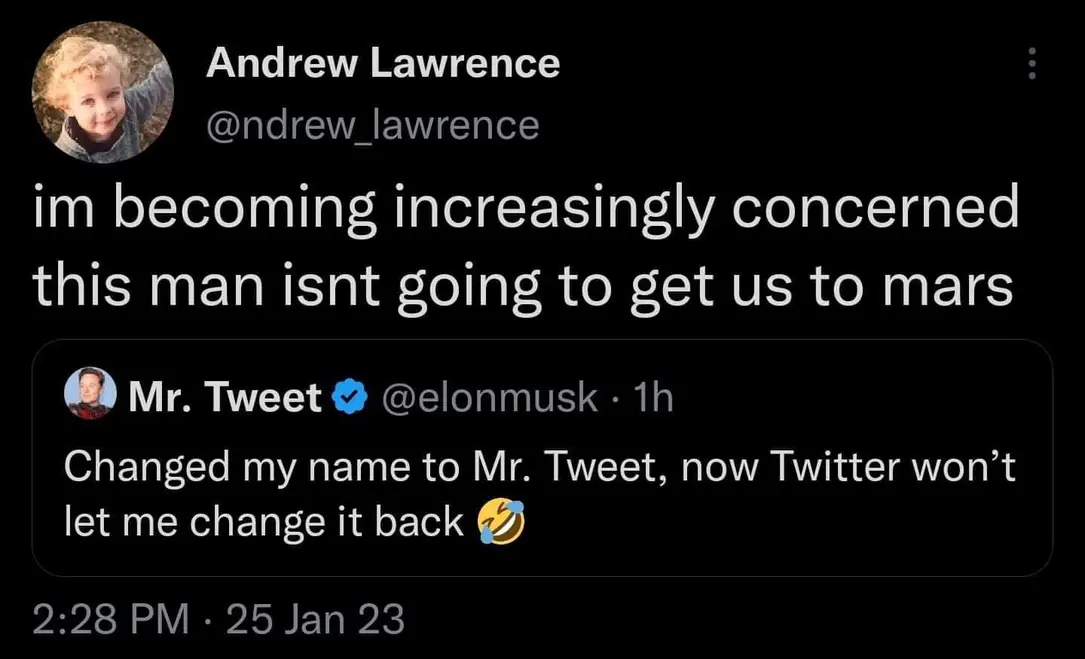
The meme is a response to a tweet from Elon Musk, where he changed his name to "Mr. Tweet" and then changed it back to his original name. The meme is a joke about how Elon Musk's name change was only temporary and that he's still the same person. The meme is saying that even though Elon Musk's name change was only for a day, it's still the same old him.
detailed-analysis (gemma3-27b-vision)
Okay, here's an analysis of the Twitter exchange, broken down by the requested theoretical lenses, and with sections only where applicable.
Visual Description
The image is a screenshot of a Twitter exchange. The top tweet is from the user @andrew_lawrence. It states "im becoming increasingly concerned this man isnt going to get us to mars" and has a profile picture of an older man with glasses and a beard. Below this is a reply from the verified account @elonmusk, displaying the name "Mr. Tweet," and the text "Changed my name to Mr. Tweet, now Twitter won’t let me change it back 🤣". The tweet timestamps are also visible. The aesthetic is minimalist, representing the typical Twitter interface.
Foucauldian Genealogical Discourse Analysis
This exchange reveals an interesting interplay of discourse and power. The initial tweet from @andrew_lawrence is a statement of anxiety, and implicitly critiques the discourse surrounding Elon Musk's SpaceX and the promise of space colonization. The genealogy of this discourse involves a history of utopian narratives surrounding technological progress, particularly in the field of rocketry. This narrative positions Musk as a visionary, a savior who will lead humanity to a new frontier.
Musk’s reply, seemingly trivial in content, is a strategic intervention within that discourse. By changing his name to "Mr. Tweet" and framing the issue as a technical glitch with Twitter, he performs a few key functions:
- Shifting the focus: He redirects attention from the grand narrative of space colonization to a minor, relatable annoyance.
- Presenting himself as relatable: By showing a vulnerability—being unable to change his name back—he attempts to construct a persona that is less the “visionary genius” and more the “everyday user.” This is a form of power/knowledge – shaping how he is understood.
- Reinforcing control: Despite the apparent triviality, the fact that Twitter (which he now owns) won’t let him change his name highlights his control over the platform and, by extension, the narrative.
The exchange isn’t about getting to Mars; it's about the maintenance of power and the shaping of perception. Musk uses a seemingly absurd action to exert control over the discourse surrounding himself and his projects.
Critical Theory
This exchange embodies many themes central to Critical Theory, especially related to the Culture Industry and Commodification of the Self. Musk’s persona and the marketing surrounding SpaceX are heavily curated and presented as a spectacle. The initial anxiety expressed by @andrew_lawrence, about Musk failing to deliver on his promise of getting humans to Mars, underscores the ways in which the ‘promises’ of technological advancement can be used to manipulate anxieties about the future. Musk's playful name change could be seen as further commodification of his personal brand, turning even a minor annoyance into content for engagement and spectacle. The anxiety surrounding his promises becomes less about actual space travel and more about the maintenance of a compelling narrative.
Postmodernism
The exchange embodies several key characteristics of postmodern thought:
- Hyperreality & Simulacra: The entire narrative surrounding SpaceX, and Musk's persona, leans heavily into hyperreality. The "promise" of Mars colonization is more a manufactured image (a simulacrum) than a grounded reality. The name change is equally absurd and divorced from genuine consequence.
- Irony & Parody: Musk's name change is a performative act of irony. He’s playing with the conventions of online identity and engaging in self-parody. This blurs the lines between authenticity and artifice.
- Deconstruction of Grand Narratives: The initial tweet references the "grand narrative" of space colonization, while Musk's reply undermines it with a triviality. The exchange deconstructs the seriousness of the "promise" of getting to Mars, turning it into a joke.
- Fragmentation of Meaning: The two tweets, while connected, don’t form a coherent argument. They are fragmented expressions of anxiety and playful self-promotion, reflecting the fragmented nature of online communication and postmodern experience.
Please Note: A Queer Feminist Intersectional Analysis and Marxist Conflict Theory aren't particularly strong fits for this exchange. While the ownership of Twitter (and its subsequent changes) is relevant to class power dynamics, it isn't central to the immediate interaction. Similarly, there's no explicit gender, sexuality, or intersectional power dynamics at play in the visible content.
Let me know if you'd like any of these analyses expanded, or if you'd like me to focus on a specific theoretical lens in more detail!
simple-description (llama3.2-vision)
This meme is a screenshot of a Twitter exchange between two users. The first user, Andrew Lawrence, expresses frustration with Elon Musk's Twitter account, feeling that it's becoming increasingly concerned with the idea that the man is not going to get them to Mars. The second user, "Mr. Tweet", responds with a humorous and sarcastic comment, saying he changed his name to "Mr. Tweet" and that Twitter won't let him change it back.
tesseract-ocr
Andrew Lawrence : O/T aE Tale im becoming increasingly concerned this man isnt going to get us to mars @ Mr. Tweet @ @elonmusk - 1h Changed my name to Mr. Tweet, now Twitter won’t let me change it back 2:28 PM - 25 Jan 23