First Seen
2023-06-20T00:05:32+00:00
simple-description (qwen3.5_2b-q8_0)
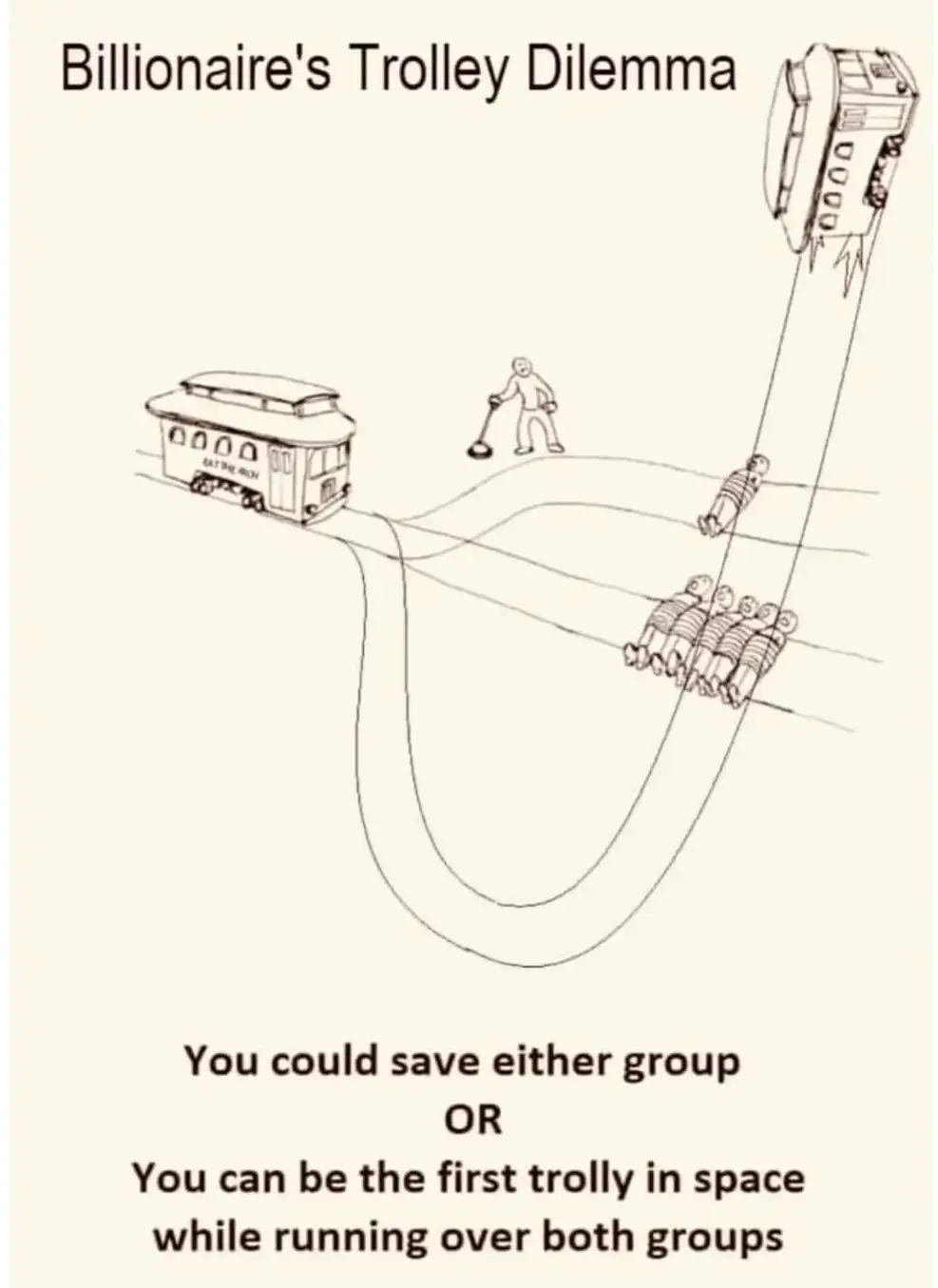
The Trolley Problem: A Billionaire's Dilemma
The meme is a satirical take on the "trolley problem," but with a twist that highlights a cynical view of prioritizing wealth (the trolleys) over people (the groups on the tracks).
Visual Description:
The image depicts the classic "trolley problem" scenario. A train is approaching two groups of people, who are on different tracks below it.
Text Quote:
> "You could save either group OR You can be the first trolley in space while running over both groups"
Explanation:
This meme is a "Twisted Trolley Problem," suggesting a cynical view of how billionaires or wealthy individuals might prioritize their wealth (the trolleys) over the actual people (the groups on the tracks).
The text presents a dilemma: "You could save either group." This implies a choice to sacrifice one group of people to save the other.
OR
"You can be the first trolley in space while running over both groups."
This implies an alternative solution: Instead of saving a specific group, you could get on the trolleys (yourself/the billionaire) and crash both groups (and the people on them) to save the trolleys (yourself/the system).
Interpretation:
The joke is a satirical take on prioritizing wealth or machines over people. The "Anti-Billionaire" angle is about how billionaires might get angry because one group gets hurt while another is saved. It suggests that instead of saving a specific group, you just save the trolleys (yourself/the system) by crashing them on everyone. It implies you'd rather crash the trolleys (yourself/the billionaire) than let the groups (people) survive.
So the joke is: "I'd rather the trolleys crash than the people on the tracks live."
This is a cynical view: "I'd rather sacrifice the groups (people) to save the trolleys (myself/the billionaire)."
simple-description (llama3.2-vision_11b)
This meme is from the category "Anti-Billionaire" and it's a humorous take on the idea of billionaires having too much power and influence. The image shows a cartoonish illustration of a billionaire's private island, but with a twist: the billionaire is being pulled by a giant, mutated version of a "trolley" (a type of streetcar), which is being controlled by a group of people who are all holding onto a rope that's attached to the billionaire. The text at the top of the image reads "You can't save everyone" and at the bottom it says "You can't save everyone, but you can save yourself".
detailed-analysis (gemma3-27b-vision)
Okay, let's break down this cartoon, titled “Billionaire’s Trolley Dilemma,” through the lenses you requested. It’s a complex image, so we'll see how much each theory applies.
Visual Description
The cartoon presents a satirical take on the classic “trolley problem” thought experiment. However, it drastically alters the scenario to reflect extreme wealth and technological hubris. Instead of a traditional railway trolley, we see two separate trolleys suspended in the air by cables, forming a loop. One trolley is heading toward a single person, and the other toward a group of people. The setup implies a highly engineered, possibly artificial environment. A large, technologically advanced vehicle (which could be a space vehicle) looms above, with a mechanism that connects to both trolleys. The key twist is the alternative offered: the "controller" could divert the space vehicle itself to run over both groups. The language is stark: "You could save either group OR You can be the first trolley in space while running over both groups.” The drawing is simplistic, line-based, highlighting the conceptual nature of the problem rather than realistic detail.
Foucauldian Genealogical Discourse Analysis
This cartoon provides ripe material for a Foucauldian analysis.
- Power/Knowledge: The cartoon implicitly demonstrates how power operates through the framing of choices. The very ability to present this as a "dilemma" rests on the immense power and control the ‘billionaire’ (or whoever controls this technological system) possesses. They define the parameters, the choices, and the consequences. The “dilemma” isn’t about morality; it's about the assertion of that power.
- Discourse and Subjectivity: The cartoon’s presentation constructs a specific mode of thinking. It normalizes the idea of calculating life-and-death choices as a matter of engineering and control. It creates a subject position for the “controller” – someone detached, capable of making such coldly rational calculations, and (implied) empowered to do so.
- Genealogy of Control: We could trace the genealogy of this situation: from the historical development of control mechanisms (like the railway switch itself) to the modern era of technological systems and algorithms. The “space trolley” is the ultimate expression of this – a system that completely objectifies human life and reduces it to a variable in a calculation. The "choice" is not about ethics; it’s about the deployment of technological power.
Critical Theory
This cartoon lends itself well to a Critical Theory reading, particularly drawing on the Frankfurt School.
- Instrumental Reason: The cartoon illustrates the dangers of "instrumental reason"—the application of logic and efficiency without ethical consideration. The scenario is presented as a purely technical problem, devoid of moral weight. The "controller" is encouraged to see humans as data points in an optimization problem.
- Domination and Control: The image reveals the structures of domination inherent in the situation. The “billionaire” – representative of the powerful elite – doesn't experience the consequences of their choices. They are detached and in control, while others are subjected to the system. The trolley itself becomes a symbol of technological power used to control and potentially destroy.
- Critique of Enlightenment Values: While seemingly offering a choice, the cartoon implicitly critiques the Enlightenment ideal of rational thought as inherently liberating. It suggests that rational calculation, when divorced from ethics and compassion, can become a tool of oppression. The absurd offer of being “the first trolley in space” while causing harm underscores the alienation and dehumanization that can result from prioritizing technical progress over human values.
Marxist Conflict Theory
The cartoon is explicitly about class power.
- Class Struggle: The "billionaire" (and whoever they represent - the ruling class) is presented as completely divorced from the consequences of their actions. They can engineer a scenario where they decide who lives and dies, with no personal risk. This highlights the inherent inequalities of a capitalist system where those with wealth and power are insulated from the harm they inflict upon others.
- Means of Production: The “space trolley” represents the means of production – the technological and economic resources that allow for such control. The billionaire isn't just deciding who dies; they own the machinery that enables the choice.
- Alienation: The trolley itself represents alienation: the separation of humans from their labor, from each other, and from the consequences of their actions. The “controller” is alienated from the moral weight of their decision, and the people on the tracks are alienated from the power that determines their fate.
Postmodernism
This image has elements consistent with postmodernism.
- Meta-Narrative Critique: The cartoon dismantles the very idea of a universal ethical framework. By presenting the trolley problem in such an absurd and hyper-technological way, it challenges the assumption that there is a "right" answer or even a coherent moral basis for making the choice.
- Simulation and Hyperreality: The engineered environment could be seen as a simulation – a fabricated reality where the rules and consequences are arbitrarily determined. The “controller” is not dealing with real-world constraints but with a hyperreal scenario that has been designed for their amusement or control.
- Irony and Parody: The cartoon is deeply ironic and parodic. It takes a well-known thought experiment and exaggerates it to the point of absurdity, highlighting the inherent contradictions and dehumanizing potential of modern technology and capitalism.
Queer Feminist Intersectional Analysis
This is the most challenging lens to apply directly, but it's not entirely absent.
- Power Dynamics and Vulnerability: While not explicitly gendered, the image highlights how certain groups are disproportionately vulnerable to power structures. The people on the tracks become objects of control, lacking agency over their own fate.
- Critique of Rationality: Feminist critiques of traditional rationality suggest that a purely logical approach (as presented in the cartoon) can often ignore emotional and ethical considerations.
- Intersectional Vulnerability: If we imagined the people on the tracks as representing marginalized communities (e.g., based on race, class, ability), the image could be seen as a metaphor for the ways in which these groups are often subjected to arbitrary power structures and systemic violence. The "controller" becomes a symbol of those who wield this power.
Let me know if you'd like me to elaborate on any of these points or explore a different theoretical lens!
simple-description (llama3.2-vision)
The meme is a humorous illustration of the "Billionaire's Trolley Dilemma" paradox, which is a thought experiment that asks whether it's better to sacrifice a few people to save the majority. The image shows a trolley on a track that's about to crash, with a group of people standing on the track. The text above the image reads "You could save the group, or you could be the first trolley in space, while running over both groups."
tesseract-ocr
Billionaire's Trolley Dilemma i, Io j] Jc \ os , i / | . Q. / Te, Ad / | Pa fin f / \ ~ _| 7 \ / } \ \ Jj / You could save either group OR You can be the first trolly in space while running over both groups