First Seen
2025-06-06T06:27:05+00:00
simple-description (qwen3.5_2b-q8_0)
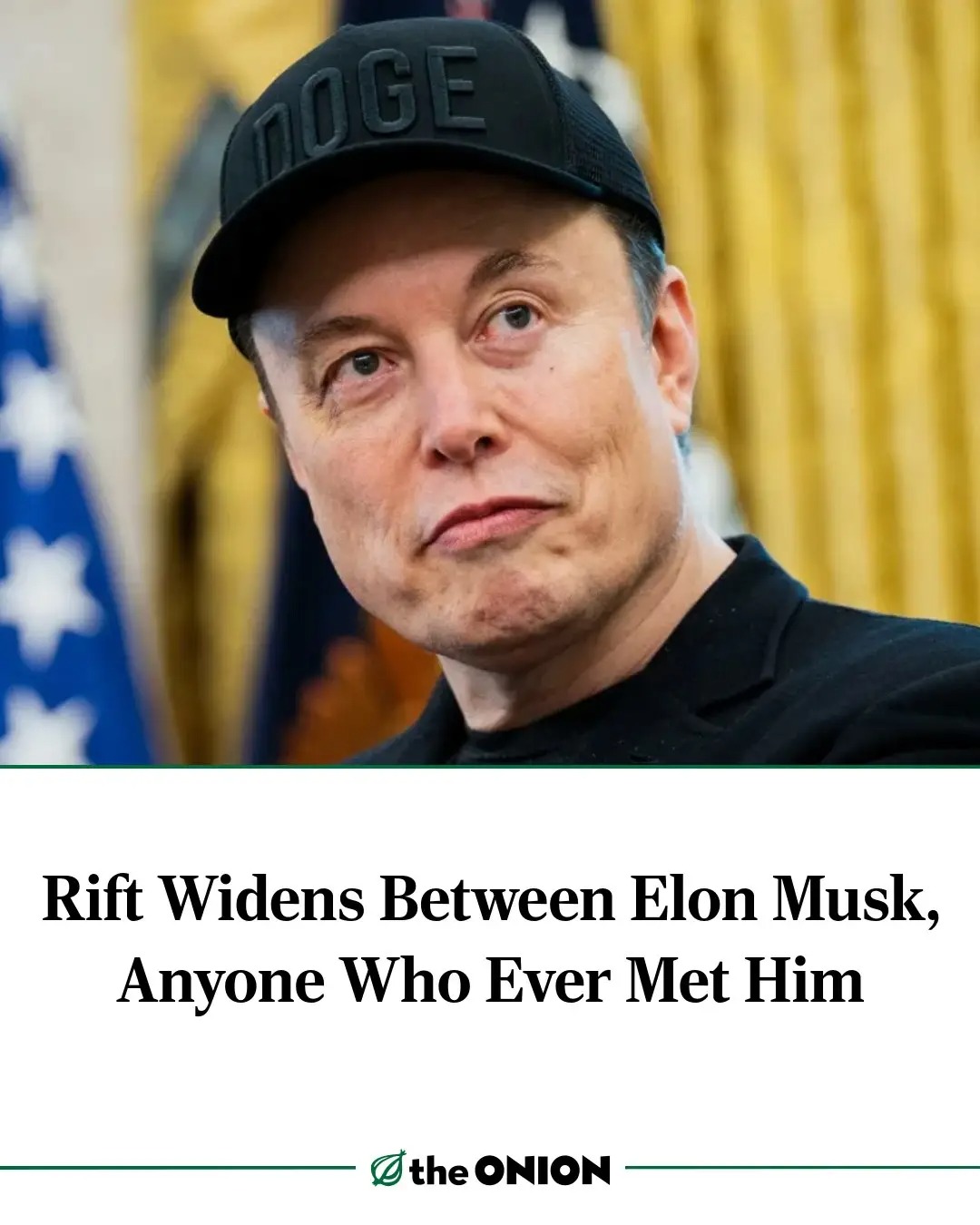
This image features a man wearing a black hat with the text "NOGE" on it, a reference to his famous "No God" hat. The caption below reads, "Rift Widens Between Elon Musk, Anyone Who Ever Met Him," implying that his wealth is so dominant that even acquaintances distance themselves from him. This is a classic anti-billionaire joke because it mocks the idea that such influence is harmless or even repulsive.
detailed-analysis (gemma3_27b-it-q8_0)
Okay, let's dissect this The Onion meme from an “Anti-Billionaire” perspective, utilizing relevant theoretical frameworks where applicable.
Visual Description
The image portrays Elon Musk, wearing a baseball cap emblazoned with "Doge" (a popular internet meme coin). He has a slightly bewildered, puffy-cheeked expression and is positioned in front of a blurred American flag. The framing focuses closely on his face, creating a slightly unflattering and awkward presentation. The composition emphasizes a sense of disconnect and the somewhat performative nature of his public persona. The cap adds a layer of irony, signaling his involvement in online culture and cryptocurrency, highlighting the speculative and often detached nature of his wealth.
Foucauldian Genealogical Discourse Analysis
From a Foucauldian lens, this meme deconstructs the discourse surrounding Elon Musk – the narratives that have been constructed around him as a visionary, genius, and "modern-day inventor". The Onion isn’t just making a joke; it’s challenging the power/knowledge relationship that enables this discourse. Musk is presented as increasingly removed from the lived experience of those who encounter him, creating a disjuncture.
The meme suggests a genealogical shift: Musk has moved from a figure framed as a tech innovator to a figure whose reputation is increasingly defined by a disconnect with reality and those around him. The "rift" isn’t just a personal observation but speaks to a wider societal questioning of how we construct authority and believe in the narratives of powerful individuals. The meme disrupts the historical production of the "Elon Musk" persona and suggests a growing counter-narrative. The cap indicates the adoption of memetic language as a power move that simultaneously signifies connection and distance.
Critical Theory
Critical Theory concerns itself with understanding how power structures maintain social control and inequality. This meme fits neatly within this framework by subverting the ‘cult of personality’ around billionaires. Elon Musk, like other tech magnates, benefits from a narrative of exceptionalism – the idea that his individual genius justifies his wealth and influence.
This meme directly challenges that narrative. The title ("Rift Widens...") implies a growing awareness that Musk’s public persona is at odds with the experience of interacting with him. It suggests that the carefully constructed image is cracking, revealing something less impressive underneath. This dismantling of the individual ‘genius’ is a way of questioning the very system that allows such vast accumulations of wealth and power. The meme serves as a form of critique of the hegemonic narrative surrounding “disruptive” entrepreneurship and its societal consequences.
Marxist Conflict Theory
From a Marxist perspective, the meme highlights the inherent contradictions within capitalism. Musk is the embodiment of the capitalist class, benefiting from the exploitation of labor and the concentration of capital. The "rift" represents a growing class consciousness.
The people who have met Musk (employees, investors, even journalists) represent a segment of society that has directly experienced the realities of his power – perhaps the demanding work conditions, the capricious decision-making, or the prioritization of profit over people. The meme suggests that this experience is creating a growing disconnect between his public image and the lived realities of those subjected to his power. This disconnect signals an increasing awareness of the inherent conflict between the interests of the capitalist class (Musk) and the working class/general public. The meme mocks the very foundation of capitalist ideology—the belief in meritocracy and individual success—by suggesting that those who are closest to the "successful" individual see a different, less glamorous reality.
Postmodernism
The meme engages with postmodern themes of simulation and hyperreality. Musk’s persona has become a carefully constructed performance, mediated through social media and PR. The "Doge" hat is a symbol of the increasingly arbitrary and performative nature of identity in the digital age.
The title, presented as a serious “news” item by The Onion, highlights the blurring of lines between reality and satire. It asks us to question what is “real” about Musk's image and what is simply a carefully curated performance. The meme isn’t necessarily offering a definitive truth, but rather exposing the constructed nature of truth itself. The absurdity of the situation—the widening rift—reflects the fragmentation and uncertainty characteristic of postmodern thought.
In summary: This meme, viewed through an anti-billionaire lens, is a satirical critique of power, wealth, and the narratives surrounding elite individuals. It utilizes theoretical frameworks to deconstruct the image of Elon Musk, challenge the legitimacy of his authority, and expose the underlying contradictions within the capitalist system. It’s a playful yet pointed reminder that appearances can be deceiving, and that those in power are often disconnected from the realities of those they affect.
simple-description (llama3.2-vision_11b)
The meme is a photo of Elon Musk with a caption that reads "Rift Widens Between Elon Musk, Anyone Who Ever Met Him". This is a play on the phrase "rift widens" which typically means a disagreement or separation between two groups. In this case, the meme is poking fun at Elon Musk's reputation for being difficult to work with, implying that anyone who has met him has been affected by his behavior.
detailed-analysis (gemma3-27b-vision)
Okay, here's an analysis of the image and headline, broken down into relevant theoretical sections. It's important to remember The Onion is satire, so the analysis will be framed in terms of how the image functions as satire and the theoretical insights it evokes, rather than taking the headline literally as a neutral statement.
Visual Description
The image shows Elon Musk, in a close-up portrait. He’s wearing a black baseball cap with “Doge” on it, and has a slightly pouting, almost sullen expression. The background appears to be the Oval Office, suggesting an implied association with presidential power and authority, but it's framed in a way that feels slightly incongruous, perhaps hinting at an ill fit. The lighting is standard portrait lighting, and the overall aesthetic is a fairly straightforward, unremarkable photo. The effect is less about aesthetic beauty and more about the presentation of Musk's persona.
Foucauldian Genealogical Discourse Analysis
The headline and image create a space for exploring the discourses surrounding “Elon Musk” as a figure constructed by power dynamics. Foucault argues power isn’t just repressive but productive; it creates subjects and realities. Here, the headline implies a rupture or "rift" - a break in understanding. This isn't just about disagreement; it’s a split between the discourse of Elon Musk (the public persona, the self-promotion, the tech-bro narratives) and the lived experience of those who’ve encountered him.
The "Doge" hat is significant. It's a meme, a digital subculture, and a marker of his involvement in cryptocurrency and online culture. Foucault would ask how these online discourses constitute Musk's power and how they relate to broader systems of knowledge and control. The contrast between the meme-ified hat and the Oval Office background is a subtle visual clue that these two discourses collide rather than align. The headline implies this collision creates a rupture in reality for those who have met him – a recognition that the constructed persona of Elon Musk is incompatible with the person they actually encountered.
Critical Theory
The image and headline can be examined through a Critical Theory lens, specifically the Frankfurt School's critique of the "culture industry." The “Elon Musk” brand is a carefully constructed image, relentlessly promoted and disseminated. The headline suggests a failure of this image to align with the reality experienced by individuals.
The image functions as a critique of celebrity and the cult of personality in the tech world. The headline suggests a disjuncture between the polished, public image and the actual person, hinting at the alienation and inauthenticity inherent in the hyper-commodified world of celebrity. The satirical implication is that the constructed persona of Elon Musk has become so divorced from his actual behavior that it creates a fundamental gap in understanding.
Marxist Conflict Theory
From a Marxist perspective, the image represents a conflict between ideology and material reality. Elon Musk is a figure whose wealth and power are rooted in a specific economic system (capitalism, specifically the tech sector). His public image is a tool for maintaining and legitimizing that system. The headline suggests that those who have met him have seen behind the façade, experiencing a dissonance between the ideological projection and the material realities of his behavior.
The headline implicitly highlights a conflict of class and power. Those who have met him – presumably individuals who have interacted with him in a professional or social capacity – have had a glimpse into his actual behavior, and it doesn’t align with the idealized version presented to the public. This hints at the inherent contradictions and exploitations embedded in the capitalist system, and the ways in which individuals attempt to maintain their power and control.
Postmodernism
The image and headline operate within a postmodern framework by questioning the possibility of a unified, coherent self or a stable reality. Elon Musk is presented as a fragmented figure, a collection of brands, memes, and public relations stunts. The headline emphasizes this fragmentation, suggesting that the “Elon Musk” people encounter is vastly different from the image projected.
The satirical implication is that truth itself is subjective and constructed, and that there is no objective reality to be found. The headline suggests that the gap between the image and the reality is so vast that it undermines the very notion of a coherent self. The image plays with the concept of simulation and hyperreality, suggesting that the "Elon Musk" we see is a simulacrum—a copy without an original.
Important Note: This analysis relies heavily on interpreting the satirical intent of The Onion. It’s not simply about Elon Musk, but about the satirical commentary on power, image, and the construction of reality in the contemporary world.
simple-description (llama3.2-vision)
This meme features a photo of Elon Musk, the CEO of SpaceX and Tesla, with a caption that reads "Rift Widens Between Elon Musk, Anyone Who Ever Met Him". The meme is likely a humorous commentary on the idea that anyone who has met Elon Musk has been left with a sense of disconnection or a "rift" with him, implying that his personality or behavior is so off-putting that it's impossible to connect with him. The tone is likely meant to be sarcastic and humorous.