First Seen
2023-05-10T20:59:59+00:00
simple-description (llama3.2-vision_11b)
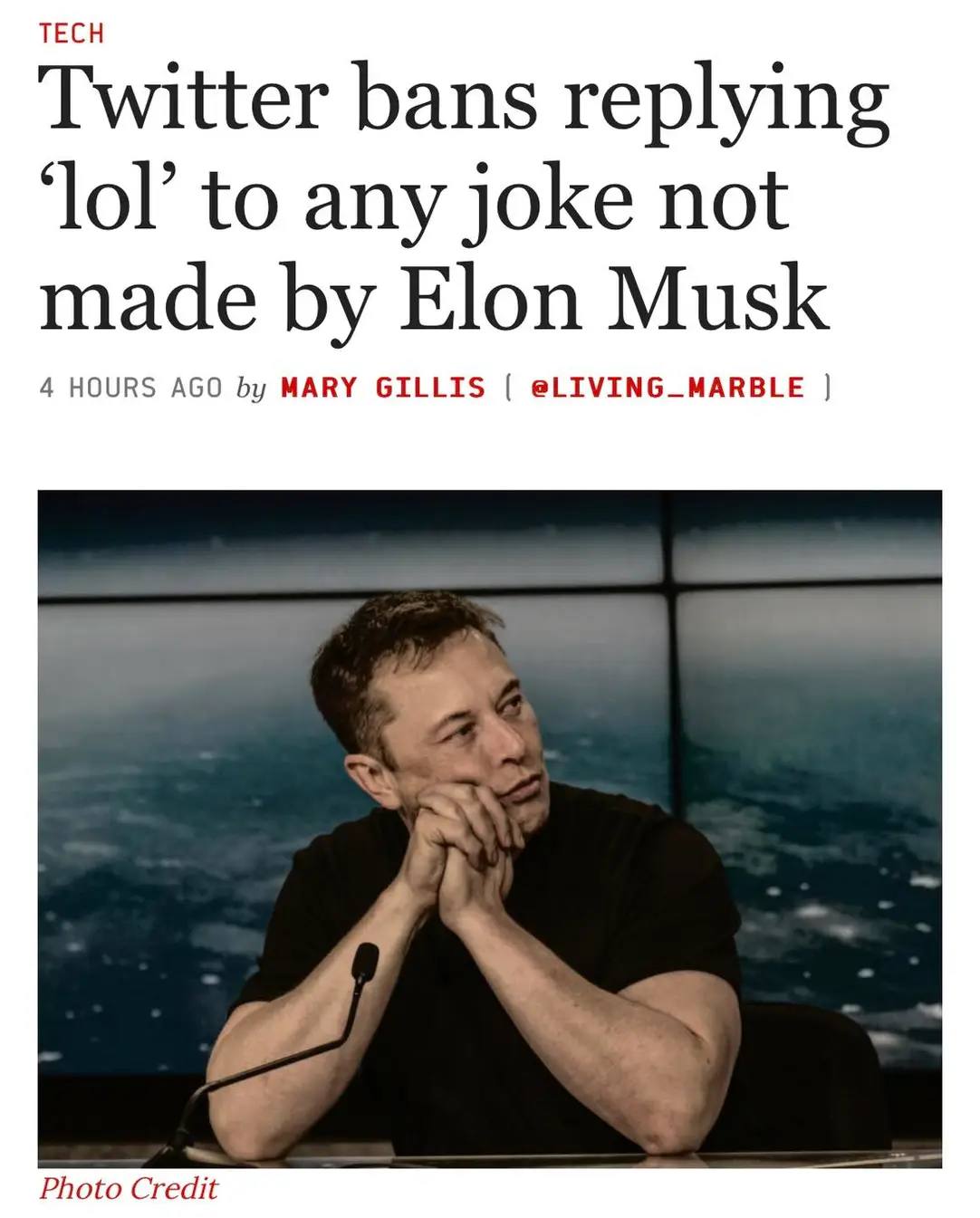
The meme depicts a photo of Elon Musk with a caption that reads: "Twitter bans me for making a joke about Elon Musk's ego". The image shows Musk with a smug expression, implying that he's being ironic about his own ego. The meme is poking fun at Musk's reputation for being self-absorbed, suggesting that even he can't take a joke about himself.
detailed-analysis (gemma3-27b-vision)
Here's an analysis of the provided image and headline, broken down into sections as requested. I've noted where sections don't readily apply.
Visual Description
The image is a medium shot of Elon Musk, looking contemplative, seated at a table. He's leaning on his hand, gazing towards his left with a slightly furrowed brow. The lighting is dramatic, with a strong focus on his face, creating a somber mood. The background appears to be blurred, suggesting a window view or a conference setting with muted colors. He's wearing a dark suit, and there’s a microphone visible indicating he's likely speaking or in a presentation setting. The composition emphasizes his isolated, thoughtful demeanor.
Foucauldian Genealogical Discourse Analysis
The headline – "Twitter bans replying ‘lol’ to any joke made by Elon Musk" – presents a fascinating case for Foucauldian analysis. Michel Foucault argued that power isn’t simply repressive, but productive. This ban isn’t just preventing a simple reaction; it constructs a hierarchy of humor and authority.
- Discourse and Power: The ban establishes a discourse where Musk's jokes are inherently more worthy of respect (or at least, less subject to casual dismissal) than others. It’s a power play in the digital realm, defining who gets to be funny and how their humor is received.
- Genealogy of 'lol': Tracing the history of 'lol' itself is interesting. It began as a purely expressive internet reaction, a signifier of amusement. Here, it is stripped of its agency and becomes a symbol of insubordination, something to be policed. The ban doesn't target all reactions, but specifically this one, showing how even seemingly trivial elements of online culture can be deployed in power structures.
- Discipline and Control: The ban is a form of digital discipline. It is controlling the users’ response to Musk. The ban is a way to maintain the illusion of control.
Critical Theory
This situation speaks directly to several themes within Critical Theory, specifically relating to the culture industry and the construction of authority.
- Culture Industry: The fact that a social media platform is defining the rules of engagement around a single individual's humor illustrates the power of the "culture industry" (as described by Adorno and Horkheimer). The platform isn't fostering organic cultural expression; it’s actively managing it to benefit a particular figure.
- Hegemony: The ban can be seen as an attempt to reinforce Musk's hegemonic position. Hegemony isn't simply domination but the consent of the governed. By creating a rule that appears absurd (banning a simple internet reaction), Twitter is subtly signalling that Musk is above the usual rules of engagement, demanding a degree of deference.
- Commodification of Attention: This whole scenario is fueled by the commodification of attention. The ban, even if intended as a joke or a form of provocation, generates discussion and therefore engagement, benefiting the platform through increased user activity and data collection.
Marxist Conflict Theory
While not a direct, obvious example of class struggle, a Marxist reading can find interesting points:
- Ownership & Control of Means of Communication: Twitter, as a privately-owned platform, represents the "means of communication." This ban demonstrates the power of those who control these means to shape the discourse. This can be seen as a form of ideological control, even if seemingly trivial.
- Digital Proletariat: The users of Twitter, who are subject to these arbitrary rules, can be seen as a form of “digital proletariat”—those who generate the content and engagement, but have little say in the platform's governance.
- Reinforcing Power Structures: The ban subtly reinforces the existing power structures within the tech industry and the wealth of those like Musk, whose jokes are granted special protection.
Postmodernism
This scenario is ripe for a postmodern interpretation:
- Simulacra and Simulation: The ban itself might be a simulacrum – a copy without an original. Is it a real rule, or a performance designed to generate attention? The line between reality and representation is blurred.
- Deconstruction of Meaning: The ban deconstructs the meaning of "lol". It was previously a simple expression of amusement, but now it’s framed as an act of rebellion, a challenge to authority. The meaning is unstable and subject to manipulation.
- Hyperreality: The incident exists primarily as a spectacle online, within the realm of hyperreality, where simulations have become more real than reality itself. The debate about the ban is more significant than the ban itself.
Queer Feminist Intersectional Analysis
While not immediately apparent, a queer feminist intersectional lens can offer a nuanced reading:
- Silencing of Affect: The ban on “lol” can be seen as a subtle form of control over emotional expression. Historically, women and queer individuals have been disproportionately silenced or dismissed when expressing emotions (often deemed "hysterical" or "overreacting"). This ban, while seemingly trivial, participates in the broader pattern of controlling and policing emotional responses.
- Power Dynamics and Authority: The ban reinforces the authority of a powerful, white male figure (Musk) and demands deference from others. This aligns with historical power dynamics where marginalized groups are expected to be polite and deferential to those in power.
- The Performance of Masculinity: The absurdity of the ban (protecting Musk’s jokes) could be seen as a performance of masculinity—asserting dominance and demanding respect through arbitrary rules.
Let me know if you'd like a more detailed analysis of any specific section!
simple-description (llama3.2-vision)
The meme is a photo of Elon Musk with a disappointed expression, captioned "I've got 5000 tweets to go before I die". The image is likely a screenshot from one of Musk's infamous Twitter rants, where he has a history of making provocative and humorous comments. The caption is a tongue-in-cheek reference to the fact that Musk has a large Twitter following, and is likely making a joke about his own mortality.
tesseract-ocr
Twitter bans replying ‘lol’ to any joke not made by Elon Musk 4 HOURS AGO by MARY GILLIS [{ @LIVING_MARBLE ]