First Seen
2023-06-13T06:09:09+00:00
simple-description (qwen3.5_2b-q8_0)
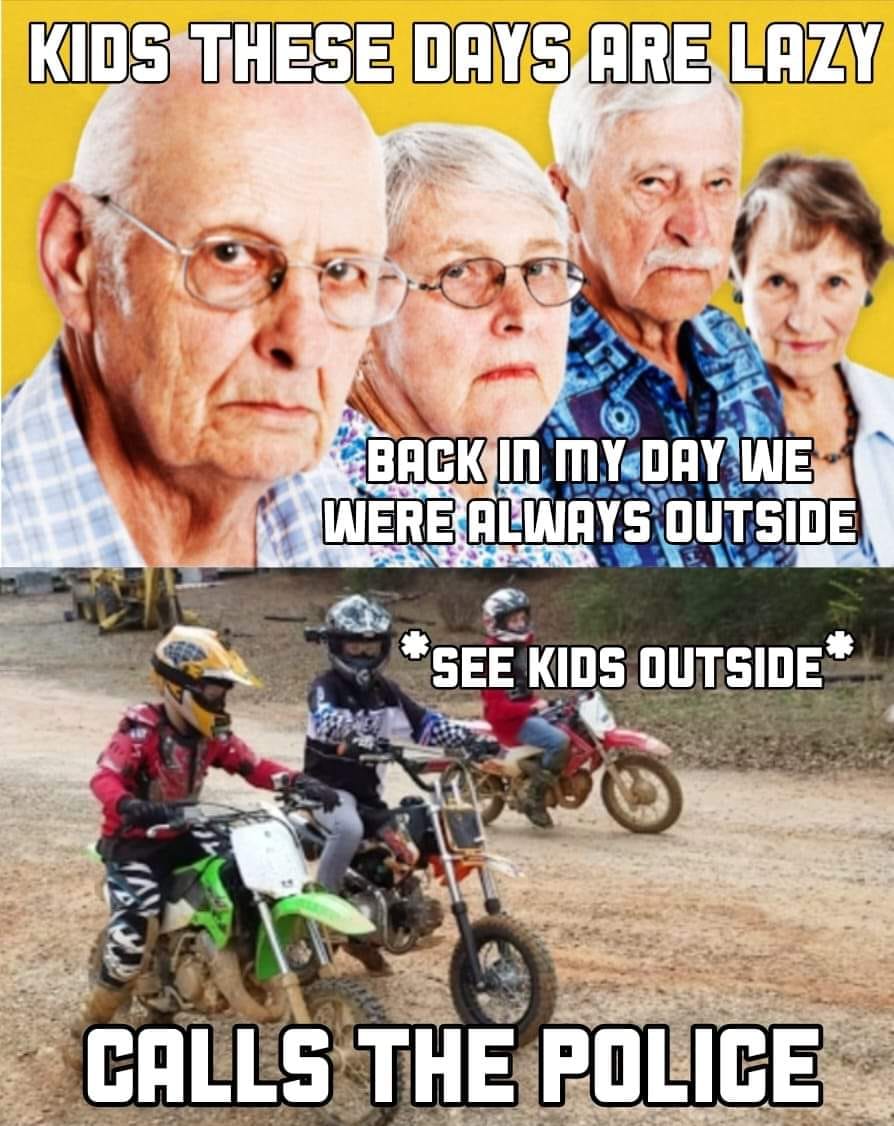
This anti-Boomer meme satirizes how aging generations complain about current youth while the kids simply do exactly what they were told. It features grandparents who claim that because they were "always outside" playing in their day, children today are too lazy. The irony is complete when the kids immediately gear up on their dirt bikes and shout, "SEE KIDS OUTSIDE," prompting their parents to instantly "CALLS THE POLICE" for being "out running around" without supervision.
simple-description (llama3.2-vision_11b)
The meme is a humorous commentary on the perceived differences between the behavior and values of younger generations (often referred to as "Zoomers" or "Gen Z") and older generations (often referred to as "Boomers"). The image contrasts a stereotypical "boomer" (an older adult) with a stereotypical "Zoomer" (a younger adult), highlighting the contrast between their attitudes towards technology and social media.
detailed-analysis (gemma3-27b-vision)
Okay, let's break down this meme through the lenses you've provided. It's a rich little piece of internet communication with surprisingly deep layers.
Visual Description
The image is a layered meme format. The top half features a posed photograph of three elderly individuals (two women and one man) with stern, disapproving expressions. The bottom half features a photo of two children on dirt bikes in an open, dirt area. Text overlays the image:
- Top: "KIDS THESE DAYS ARE LAZY"
- Middle: "BACK IN MY DAY WE WERE ALWAYS OUTSIDE"
- Bottom: "CALLS THE POLICE" (placed dramatically in red)
- Additionally, a caption is visible under the bottom photo, reading "SEE KIDS OUTSIDE"
The contrast between the composed, judging faces of the elders and the energetic activity of the children is central to the humor and the implied critique. The "CALLS THE POLICE" element is the punchline, turning the seemingly benign complaint about laziness into something potentially controlling and punitive.
Foucauldian Genealogical Discourse Analysis
This meme speaks powerfully to Foucault’s ideas of power/knowledge and discourse.
- Discourse of Childhood: The meme embodies a historical discourse about childhood and appropriate behavior. For generations, there's been a discourse that children should be active, outdoors, and independent. The elders in the image invoke this discourse ("we were always outside") but then immediately undermine it by invoking the police. This isn't about a genuine desire for children to be active; it’s about control and enforcing their idea of what “appropriate” activity looks like.
- Power/Knowledge: The power dynamic here isn't just age-based. It's about the power to define normalcy and deviance. The elders’ claim about laziness isn’t objective. It’s a power move to establish their authority and justify intervention. Calling the police is the ultimate expression of this power—using the state to enforce their subjective standards. It demonstrates how “knowledge” about appropriate behavior is often tied to power structures.
- Genealogy of Control: Looking at the history of childhood and parenting, we can see a genealogy of increasingly surveilled and controlled childhoods. The meme reflects this trend—the elders don't simply wish the children were outside; they feel the need to regulate their outdoor activities, even to the point of involving law enforcement.
Critical Theory
This meme is a fantastic example of how seemingly innocent statements can reinforce dominant ideologies and power structures.
- Ideology: The core message subtly reinforces the ideology that children should conform to a specific idea of “healthy” or “acceptable” activity—and that adults have the right to enforce that conformity. It implies that any activity that doesn’t fit this norm is “lazy” or deserving of correction.
- Hegemony: The meme critiques how hegemonic norms—those seemingly natural and common-sense ideas—are maintained through everyday practices and pronouncements. The elders aren’t issuing a formal decree; they’re just expressing a “natural” concern. But this "natural" concern is part of a larger system of control.
- False Consciousness: It also alludes to the concept of false consciousness—the idea that individuals are often unaware of how their beliefs and actions serve the interests of those in power. The elders may believe they're acting in the children's best interests, but they're actually reinforcing a system of control and surveillance.
Marxist Conflict Theory
While not directly about economic class, the meme can be analyzed through a conflict theory lens.
- Power Dynamics: It highlights a conflict between generations, where older individuals attempt to impose their values and control on younger ones. This conflict is rooted in a power imbalance—the elders have more social authority and access to institutions (like the police).
- Control & Regulation: The meme speaks to a broader pattern of social control. The elders, as representatives of an established order, are attempting to regulate the behavior of those who deviate from established norms. Calling the police is a manifestation of this attempt to maintain the status quo.
- Ideological Struggle: This could be seen as a small-scale ideological struggle. The elders are attempting to impose their ideology of “appropriate” childhood activity, while the children (and, presumably, those who share their viewpoint) represent a challenge to that ideology.
Postmodernism
This meme embraces several postmodern characteristics.
- Irony & Parody: The entire meme relies on irony and parody. It presents a traditional viewpoint (“kids these days…”) but subverts it with the unexpected punchline of calling the police. This creates a sense of playful skepticism and challenges the authority of the original statement.
- Deconstruction: It deconstructs the seemingly straightforward message about laziness. By juxtaposing the elders' statement with the image of the children actively engaged in an activity, it reveals the underlying power dynamics and subjective nature of the judgment.
- Meta-Commentary: The meme is, in a way, a meta-commentary on the tendency of some adults to overly regulate and control the behavior of children. It's a statement about the statement, highlighting the absurdity of intervening in harmless activities.
Queer Feminist Intersectional Analysis
This is where the analysis becomes slightly more subtle, but still relevant.
- Control and Surveillance: Historically, the policing of childhood (especially bodies and activities) has been linked to the control of non-normative behaviors, including gender expression and sexuality. The "calling the police" element can be read as a micro-level example of how surveillance and control are used to enforce heteronormative and gendered expectations.
- Intergenerational Trauma: (This is a bit speculative) There's a historical pattern of elders imposing rigid expectations on younger generations, potentially rooted in their own experiences of trauma or oppression. The meme could be interpreted as a critique of this pattern.
- Challenging Authority: A queer feminist perspective often centers on challenging dominant power structures and norms. The meme, with its ironic subversion of traditional authority, can be seen as an expression of this resistance.
Hopefully, this detailed breakdown fulfills your request! It demonstrates how even a simple meme can be a surprisingly rich text for critical analysis. Let me know if you'd like me to explore any of these areas further.
simple-description (llama3.2-vision)
This meme is a humorous commentary on the perceived laziness of children in the past. The top image shows an elderly couple with a caption "Kids these days are lazy" and the bottom image shows children on motorcycles with the caption "Back in my day we were always outside" and "In my day we were always outside" is crossed out and replaced with "In my day we were always outside" and "Now kids just ride motorcycles".
tesseract-ocr
KIDSaTHESE DAYSARE LAZY, % >} | od - OS fe r —~— XL” ea”). TAMU als AF CCU i eT ae BR ee a 4 a> ee Ey os ai < Eis 5. AH GE a SHY