First Seen
2023-08-12T00:08:43+00:00
simple-description (qwen3.5_2b-q8_0)
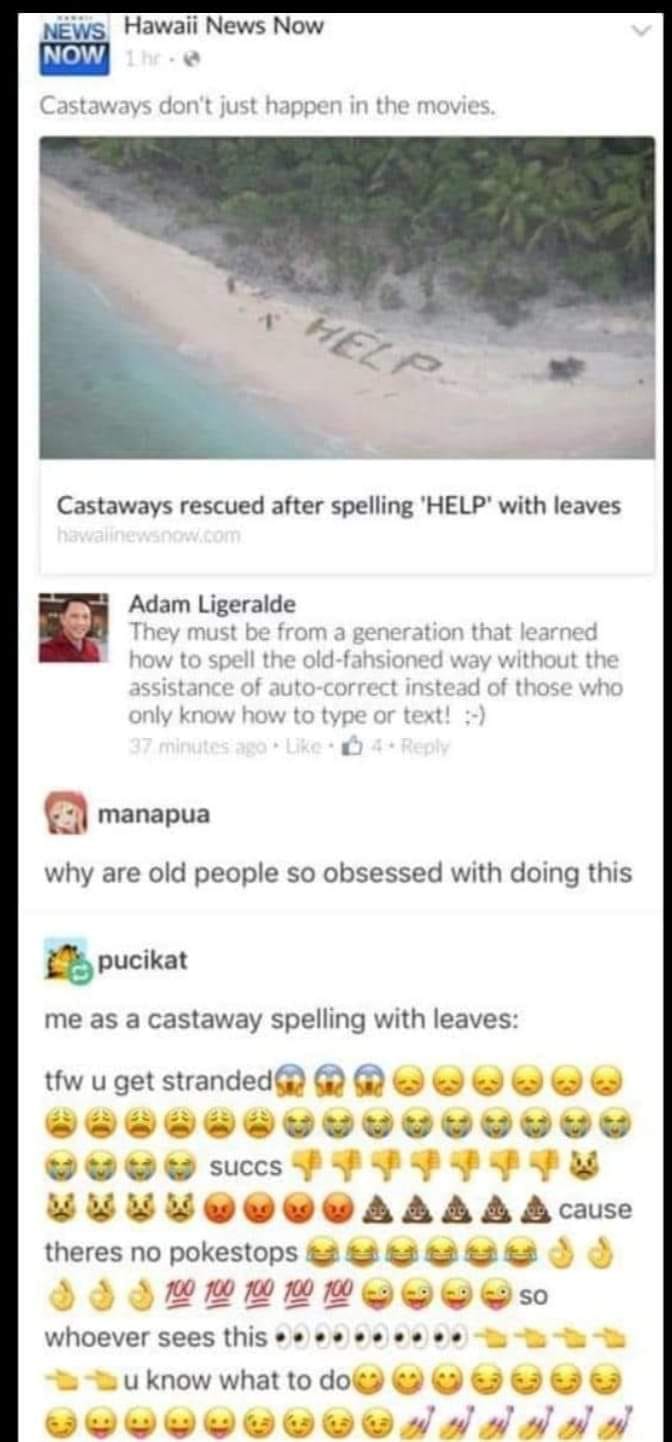
This meme humorously depicts an older man stranded on a beach who has to spell out "HELP" using a real leaf instead of typing. A comment mocks this behavior by claiming the castaway learned how to spell "old-fashioned" without "auto-correct," implying he is "smart" for sticking to traditional methods over modern technology.
simple-description (llama3.2-vision_11b)
The meme is a screenshot of a Reddit comment where a user is explaining a "Boomer" (a colloquial term for an older adult who is out of touch with modern technology) who is frustrated with a new smartphone feature that automatically corrects their spelling mistakes. The user is sarcastically saying "I can read" in response to the Boomer's complaint, implying that they are not capable of understanding the nuances of modern technology.
detailed-analysis (gemma3-27b-vision)
Okay, here's an analysis of the image and its accompanying comments, broken down into sections based on the requested theoretical frameworks. Please note that some frameworks are more applicable than others, and some may feel stretched. I'll indicate where a section feels less robust.
Visual Description
The image shows an aerial view of a beach. Large letters spelling "HELP" are created from dark green vegetation (likely leaves or branches) on the sand. The ocean is visible in the background, with waves breaking along the shore. The composition emphasizes the scale of the message relative to the landscape, highlighting the desperation of the individuals attempting to signal for rescue. The photo is presented as news content from “Hawaii News Now.” The lighting is bright, suggesting a clear day.
Foucauldian Genealogical Discourse Analysis
This image and the ensuing comments offer a compelling example of how the act of signaling for help becomes a site of discourse formation. Focusing on the "HELP" message crafted from leaves, we can trace a genealogy of this form of communication.
- Historical Context: Historically, distress signals have evolved from fires, smoke signals, flags, mirrors, and eventually radio and digital methods. Creating a message with natural materials like leaves is a return to a pre-technological form of communication, evoking a 'primitive' or 'authentic' mode of signaling.
- Power/Knowledge: The success of the signal relies on a shared understanding of the letters and the concept of 'HELP' as a plea for assistance. This understanding is power/knowledge—a socially constructed system that dictates how we interpret signs and respond to them. Those who recognize the message hold a form of power over those in need.
- Discursive Formation: The act of crafting the message itself performs the act of needing help, shaping the understanding of the situation. It’s not just about needing help, it is a manifestation of it. The comments, particularly the focus on the "old-fashioned" method, highlight the changing discourses around communication and rescue, framing the technique as an anachronism.
- The 'Normal' Signal: The contrast between this 'natural' form of help and modern forms, such as the use of signal flares or a radio, highlights what is considered 'normal' or 'expected'. The image challenges this 'normal' and highlights the power relations involved in setting it.
Critical Theory
From a Critical Theory perspective, the image and commentary can be examined through the lens of societal control and the production of narratives.
- Commodification of Distress: The fact that this event is reported as “news” immediately turns a genuine crisis into content for consumption. The photograph represents the distress rather than directly alleviating it. This is a common characteristic of media, which often prioritizes spectacle over substance.
- Normalization of Precarity: The event itself, someone being stranded and needing rescue, normalizes a level of precarity in modern life. It suggests vulnerability is an inherent condition, particularly in relation to nature.
- Critique of 'Authenticity': The comments focusing on the "old-fashioned" method suggest a preoccupation with authenticity. The commenters praise the castaways for using a pre-technological method, implying a preference for 'natural' communication over modern, digital forms. This could be seen as a nostalgic desire for a simpler time, or a rejection of modern technology.
Marxist Conflict Theory
While not overtly a Marxist subject, conflict can be discerned in this event.
- Resource Control and Access: The castaways' situation is a result of a failure in access to resources (a working boat, a functioning communication device). The event suggests an inherent inequality in access to the means of survival and communication.
- Labor and Survival: The creation of the "HELP" message is a form of labor undertaken by the castaways in an attempt to secure their basic survival needs. This labor is not rewarded through wages or a formal system, but through the potential for rescue.
- The Role of Capital: Modern rescue efforts are heavily reliant on capital investment in technology (boats, aircraft, communication systems). The fact that the castaways were able to be rescued indicates the existence of a system that allows for this intervention, a system predicated on capitalist organization.
Postmodernism
The image and especially the response are ripe for a Postmodern reading.
- Simulation and Hyperreality: The image of the "HELP" message becomes a simulation of the distress itself. The act of photographing and sharing the image creates a hyperreality where the representation of the event eclipses the event itself. The emoji-laden responses amplify this effect.
- Deconstruction of Meaning: The focus on the 'old-fashioned' method of signaling deconstructs the traditional association between method and meaning. The castaways aren't signaling in the "correct" way, challenging the notion of a singular, correct way to communicate distress.
- Playfulness & Irony: The response comments featuring emojis demonstrate a certain level of irony and playfulness. The response reduces the gravity of a potential life-or-death scenario to a series of online reactions, highlighting the fragmentation of meaning in the digital age.
- The Emoji Language: The extensive use of emojis functions as a meta-commentary on the situation. The responses are less about conveying genuine concern and more about participating in a digital performance of concern, highlighting the absurdity of online communication.
Queer Feminist Intersectional Analysis
This framework is the weakest fit, but some connections can be drawn:
- Vulnerability & Care: The castaways' situation highlights vulnerability, a theme often explored in feminist thought. The act of rescue can be seen as an act of care, albeit one that is mediated by external forces.
- Precarity & Marginalization: The event may highlight how certain groups are disproportionately affected by precarity. While the image doesn't immediately suggest this, the absence of identifying information leaves room to consider whether the castaways' situation is linked to systemic inequalities.
- Digital Performance of Emotion: The emoji-laden responses, while playful, could be interpreted through a queer feminist lens as a form of digital performance. This is a way of engaging with emotion and expressing solidarity, but it’s also a highly constructed and mediated form of expression.
- Intersectionality & Visibility: Further investigation would be needed to determine whether the castaways come from historically marginalized groups, and how that might intersect with their situation. If so, the event could be viewed as a reflection of broader patterns of inequality and vulnerability.
I hope this detailed analysis provides a comprehensive understanding of the image and its comments through the requested theoretical frameworks. Let me know if you'd like any aspect elaborated upon.
simple-description (llama3.2-vision)
This meme is a screenshot of a Facebook comment thread where a user is responding to a news article about a group of castaways who survived on a deserted island by spelling "HELP" with palm fronds. The user is jokingly asking why the castaways didn't just use their knowledge of the movies to spell "HELP" with leaves, and the conversation devolves into a series of ridiculous and humorous responses, including a user asking why the castaways didn't use their knowledge of the movies to spell "HELP" with leaves, and another user responding with a series of ridiculous and humorous responses, including "they should have used their knowledge of the movies to spell 'HELP' with leaves" and "they should have used their knowledge of the movies to spell 'HELP' with leaves".
tesseract-ocr
fay Hawaii News Now Castaways don't just happen in the movie ~ Y al <> : <> = Castaways rescued after spelling "HELP" with leaves mm Adam Ligeralde Sa They must be from a generation that learned how to spell the old-fahsioned way without the assistance of auto-correct instead of those wh only know how to type or text! t @) manapua why are old people so obsessed with doing this £5 pucikat me as a Castaway spelling with leaves: tfw u get stranded@® @ Meeeooee SeSeeeeeCuUTVVEeTeVUTVe BESS sucs PPRVPPRPPy BEVVSSVOSAAAA A case theres no pokestops 9 9 &§ SP PGs D SS PRPLPLOSSSS>s0 whoever sees this ©'*)¢*)e*) ee ¢¢ “i “hh » “& u know what to do® & & & &@ & & Bees eeeeeGeGddddadd