First Seen
2023-08-24T17:51:08+00:00
simple-description (qwen3.5_2b-q8_0)
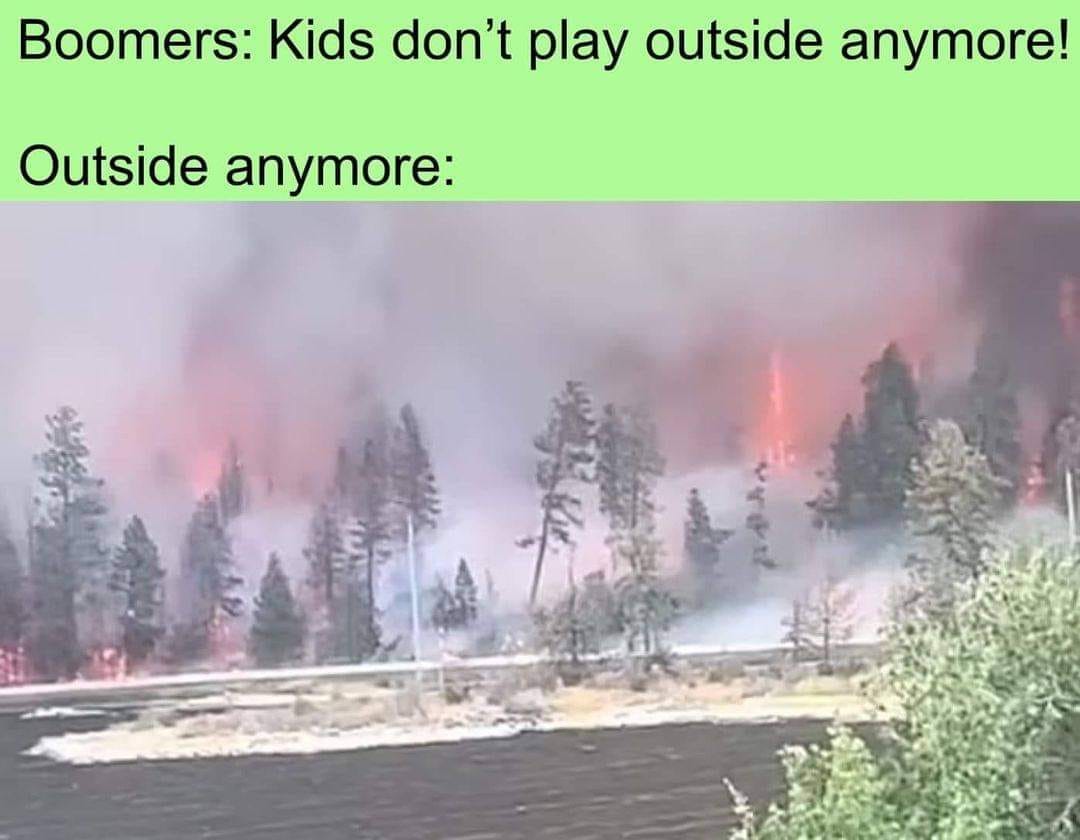
This humorous meme contrasts the generations' views on outdoor safety and childhood. At the top, the caption sets up a stereotype: "Boomers: Kids don't play outside anymore!" while the bottom text, "Outside anymore," is paired with a terrifying image of a massive wildfire burning through a forest. The joke relies on the idea that while Boomers might think the outdoors is safe and kids just run around, they likely don't understand the reality that the world is still burning even when they were their age.
simple-description (llama3.2-vision_11b)
This meme is from the Anti-Boomer category, which is a subcategory of Anti-Jokes that pokes fun at stereotypes of Baby Boomers. The meme is a humorous commentary on the perceived differences in childhood experiences between the current generation and the Baby Boomers. The image shows a person's childhood bedroom with a nostalgic 80s/90s setup, but with a modern twist, implying that the current generation is more tech-savvy and less nostalgic.
detailed-analysis (gemma3-27b-vision)
Okay, let's break down this meme/image through various theoretical lenses.
Visual Description
The image depicts a dense forest, heavily obscured by a reddish-pink haze likely caused by wildfire smoke. The trees are silhouetted against the smoky sky, creating a dramatic and somewhat ominous effect. The foreground shows a body of water with some vegetation along the bank. The overall impression is one of environmental distress and potential danger. The color palette is dominated by variations of red, pink, and grey, reinforcing the sense of heat and destruction.
Foucauldian Genealogical Discourse Analysis
The meme functions as a discourse challenging a simplistic narrative. The “Boomer” lament about kids not playing outside is framed against the reality of increasingly dangerous outdoor environments. A Foucauldian approach, specifically a genealogical one, would explore how the idea of "playing outside" is constructed through historical power dynamics.
- Discursive Formation: The meme deconstructs the traditional discourse around childhood and outdoor play. The lament assumes a pastoral, idyllic view of the outdoors. The image directly challenges this by presenting an environment rendered dangerous by factors like climate change.
- Power/Knowledge: Historically, the idea of “playing outside” has been tied to notions of health, rugged individualism, and national identity. This image subverts that, suggesting that the conditions enabling such "free play" are disappearing. The "Boomer" framing implies a nostalgic power dynamic—a perceived superiority of their past experiences.
- Genealogy: Tracing the genealogy of the lament reveals a relationship between cultural ideals about childhood, expectations about nature, and the material conditions of the present. The meme highlights the shift in material conditions – the increase in environmental hazards – that have changed the possibility of “playing outside”.
Critical Theory
From a Critical Theory perspective, the meme exposes the contradictions inherent in the dominant narratives surrounding climate change and responsibility.
- Ideology: The “Boomer” lament operates as a kind of nostalgic ideology, obscuring the systemic issues contributing to environmental degradation. It implicitly shifts blame to a younger generation (“kids”) for not engaging in a behavior that is becoming increasingly untenable.
- Domination/Emancipation: The image points to how environmental changes (driven by larger power structures and capitalistic exploitation) dominate the ability of children to safely experience nature. The meme acts as a form of critique, offering a counter-narrative that challenges the complacency of the “Boomer” perspective and suggests a need for systemic change.
- False Consciousness: The "Boomer" lament could be seen as reflecting a kind of false consciousness – a lack of awareness of the real factors that make outdoor play dangerous. They are focusing on a superficial change in behavior rather than the underlying structural problems.
Marxist Conflict Theory
From a Marxist perspective, the image embodies the inherent conflicts between capital, nature, and social classes.
- Material Conditions: The image is a direct result of material conditions – specifically the impacts of climate change driven by industrial capitalism. The wildfires are not a random event but a product of a system prioritizing profit over environmental sustainability.
- Class Conflict: While not explicitly about class, the image points to how the burdens of environmental degradation are often disproportionately borne by future generations (children) and marginalized communities. The "Boomer" lament can be read as a form of intergenerational conflict – a lack of concern for the consequences of their actions on those who will inherit the damaged planet.
- Alienation: The destroyed natural environment represents a form of alienation – the separation of humans from nature, caused by the capitalist mode of production.
Postmodernism
A postmodern reading would focus on the breakdown of grand narratives and the fragmentation of meaning.
- Deconstruction: The meme deconstructs the romanticized idea of “playing outside” by juxtaposing it with the harsh reality of environmental destruction. It challenges the notion of a stable, unified experience of nature.
- Simulacra and Simulation: The “Boomer” lament could be seen as a simulacrum – a copy without an original. It's a nostalgic fantasy detached from the actual conditions of the present.
- Meta-narrative: The meme challenges the grand narrative of progress and the inherent goodness of human interaction with nature.
I hope this analysis is helpful. Let me know if you'd like me to elaborate on any particular point or lens!
simple-description (llama3.2-vision)
This meme is a humorous comparison between the childhoods of baby boomers and millennials. It features a split-screen image, with a serene forest scene on one side and a chaotic, apocalyptic landscape on the other. The text at the top reads "Boomers: Kids don't play outside anymore!" and the text at the bottom says "In reality: [image of a forest on fire]". The meme is poking fun at the idea that the previous generation's perception of children's lack of outdoor play is actually a reflection of the devastating effects of climate change.
tesseract-ocr
Boomers: Kids don’t play outside anymore! Outside anymore: . | e : - 4% “Re ; A nm = Pay See i 3 7 é 5 A -|* ti ip -_ aN rie oa Le z : a ‘dae ' - i z aN ret me a i — Se ee = Ss : ie = ow a — = — way ra i a a | Nee: S086 . $e res i a : ae : 3 . ee 2s a wr