First Seen
2023-05-10T21:03:33+00:00
simple-description (llama3.2-vision_11b)
The meme is a play on the classic children's book "The Hobbit" and its sequel "The Hobbit: The Hobbit" (which is not a sequel, but a book) and the book "The Hobbit" is a book that is not a book. The image shows a character from the book "The Hobbit" and the book "The Hobbit" is not a book, and the book "The Hobbit" is a book that is not a book. The text "The Hobbit" is a book that is not a book.
detailed-analysis (gemma3-27b-vision)
Here's an analysis of the image, broken down into the requested theoretical frameworks. I've skipped sections where the image doesn't lend itself particularly well to that theory.
Visual Description
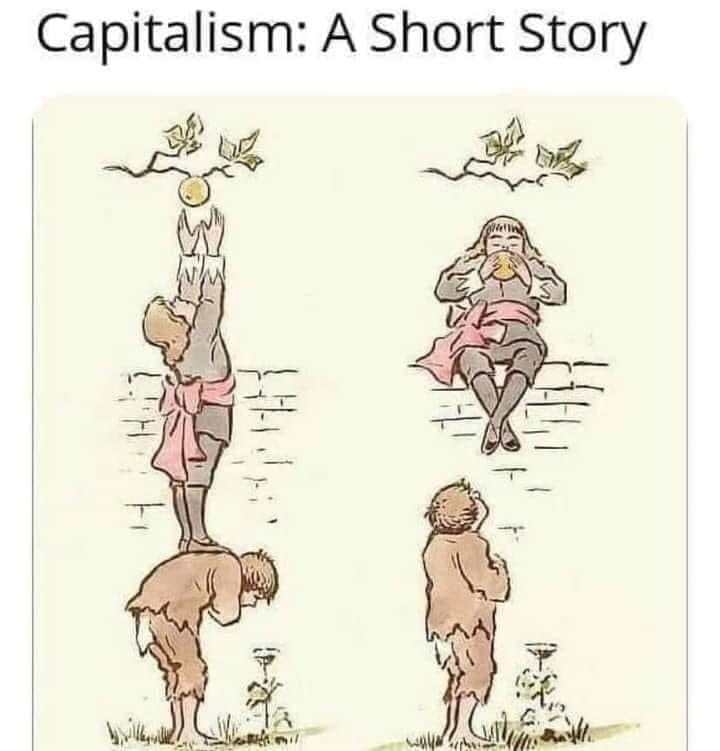
The image is a four-panel cartoon depicting a stark power dynamic. In the first panel, a figure in finer clothes stands on the shoulders of a visibly impoverished figure to reach a piece of fruit high on a tree. The second panel shows the well-dressed figure comfortably seated, consuming the fruit, while the supporting figure remains unseen, implied to still be providing the support. The third panel presents a solitary, downtrodden figure, presumably the one who supported the other. The image emphasizes the physical and metaphorical elevation of one individual at the expense of another, highlighting an imbalance of power and exploitation. The color palette is muted, which emphasizes the bleakness of the scenario.
Marxist Conflict Theory
This image is a remarkably direct representation of core tenets of Marxist thought. It vividly illustrates the exploitative relationship between the bourgeoisie (the well-dressed figure) and the proletariat (the impoverished figure).
- Base and Superstructure: The physical act of one figure literally standing on the other represents the foundational economic relationship – the base. The comfortable consumption of the fruit (the product of labor) by the upper figure is part of the superstructure – the cultural and ideological elements that reinforce the power structure.
- Surplus Value: The fruit represents the value created by the labor of both figures. However, all of the benefit from that labor accrues to the upper figure. The lower figure receives nothing, representing the appropriation of surplus value by the capitalist class.
- Alienation: The final panel depicts the isolated, downtrodden figure, demonstrating the alienation of the working class from the product of their labor and from each other. They are left with nothing after enabling the success of another.
- Class Struggle: The image inherently depicts a power imbalance, suggesting a struggle between classes. The supporting figure is actively enabling, yet receives no benefit from, the upper figure's success.
Foucauldian Genealogical Discourse Analysis
While not immediately obvious, a Foucauldian analysis can focus on the discourse that allows this power arrangement to be normalized.
- Power/Knowledge: The image suggests a discourse that justifies the upper figure’s position and obscures the exploitative relationship. The discourse might emphasize meritocracy ("They are successful because they worked for it") or the necessity of a hierarchical structure. This discourse creates the “knowledge” that justifies the upper figure’s claim to the fruit.
- Genealogy of Control: A genealogical analysis would trace the historical development of the ideologies that permit such a system to exist. This would involve examining how ideas about labor, ownership, and social hierarchy have evolved over time, creating a normalized system of exploitation.
- Disciplinary Power: The unseen support in the second panel implies a form of discipline. There is an expectation (perhaps unspoken) that the supporting figure will continue to provide support, maintaining the power structure. The image demonstrates a system of control and expectation, rather than direct force.
Critical Theory
The image fits neatly into the broader framework of Critical Theory, particularly its focus on examining systems of domination and oppression.
- Ideology: The image is a potent visual critique of dominant ideologies that legitimize inequality. The comfortable consumption of the fruit masks the underlying exploitation. The image reveals how ideologies can function to maintain power imbalances.
- Domination: The image highlights the dynamics of domination – how one group (the upper figure) exerts power over another (the lower figure). It demonstrates how this power can be embedded in everyday structures and practices.
- Emancipation: Implicit in the critique is a call for emancipation – the liberation of the exploited figure. The image serves as a visual challenge to the status quo and a catalyst for social change.
Note: The image doesn't readily lend itself to Postmodernism or Queer Feminist Intersectional Analysis. It's possible to stretch a postmodern reading to discuss the deconstruction of the myth of meritocracy, but it’s not a central theme. It doesn’t explicitly deal with gender, sexuality, or intersectionality in a way that warrants analysis through those lenses.
Let me know if you would like me to elaborate on any of these points or explore a different theoretical angle.
simple-description (llama3.2-vision)
This meme is a visual representation of the concept of capitalism, with a series of illustrations showing a person trying to reach a high shelf with a long stick, only to have the stick break, then a person trying to climb a tree, only to get stuck, and finally a person sitting on a couch eating a sandwich, with the text "Capitalism: A Short Story" at the top.
tesseract-ocr
Capitalism: A Short Story Ns 4) 2x8 a os) GES . — — a =i) = = yo "- fe, « a) Ck Lek oy je Yi aN UJ In NAS ie. \y et An ” ow SA I hE ee