First Seen
2023-05-10T21:03:33+00:00
simple-description (llama3.2-vision_11b)
The meme is a four-panel comic that illustrates the struggle between the individual and the corporation. The first panel shows a single person working at a stand selling apples, with a sign that reads "Apples for Sale". The second panel shows the same person being replaced by a corporation, with a sign that reads "Apples for Sale" but with a much larger and more efficient operation. The third panel shows the corporation's employees, including a manager who is sitting at a desk, surrounded by a large number of employees who are all working to pick and sell apples. The fourth panel shows the manager sitting at a desk, surrounded by a large number of employees who are all working to pick and sell apples. The text in the image reads "Apples for Sale".
detailed-analysis (gemma3-27b-vision)
Okay, let's break down this four-panel cartoon through the lenses you've requested. This is a thought-provoking image, and a lot of theoretical perspectives can be applied.
Visual Description
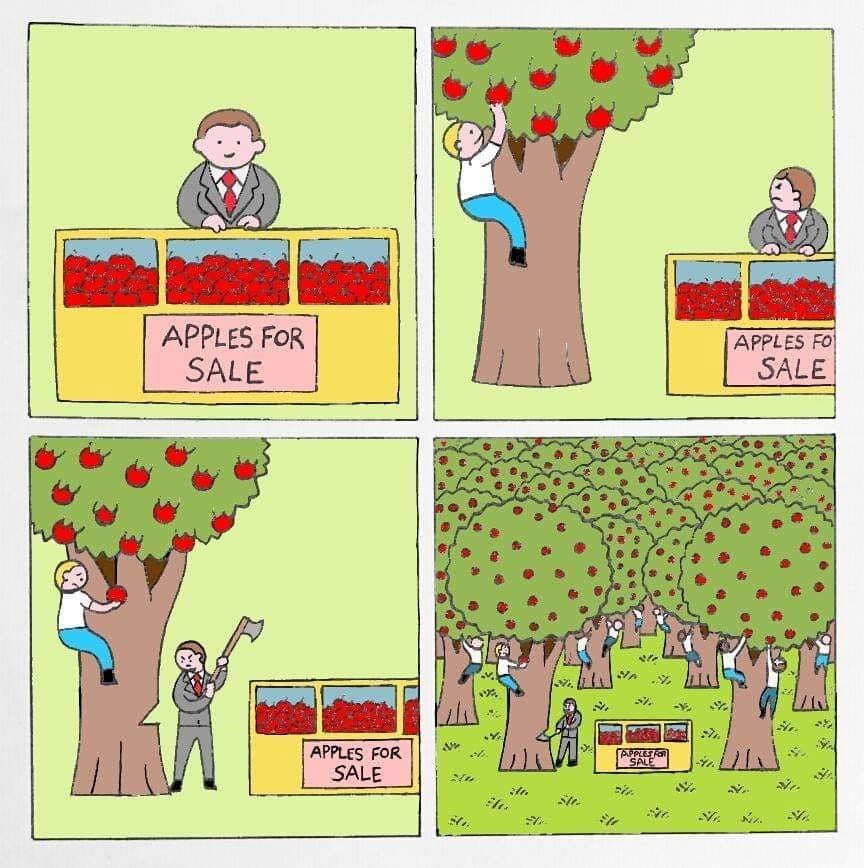
The cartoon depicts a seemingly idyllic apple orchard. In the first panel, a man in a suit stands behind a table overflowing with apples, with a sign reading "APPLES FOR SALE." In the second panel, a person begins to climb the tree, seemingly to harvest apples. In the third panel, the man with the axe begins to chop at the tree. By the fourth and final panel, the tree is rapidly being chopped down with the help of many people, and with the apples seemingly flying everywhere. There is a sign in the fourth panel stating “APPLES FOR SALE” as well. The background is simple, green grass and a blue sky. The style is simple and flat, resembling a cartoon. The color scheme is minimalist with reds and greens.
Foucauldian Genealogical Discourse Analysis
This cartoon provides a potent illustration of Foucault’s concept of power/knowledge and his genealogical method.
- Discourse of Productivity: Initially, the "APPLES FOR SALE" sign represents a discourse of economic productivity and exchange. The apples are presented as commodities, their value determined by the market.
- Discipline & Control: However, the rapid escalation of tree-felling is not about sustainable harvest. It’s about extraction and control. The act of chopping down the tree, rather than picking the apples, signifies a shift from discipline (cultivating the tree) to a more violent form of power—the exercise of force to maximize short-term gain.
- Genealogy of Power: Foucault’s genealogy would ask how this discourse of relentless extraction emerged. What historical and social forces led to a prioritization of immediate profit over the long-term health of the source? The cartoon suggests that this isn't a natural state but a constructed one—a product of specific power relations.
- Panopticism: While less overt, the proliferation of people wielding axes in the final panel can be seen as a distributed form of panoptic control. Each person is participating in the destruction, reinforcing the normalization of this practice.
Marxist Conflict Theory
This cartoon is a powerful critique of capitalist exploitation.
- Means of Production: The apple tree is the 'means of production.' It is the source of wealth (the apples).
- Bourgeoisie & Proletariat: The man in the suit in the first panel can be seen as the bourgeoisie – the owner of the means of production. The people with axes are the proletariat, the working class carrying out the destruction.
- Alienation: The cartoon highlights the alienation inherent in capitalist systems. The people are not engaged in a relationship with the tree, nurturing it for future harvests. They are merely instruments of destruction, focused solely on maximizing immediate profit. There is no concern for sustainability or the future.
- Exploitation: The tree is exploited – used up and destroyed – for the sake of profit. The ultimate goal isn’t to obtain apples, but to extract as much value as possible as quickly as possible, regardless of the long-term consequences.
- Class Conflict: The shift from picking to felling represents an escalation of the conflict between those who control the means of production and those who are forced to participate in its exploitation.
Postmodernism
While not the most dominant reading, a postmodern lens can also offer insights.
- Deconstruction of Value: The cartoon deconstructs the traditional notion of value. Initially, the apples appear to have value as a product. But the act of chopping down the tree reveals a different kind of value—a purely economic one—that prioritizes short-term gain over long-term sustainability.
- Hyperreality: The abundance of apples in the final panel, flying through the air, could be seen as a representation of hyperreality. The image is an exaggeration of abundance, divorced from the real-world consequences of environmental destruction.
- Meta-Narratives: The cartoon challenges the meta-narrative of progress and economic growth. It suggests that this narrative is often built on exploitation and unsustainable practices.
- Instability of Meaning: The shift from picking apples to chopping down the tree demonstrates the instability of meaning. What starts as a seemingly benign act of commerce quickly spirals into a destructive frenzy, highlighting the lack of inherent meaning in economic systems.
Critical Theory
This cartoon strongly aligns with the themes explored in Critical Theory, particularly the Frankfurt School.
- Instrumental Reason: The cartoon critiques the dominance of “instrumental reason.” The people are not asking why they are chopping down the tree, only how to do it more efficiently. The focus is solely on achieving a specific goal (maximizing profit) without considering the ethical or environmental consequences.
- Culture Industry: The “APPLES FOR SALE” sign represents the commodification of nature, turning it into a product for consumption. This aligns with the Frankfurt School's critique of the “culture industry” – the way mass media and consumer culture reproduce dominant ideologies.
- Domination and Control: The act of chopping down the tree symbolizes the exercise of domination over nature. It reflects a mindset that views the natural world as a resource to be exploited, rather than a system to be respected.
Queer Feminist Intersectional Analysis
This reading is more nuanced and requires some extrapolation.
- Exploitation and Vulnerability: From a feminist perspective, the tree itself can be seen as a metaphor for a marginalized body – a source of life and sustenance that is exploited and destroyed for the benefit of others. The tree's vulnerability echoes the vulnerability of marginalized communities.
- Intersectionality of Exploitation: The destruction of the tree can be linked to broader patterns of environmental racism and classism, where marginalized communities are disproportionately affected by environmental degradation.
- Rejection of Growth Narratives: From a queer perspective, the relentless pursuit of "growth" (represented by the abundance of apples) can be seen as a metaphor for heteronormative reproduction and the pressure to conform to traditional expectations. The cartoon’s depiction of destruction challenges this narrative.
- Reclaiming Agency: While not explicitly depicted, the image can be reinterpreted as a call for reclaiming agency and resisting destructive forces. Challenging the status quo and prioritizing sustainability are acts of resistance.
Let me know if you’d like me to expand on any of these interpretations or explore additional theoretical lenses!
simple-description (llama3.2-vision)
This meme is a humorous comparison between a job interview and a job in a fruit orchard. The first panel shows a job interviewer asking "Do you have any questions?" and the second panel shows a person asking "Do you have any apples?" The third panel shows a person asking "How many apples can I take?" and the fourth panel shows a person asking "How many apples can I take?" with a crowd of people surrounding a tree.
tesseract-ocr
rs | owe ee ey CHighy __ Fy __|| Gay SS | nn Pi SALE ess SALE COL 2 eer o%e Rieti eee we, pg NS Rd rl ; fect *.°* ee / ve Oeics DS coma uch gs ha