First Seen
2023-07-20T02:58:40+00:00
simple-description (qwen3.5_2b-q8_0)
This meme satirizes the absurdity of the food industry by highlighting that a single burger or shake is cheaper than one person actually eats every day. The driver mocks Bobby for treating such a minor act—reported as "stealing food" from a giant corporate entity—against a company that makes billions of dollars a year. This joke points out how capitalism criminalizes basic food consumption to protect massive profits.
simple-description (llama3.2-vision_11b)
This meme is a humorous take on the idea of someone who is "too poor to steal" food from a store, as they are not wealthy enough to afford to buy food in the first place. The image likely features a character from a cartoon or animated show, with a caption that reads: "You know what's wild? The guy who's too poor to steal food from a store is still considered a threat to society."
detailed-analysis (gemma3-27b-vision)
Okay, let's break down this meme featuring King of the Hill characters Hank and Bobby Hill, through the lenses of several theoretical frameworks.
Visual Description
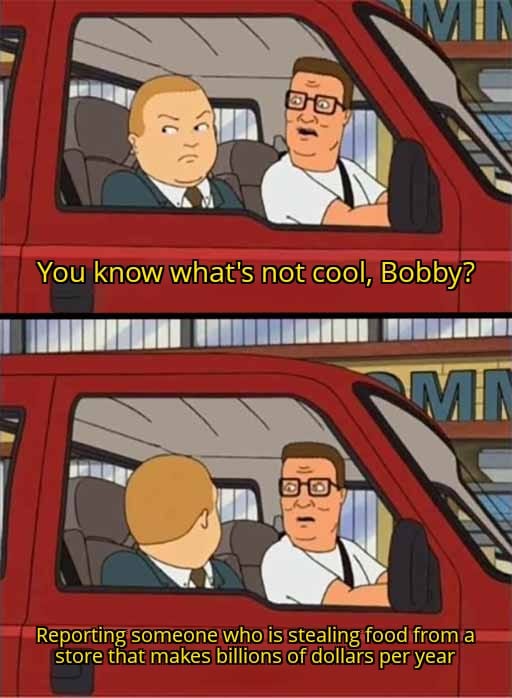
The meme is a two-panel image created from a scene in the animated television show King of the Hill.
- Panel 1: Hank Hill, a conservative, blue-collar man, is driving, looking somewhat annoyed. Bobby Hill, his awkward and unconventional son, sits in the passenger seat. Text overlaid on the panel reads, “You know what's not cool, Bobby?”
- Panel 2: Still in the car, Bobby looks apprehensive. The text overlays, "Reporting someone who is stealing food from a store that makes billions of dollars per year."
- Style: The image maintains the distinctive, slightly minimalist animation style of King of the Hill. The framing focuses on the characters’ facial expressions to convey emotional states.
- Color Palette: Dominantly red, beige, and grayscale.
Foucauldian Genealogical Discourse Analysis
This meme engages with power dynamics through Foucault's lens.
- Discourse: The meme constructs a discourse around "right" and "wrong." Hank represents societal norms and the established power structures that reinforce the idea that theft is wrong. Bobby’s response disrupts this discourse by questioning the inherent justice of reporting someone who steals necessities from a corporate entity that already possesses immense wealth.
- Genealogy of Morality: Foucault argues that morality isn't absolute, but constructed historically. The meme implicitly challenges the genealogy of the anti-theft moral code. It suggests that this moral code, while seemingly universal, serves to maintain the power of large corporations. The act of "reporting" becomes a performative act that upholds this power.
- Power/Knowledge: Hank’s authority stems from his role as a father and his alignment with the dominant cultural values. The meme’s implication is that power operates not solely through repression, but also through the creation of knowledge and the definition of what is “cool” or “uncool”. Hank's judgment becomes a way of asserting his authority.
Marxist Conflict Theory
The meme is inherently a commentary on class conflict and the unequal distribution of wealth.
- Capitalism & Exploitation: The image positions a large corporation (the "store that makes billions") as an entity that operates within a capitalist system characterized by the extraction of surplus value and, potentially, exploitation.
- Proletariat vs. Bourgeoisie: The person stealing food can be seen (metaphorically) as representing the proletariat (working class) trying to secure basic needs in a system rigged in favor of the bourgeoisie (owners of capital). Reporting this person reinforces the structures that benefit the wealthy and punish those struggling for survival.
- False Consciousness: Hank's disapproval represents a form of "false consciousness," where he internalizes the values of the dominant class and fails to recognize the systemic injustice at play. He is more concerned with upholding the abstract principle of "not stealing" than with addressing the root causes of poverty.
Critical Theory
The meme functions as a critical commentary on social norms and systems of power.
- Ideology: The meme deconstructs the ideology that equates all theft as equally wrong, regardless of context or motivation. It questions the unquestioned assumptions embedded within this belief.
- Critique of Authority: Hank’s paternalistic "You know what's not cool, Bobby?" functions as a micro-level example of broader authoritarian structures. Bobby's response challenges this authority by introducing a moral counter-argument.
- Emancipation: While subtle, the meme implies a call for critical thought and a rejection of unquestioning obedience to authority. Bobby is implicitly advocating for a system that prioritizes human needs over corporate profits.
Postmodernism
While the meme doesn't explicitly exhibit all hallmarks of postmodernism, certain elements are present:
- Deconstruction of Grand Narratives: The meme subtly deconstructs the grand narrative of "law and order" and "property rights" by questioning their absolute validity.
- Relativism: The meme suggests that morality isn’t absolute but is contextual. What is considered “wrong” depends on the power dynamics and circumstances.
- Irony: The meme’s humor derives from the ironic juxtaposition of a minor infraction (stealing food) against the backdrop of massive corporate wealth.
Important Note: The meme's effectiveness lies in its simplicity. It doesn't offer a fully developed argument, but it functions as a prompt for critical reflection.
Let me know if you'd like me to elaborate on any of these analyses or explore another theoretical framework!
simple-description (llama3.2-vision)
This meme is a humorous exchange between two characters, Hank and Dale, from the TV show "King of the Hill". The conversation starts with Hank asking Dale if he knows what's not cool, and Dale responds with a sarcastic remark about a person who is stealing food from a store that makes billions of dollars per year. The meme pokes fun at the absurdity of the situation, highlighting the hypocrisy of someone who is stealing from a wealthy business.
tesseract-ocr
Re AV 4d I 5 LIN > — ol = ( i NS # if . ATA, oi ‘ You know what's not cool, Bobby? Me LIEU ULE Cane RU! 5 VLAN = ] may = iN .— ma S Reporting’someone|whoiis'stealing;food fromia store that makes billions of dollars per year