First Seen
2024-05-04T03:19:19.606238+00:00
simple-description (qwen3.5_2b-q8_0)
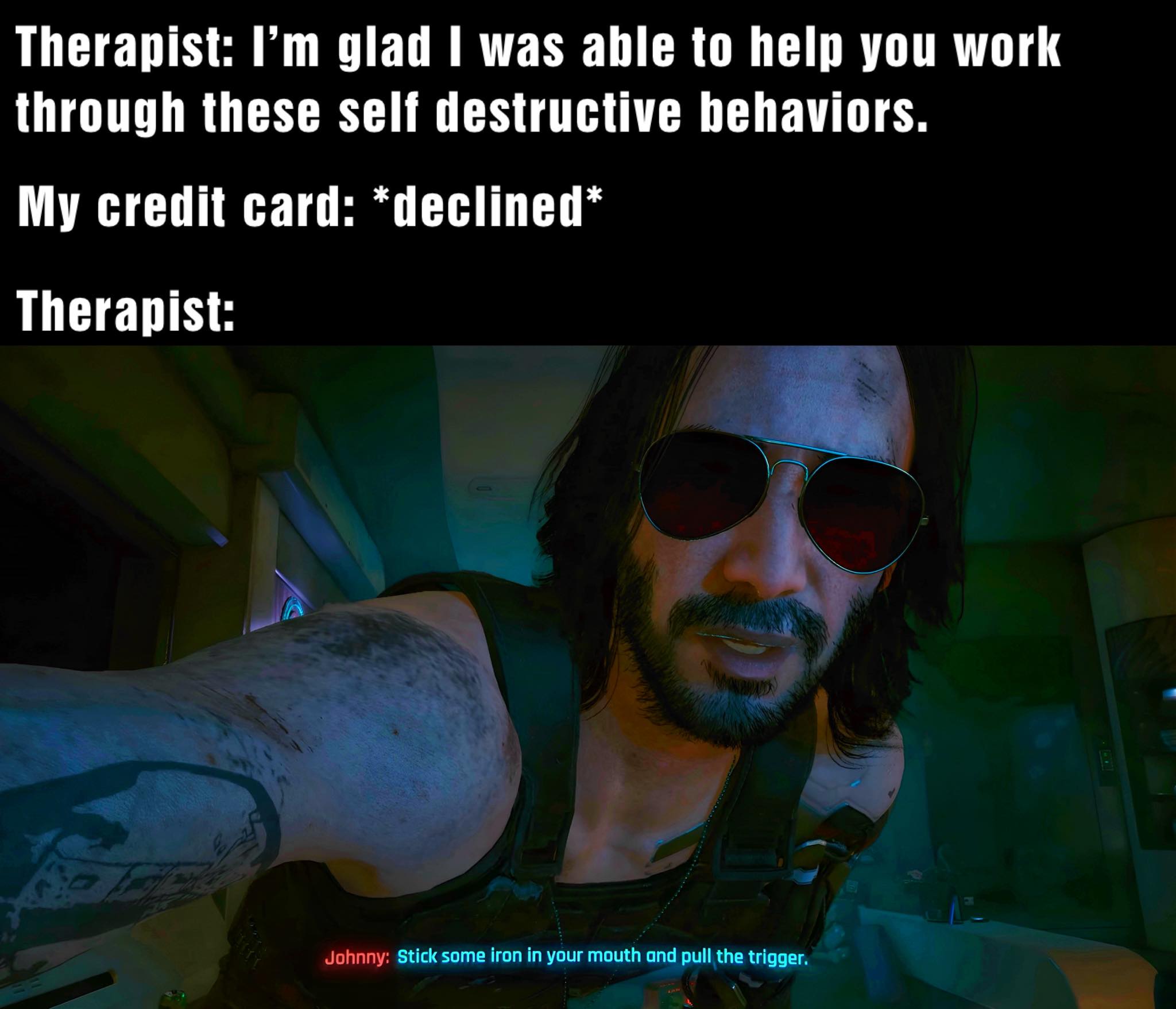
This meme plays on the idea that healthcare or counseling should always be "free at the point of use." Even though a therapist claims to have helped a person overcome destructive habits, their credit card is shown as declined, implying the services are so valuable they shouldn't need to be bought. The caption concludes with a bizarre instruction from a video game character to "stick some iron in your mouth and pull the trigger," suggesting that if therapy isn't an option, extreme violence is the alternative.
simple-description (llama3.2-vision_11b)
The meme is a humorous take on the frustration of dealing with a healthcare system that prioritizes profit over patient care. It features a character from the game Cyberpunk 2077, Johnny Silverhand, who is known for his sarcastic and confrontational personality. The image shows Johnny saying "You want a refund? I'll give you a refund... of your life!" in response to a patient's complaint about their healthcare experience. The meme is a commentary on the absurdity of the healthcare system and the frustration that patients often experience when dealing with medical professionals who are more concerned with profits than patient care.
detailed-analysis (gemma3-27b-vision)
Okay, let's break down this image and the text accompanying it through several theoretical lenses.
Visual Description
The image features a close-up shot of a man, strongly resembling Keanu Reeves, bathed in strong cyan and purple lighting. He's wearing sunglasses, has a stubbled beard, and is partially shirtless, revealing a tattoo on his arm. The lighting is high contrast, creating deep shadows and emphasizing his facial features. The background is blurred and industrial, suggesting an interior space with metallic structures. Below the man is text: “Johnny: Stick some iron in your mouth and pull the trigger.” Above the man are the words "Therapist: I’m glad I was able to help you through these self-destructive behaviors. My credit card: declined”. This suggests a darkly humorous scenario where therapy is inaccessible due to financial constraints while the subject suggests an extreme violent act.
Foucauldian Genealogical Discourse Analysis
This image resonates strongly with a Foucauldian analysis. The "Therapist" represents the discourse of mental health, the systems of knowledge and power that define "normal" behavior and attempt to "correct" deviance. The ironic "credit card declined" sharply undercuts this discourse.
- Power/Knowledge: The therapist's statement attempts to exert power through knowledge—the presumed expertise to address "self-destructive behaviors." However, the financial denial demonstrates a material power that overrides this "expert" power. The therapist's influence is contingent on economic access.
- Genealogy: Tracing the "genealogy" of this situation reveals how mental healthcare has become increasingly commodified—tied to economic factors rather than being a universally accessible right. The irony suggests a historical shift where care is available only to those who can afford it.
- Discipline & Normalization: Therapy aims to "normalize" behavior. But the image suggests that for many, normalization is impossible within the current system. The suggestion of suicide as an alternative highlights a failure of the disciplinary systems.
- Discourse of Violence: Johnny's quote introduces a counter-discourse of violence and self-destruction, juxtaposed against the therapist's attempt to manage it. This highlights the potential limitations of therapeutic intervention and the persistent presence of darker impulses.
Critical Theory
From a critical theory perspective, the image exposes the contradictions inherent in modern society.
- Commodification of Care: The "credit card declined" is a stark symbol of how even essential services like mental healthcare have been turned into commodities subject to market forces. It underscores the alienation of individuals from genuine care and the prioritization of profit over well-being.
- Repressive Reason: The therapist, representing the "rational" system of mental health, is rendered powerless by economic forces. This suggests a critique of “repressive reason”—the idea that systems claiming rationality can perpetuate injustice and inequality.
- Critique of Power Structures: The image challenges the assumption that institutional structures like therapy are benevolent or accessible to all. The financial barrier reveals the systemic limitations and reinforces the notion that social institutions are often complicit in perpetuating existing power imbalances.
Marxist Conflict Theory
A Marxist reading emphasizes the class conflict inherent in the image.
- Material Conditions: The "credit card declined" immediately highlights the material conditions that dictate access to care. Economic status, not psychological need, is the determining factor.
- Alienation: The image depicts the alienation of individuals from essential services due to the capitalist system's focus on profit. The therapist's inability to help due to a financial barrier underscores this disconnect.
- Ideology: The therapist’s statement can be seen as reinforcing a dominant ideology that frames "self-destructive behaviors" as individual failings. The image implies that the system is more responsible for such behaviors than the individual.
- Class Struggle: The inability to afford care illustrates a broader class struggle, where access to basic needs and services is unevenly distributed based on economic status.
Postmodernism
A postmodern reading focuses on the deconstruction of meaning and the fluidity of identity.
- Simulacra and Simulation: The therapy session itself could be seen as a simulacrum—a copy without an original. The therapist’s words lack substance because the financial barrier prevents genuine help. It is a performative act, not a substantive one.
- Deconstruction of Expertise: The "credit card declined" deconstructs the authority of the therapist. It undermines the idea that expertise is inherently valuable if it's inaccessible to those who need it most.
- Irony and Parody: The image relies heavily on irony and parody, subverting the traditional relationship between therapist and patient. The juxtaposition of the therapist’s compassionate words and the financial denial creates a darkly humorous commentary on the limitations of the system.
- Fragmented Identity: The character of Johnny, with his turbulent background and nihilistic suggestion, embodies a fragmented and unstable identity, reflecting the postmodern condition of self-construction and the loss of fixed meaning.
Queer Feminist Intersectional Analysis
This lens isn't as directly applicable, but it can still provide some interesting insights.
- Systemic Oppression: The image represents another layer of systemic oppression – financial barriers to mental health – intersecting with other forms of marginalization. Individuals facing multiple forms of discrimination (race, gender, sexual orientation, class) would be disproportionately affected by the inability to access care.
- Mental Health Disparities: Marginalized communities often face greater barriers to mental healthcare due to factors like poverty, discrimination, and lack of access. The image highlights the disproportionate impact of these barriers.
- Challenging Norms: The character of Johnny, with his rebellious persona, can be seen as challenging societal norms and expectations. His suggestion of violence, while extreme, can be interpreted as a form of resistance against oppressive systems.
- Deconstructing Power Dynamics: The image disrupts traditional power dynamics by exposing the limitations of professional authority. The financial barrier reveals that even those in positions of expertise are constrained by systemic forces.
It’s important to remember that these are just interpretations, and the image can be analyzed through many other lenses. The power of art lies in its ability to provoke thought and generate multiple meanings.
simple-description (llama3.2-vision)
This meme is a humorous image that combines a scene from a popular video game (Cyberpunk 2077) with a common online experience. The image shows Johnny Silverhand, a character from the game, reacting to a person's online behavior, specifically a credit card company's response to a declined transaction. The text at the top reads, "Therapist: I'm glad I was able to help you work through these self-destructive behaviors." The image below shows Johnny Silverhand's response, with the character's dialogue: "You're gonna need a bigger therapist."
tesseract-ocr
Therapist: I’m glad | was able to help you work Ly these self destructive behaviors. A credit card: *declined* Therapist: 4 “\. gre 2 os il + a ee <S . er | d a: : = a er ; Vs ae Rie: Se AL I |: i