First Seen
2023-09-16T01:07:13+00:00
simple-description (qwen3.5_2b-q8_0)
For someone who cannot see the graph, the meme suggests that the "Housing Cost Gap" has effectively closed for homeowners because the difference between their income and housing expenses has vanished. While the light blue line representing housing costs reached nearly 30% in 2009, the dark blue line representing income remained flat, proving that for this group, the financial stress of owning homes is minimal. The chart argues that instead of being trapped by predatory finance, owners have successfully balanced their budgets so that housing is no longer a commodity that drives social inequality.
simple-description (llama3.2-vision_11b)
The meme is a graph showing the widening gap between housing costs and income in the United States. The graph illustrates how housing costs have increased significantly since the 2000s, while income has not kept pace, leading to a growing wealth gap. The meme's text reads "The gap between housing costs and income is widening. In 2020, 1 in 5 renters in the US are cost-burdened, meaning they spend more than 30% of their income on housing."
detailed-analysis (gemma3-27b-vision)
Okay, let's break down this graph through several theoretical lenses. It's important to remember these aren't necessarily definitive interpretations, but explorations of what insights each framework can offer.
Visual Description
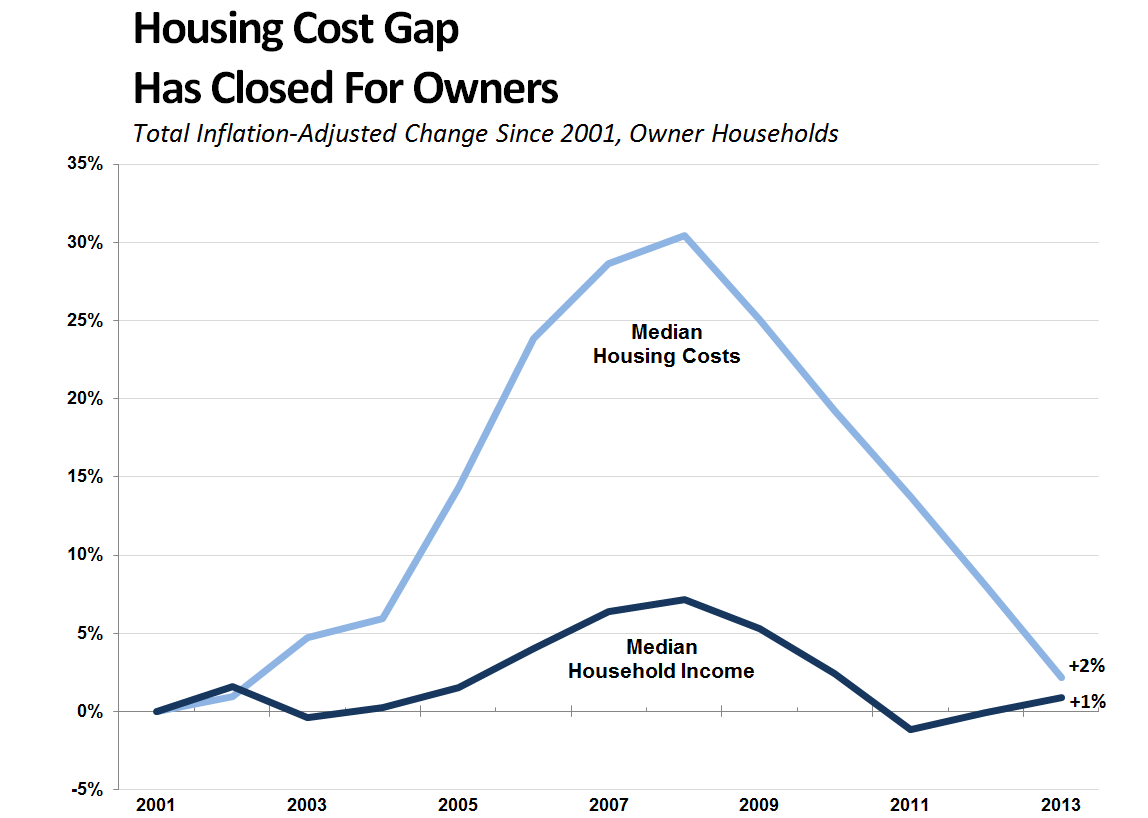
The graph presents a line chart tracking the percentage change in median housing costs and median household income from 2001 to 2013. Both lines start relatively flat around 2001. From 2003, median housing costs began to rise steadily, peaking at approximately 28-30% in 2007. Median household income sees a more moderate increase over this period, never exceeding 5%.
A significant divergence occurs between 2007 and 2011, with housing costs plummeting dramatically while income remains relatively flat. By 2011, the lines intersect. From 2011-2013, both lines rise but the graph ends before there is any clear change in trend. The graph indicates that the "gap" between housing costs and income has closed (housing costs fell back to align more closely with income) since 2001. Percentages of +1% and +2% are printed beside the final values for income and housing, respectively.
Marxist Conflict Theory
This graph strongly supports a Marxist interpretation centered around the commodification of housing and the inherent contradictions within capitalism.
- Commodification of Housing: The rising housing costs, particularly between 2003 and 2007, demonstrate how housing, a basic need, is treated as a commodity on the market. Profit maximization drives prices up, often detached from the actual cost of production or the ability of the working class to afford it.
- Exploitation and Surplus Value: The widening gap suggests an increasing extraction of surplus value from the population. As housing becomes more expensive, a larger portion of income must be allocated to shelter, leaving less for other necessities or investments, effectively benefitting those who own or control housing assets.
- Crisis of Overaccumulation: The crash of housing costs after 2007, coupled with stable income, can be seen as a symptom of overaccumulation. Capital was excessively concentrated in the housing market, creating a speculative bubble that ultimately burst, triggering a crisis. The graph is emblematic of how the inherent contradictions of capitalism (e.g., overproduction, underconsumption) create cyclical booms and busts.
- Class Struggle: The graph implicitly reveals a class struggle over access to essential resources. Those with capital (owners, investors) benefit from rising housing costs, while the working class experiences increasing economic hardship.
Foucauldian Genealogical Discourse Analysis
A Foucauldian approach wouldn’t necessarily focus on economic structures, but on the discourses that produced and legitimized the patterns shown in the graph.
- Discourses of Homeownership: Historically, homeownership has been constructed as a fundamental component of the "American Dream." This discourse creates a desire for ownership, making it a site of power and social control. The graph can be viewed through the lens of how this discourse was reinforced during the early 2000s, contributing to the rising housing prices.
- Financialization of Housing: The increasing complexity of the housing market (mortgage-backed securities, derivatives) represents a shift towards financialization. This involves the creation of new discourses and technologies of power, such as credit ratings and risk assessments, which shape access to housing.
- Governance of the Self: Homeownership has been linked to notions of self-sufficiency, responsibility, and the disciplined, entrepreneurial self. These discourses create expectations and norms that govern how individuals relate to housing and their financial well-being. The graph indicates how these discourses were disrupted by the housing crisis, revealing the vulnerabilities and precariousness of those who bought into them.
- Power/Knowledge: The graph reveals the power of knowledge and expertise in shaping the housing market. The rise and fall in prices was connected to the specialized knowledge of financial institutions, real estate professionals, and credit rating agencies, who often operated with little oversight or accountability.
Critical Theory
From a Critical Theory perspective, this graph reflects the workings of systemic domination and the reproduction of inequality.
- Systemic Inequality: The initial widening gap between housing costs and income reveals how structural factors contribute to inequality. The graph can be seen as a manifestation of broader patterns of class stratification, racial discrimination, and other forms of social injustice.
- Rationalization and Instrumental Reason: The increasing financialization of housing represents a form of rationalization, where social relations are increasingly governed by abstract rules and calculations. This process can lead to a loss of meaning and connection, as well as a disregard for human needs and values.
- Culture Industry and Ideology: The discourse of homeownership has been heavily promoted by the culture industry (media, advertising) to create a sense of desire and aspiration. This serves to reinforce dominant ideologies and obscure the underlying power relations that shape access to housing.
- Emancipation: The narrowing gap in later years might be seen as a temporary reprieve or a sign of resistance. Critical Theory calls for a deeper understanding of the forces that perpetuate inequality and a commitment to social transformation.
Postmodernism
A postmodern lens would focus on the instability of meaning, the fragmentation of experience, and the erosion of grand narratives.
- Deconstruction of the "American Dream": The graph challenges the traditional notion of the "American Dream" as a stable and attainable goal. The rise and fall of housing costs reveal the arbitrary and contingent nature of success, as well as the impossibility of achieving it for many.
- Simulation and Hyperreality: The graph can be interpreted as a sign of the increasing simulation of reality. Housing prices are driven by speculation and financial instruments that have little connection to the actual cost of building or maintaining homes.
- Fragmentation of Experience: The graph highlights the fragmented and precarious nature of modern life. Individuals are increasingly disconnected from traditional forms of community and social support, and are forced to navigate a complex and unpredictable housing market.
- Rejection of Metanarratives: Postmodernism rejects the idea of universal truths or grand narratives. The graph suggests that there is no single explanation for the rise and fall of housing prices, and that different interpretations are possible.
Queer Feminist Intersectional Analysis
This lens would highlight how the housing crisis disproportionately impacts marginalized groups, particularly LGBTQ+ individuals and women, and how these experiences are shaped by the intersection of multiple forms of oppression.
- Historical Exclusion: LGBTQ+ individuals and women have historically faced discrimination in housing markets, including redlining, denial of mortgages, and harassment. These patterns have contributed to wealth gaps and limited access to homeownership.
- Gendered Division of Labor: Women are more likely to be employed in low-wage jobs and bear the brunt of unpaid care work, making them particularly vulnerable to housing insecurity.
- Intersection of Race, Class, and Gender: Women of color are disproportionately affected by the housing crisis due to the combined effects of racism, sexism, and classism. They face higher rates of homelessness, eviction, and housing discrimination.
- Precarious Housing and Safety: LGBTQ+ individuals, particularly trans people of color, often experience higher rates of homelessness and face discrimination and violence in housing. Access to safe and affordable housing is essential for their well-being and survival.
- Challenges to the Nuclear Family Model: The traditional model of homeownership is often tied to the nuclear family, which can exclude LGBTQ+ families and single-parent households.
I hope this breakdown provides a comprehensive and nuanced analysis of the graph through various theoretical lenses. Let me know if you'd like me to expand on any of these points or explore additional perspectives.
simple-description (llama3.2-vision)
The meme is a graph showing the relationship between the inflation-adjusted change in median household income and the median household income since 1997. The graph has a dramatic spike in 2008, followed by a sharp decline, and then a steady increase. The text "2008" is written in the bottom right corner of the graph, but the rest of the text is not visible.
tesseract-ocr
Housing Cost Gap Has Closed For Owners Total Inflation-Adjusted Change Since 2001, Owner Households 35% 30% 28% Median Housing Costs 20% 15% 10% % Median Household Income 42% 0% ——“ eae 5% 2001 2003 2005 2007 2009 2011 2013