First Seen
2023-05-10T20:59:58+00:00
simple-description (llama3.2-vision_11b)
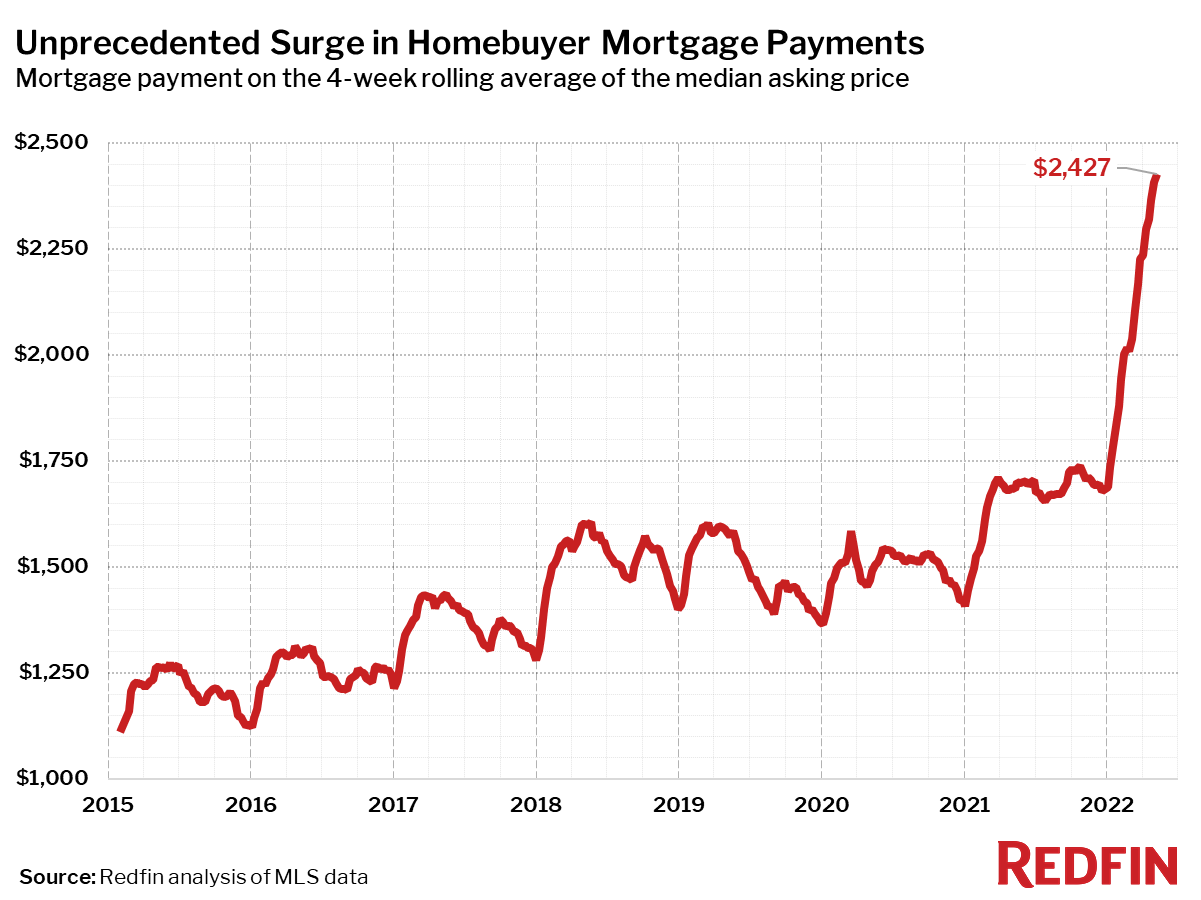
The meme is a graph showing a significant increase in the median home price in the United States, with a peak of $2,427 in 2022. The text "I'm not saying it's a housing bubble, but..." is likely a humorous commentary on the rapid increase in home prices, implying that the situation is becoming unsustainable. The graph's steep incline and the high median price are likely to be seen as a warning sign for a potential housing market collapse.
detailed-analysis (gemma3-27b-vision)
Okay, let's break down the provided chart ("Unprecedented Surge in Homebuyer Mortgage Payments") through the lenses you've requested. I'll include sections only where those theoretical frameworks genuinely apply, and will be fairly detailed.
Visual Description
The chart depicts the trend of mortgage payments (based on the 4-week rolling average of the median asking price) from 2015 to the end of 2022. The Y-axis represents the monthly mortgage payment in dollars, ranging from $1000 to $2500. The X-axis represents time, from 2015 to 2022.
The line generally trends upwards over the period. From 2015-2019, the fluctuations are relatively minor, hovering between roughly $1250 and $1700. A noticeable dip occurs around early 2020 (likely related to the pandemic's initial economic shock). However, from late 2020/early 2021 onwards, the line exhibits a much steeper upward trajectory. By the end of 2022, the mortgage payment has surged to $2427, marking a significant and unprecedented increase. The final portion of the line is very steep, indicating rapid acceleration in mortgage payments.
Foucauldian Genealogical Discourse Analysis
This chart is not merely a representation of economic trends; it’s a crystallization of discourses around homeownership, debt, and financial stability. A Foucauldian approach focuses on the power/knowledge nexus.
- The Discourse of Homeownership as the American Dream: For decades, the idea of owning a home has been constructed as a cornerstone of the American Dream. This discourse is not “natural,” but produced through historical, political, and cultural forces. This chart demonstrates how access to that ‘dream’ is increasingly difficult. It represents how the norms and expectations associated with housing (a form of ‘governmentalization’) have been historically imposed through regulations, tax incentives, and social messaging. The unprecedented rise in mortgage payments shows how this discourse is being reshaped by market forces and how this shift is often presented as inevitable, natural, or even positive, obscuring the power relations at play.
- The Normalization of Debt: The chart reveals the normalization of increasingly high levels of debt. The upward trend suggests that higher mortgage payments are becoming the "new normal," accepted as the price of entry into the housing market. This is a key example of a “pastoral power” – how we are managed as a population through norms and expectations.
- The Construction of “Risk” and “Affordability”: The very terms “affordability” and “risk” are discursively constructed. This chart visualizes a situation where the “acceptable” level of risk (taking on massive debt) and the definition of “affordable” have been subtly shifted.
- Power/Knowledge: The "source" (Redfin analysis) is critical. They are not merely presenting neutral data; they produce knowledge about the housing market, thereby influencing perceptions and potentially legitimizing existing power structures. The selection of the data points, the scaling of the chart, and even the language used to describe it all contribute to the construction of knowledge.
Marxist Conflict Theory
This chart strongly lends itself to Marxist analysis. It is a clear illustration of the inherent contradictions within capitalism and the resulting class struggle.
- Capital Accumulation and Housing as Commodity: Housing is treated not as a basic human need, but as a commodity, subject to the laws of supply and demand and driven by the pursuit of profit. The rising mortgage payments reflect the accumulation of capital by those who control the housing market – developers, banks, and investors. The benefit goes to those who own the means of production (housing), and the cost is borne by those who are forced to rent or buy (the proletariat).
- Exploitation & Surplus Value: The increasing financial burden on homebuyers represents a form of exploitation. Homeowners are compelled to devote a larger portion of their income to housing, which translates into less disposable income for other goods and services, effectively transferring wealth from the working class to the capitalist class.
- Class Polarization & Inequality: The chart highlights the growing gap between the "haves" and the "have-nots." The ability to afford a home is increasingly limited to those with significant financial resources, leading to a further concentration of wealth and power in the hands of a few. Those excluded from the housing market face increasing economic insecurity and social marginalization.
- The Role of Finance: The chart implicitly points to the role of financial institutions in exacerbating the crisis. Mortgage lenders and investors profit from the increasing demand for housing and the rising cost of debt. The financialization of housing has created a speculative bubble that is unsustainable and ultimately harmful to the majority of the population.
Postmodernism
A postmodern reading of this chart moves beyond the search for a single, overarching cause and embraces the idea of multiple, fragmented narratives and the deconstruction of grand narratives.
- The End of the “American Dream” Narrative: The chart can be seen as a visual representation of the fragmentation of the “American Dream” narrative. The steep increase in mortgage payments challenges the traditional belief that homeownership is accessible to all who work hard. It highlights the contingency of this dream—it’s not a universal truth but a historically constructed ideal that is increasingly out of reach for many.
- Simulacra & Hyperreality: The relentless marketing and media coverage of housing – idealized homes, "luxury" amenities – can be seen as creating a “simulacra,” a representation of reality that has become more real than the reality itself. The chart suggests that the pursuit of this simulacra is becoming increasingly unaffordable.
- The Loss of Meta-Narratives: Postmodernism rejects the idea of overarching, unifying narratives. This chart doesn't tell a single story of economic progress or decline; it illustrates a complex and fragmented reality shaped by multiple forces—globalization, financialization, demographic shifts, and technological change.
- The Subjective Experience of Affordability: What constitutes "affordable" is not objective, but constructed and experienced differently by each individual. This chart is a quantitative measure, but the impact is felt in the qualitative experiences of individuals struggling to keep up with rising costs.
Let me know if you'd like me to elaborate on any of these points or explore additional theoretical frameworks!
simple-description (llama3.2-vision)
This meme is a humorous illustration of the stock market's wild ride in 2022. The image shows a chart of the S&P 500 index, with a dramatic spike in the middle of the year, labeled "2022: When the market went from 'stable' to 'I need therapy'". The text "I need therapy" is written in a bold, playful font at the top of the chart, adding to the meme's lighthearted and humorous tone.
tesseract-ocr
Unprecedented Surge in Homebuyer Mortgage Payments Mortgage payment on the 4-week rolling average of the median asking price $2,500 $2,427 $2,250 $2,000 $1,750 $1,500 $1,250 $1,000 2015 2016 2017 2018 2019 2020 2021 2022 Source: Redfin analysis of MLS data REDFIN