First Seen
2023-08-07T19:51:06+00:00
simple-description (qwen3.5_2b-q8_0)
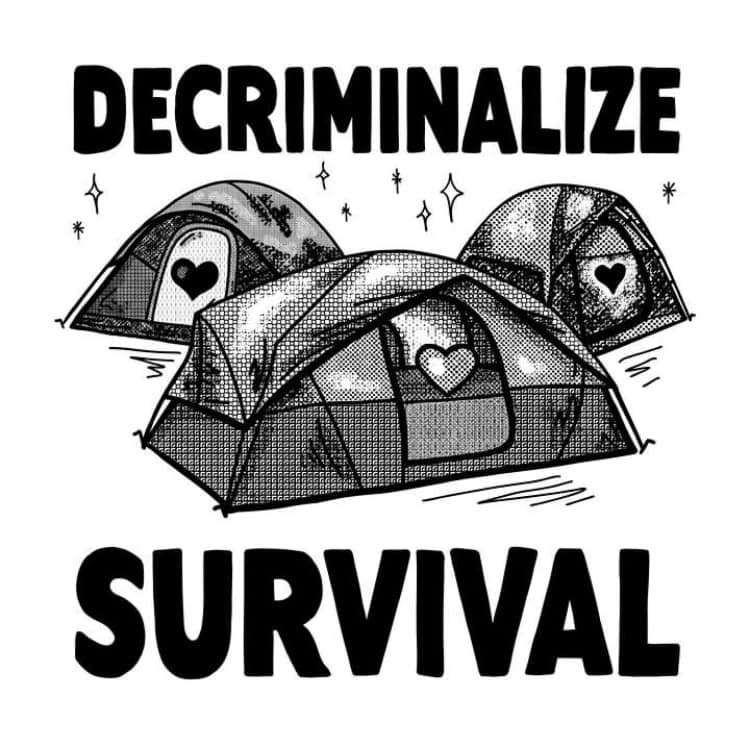
This black-and-white sketch shows three camping tents with hearts in the windows, along with a few small star marks. The text at the top reads "DECRIMINALIZE" and the word "SURVIVAL" appears at the bottom. This anti-capitalist meme argues that the government should stop treating people living in temporary shelters like tents as criminals, suggesting that their situation is a valid survival strategy rather than a punishable offense.
simple-description (llama3.2-vision_11b)
The meme is a humorous take on the idea of "decriminalizing" certain aspects of life, specifically in the context of housing and anti-capitalism. The image likely features a illustration of a tent or a small home, with the text "Decriminalize Housing" or a similar phrase, implying that the current laws and regulations surrounding housing are too restrictive and need to be reformed. The meme is poking fun at the idea that even the act of living in a tent or a small home is considered a crime, and is suggesting that this should be decriminalized.
detailed-analysis (gemma3-27b-vision)
Okay, let's break down this image through several theoretical lenses.
Visual Description
The image is a graphic design piece. It features a stylized drawing of three connected tents, depicted in a dotted, engraving-like style. Each tent has a heart symbol visible through its opening, creating a sense of shelter and vulnerability. The tents appear to be slightly askew, suggesting a precarious or unstable situation.
Above the tents, the word "DECRIMINALIZE" is boldly displayed in all caps. Below, the word "SURVIVAL" is presented similarly. The color palette is limited to black and white, giving the image a stark, impactful aesthetic. Sparkle effects surround the tents, creating a contrast between the hardship of “survival” and a glimmer of hope.
Foucauldian Genealogical Discourse Analysis
This image directly calls on the idea of "decriminalization," a key concept in Foucauldian discourse analysis. Foucault argued that the power to define what is criminal is not inherent to the act itself, but is constructed through discourse and power relations.
- Discursive Formation: The image seeks to challenge the “discursive formation” around homelessness, poverty, or marginalized populations. By asserting that "survival" shouldn't be a crime, it questions the norms and power structures that criminalize basic needs. The image implicitly asks how and why certain actions are defined as criminal, rather than simply accepting that definition.
- Power/Knowledge: The image suggests that the criminalization of survival functions as a tool of power. It implies that those in power define what is acceptable behavior to maintain control and marginalize certain groups. The linking of "decriminalize" and "survival" suggests that this is about challenging a system where simply existing can be treated as a transgression.
- Genealogy: A genealogical approach would trace the historical development of laws and societal norms that criminalize poverty and homelessness. How have these laws been constructed and justified over time, and what power dynamics underlie their creation? The image represents a desire to dismantle these historical formations.
Critical Theory
The image aligns with themes central to Critical Theory, particularly those related to social justice and emancipation.
- Ideology Critique: The image acts as an implicit critique of dominant ideologies that justify inequality and social control. The assertion that survival shouldn’t be criminalized challenges the notion that individuals are solely responsible for their circumstances. It suggests that systemic factors are at play, and that those in power benefit from maintaining the status quo.
- Emancipation: The image can be interpreted as a call for emancipation from oppressive systems. By advocating for decriminalization, it seeks to liberate individuals from the constraints of unjust laws and societal norms. The tents, representing basic shelter, become symbols of human dignity that shouldn’t be subject to legal scrutiny.
- The Social Construction of Reality: Like Foucault, Critical Theorists would emphasize that reality is socially constructed. The criminalization of survival isn’t a natural phenomenon, but a result of social and political choices.
Queer Feminist Intersectional Analysis
This image resonates with queer feminist intersectional analysis, particularly regarding marginalized communities and systemic oppression.
- Criminalization and Marginalized Groups: The image points to the fact that the criminalization of survival disproportionately affects already marginalized groups – people experiencing homelessness, people of color, LGBTQ+ individuals, disabled people, etc. These groups face multiple intersecting forms of oppression that create barriers to basic needs.
- Safety and Shelter: The tents represent a crucial need for safety and shelter. For many marginalized communities (especially LGBTQ+ youth), finding safe housing is a significant challenge. Criminalizing homelessness or camping further jeopardizes their safety.
- Intersectional Vulnerability: A queer feminist intersectional approach emphasizes that vulnerability isn't a universal experience. Individuals are vulnerable in different ways depending on their intersecting identities. The image indirectly acknowledges this complexity by suggesting that the very act of surviving is a struggle for many.
Marxist Conflict Theory
While not explicitly focused on class struggle, the image can be viewed through a Marxist lens.
- Systemic Inequality: Marxist theory emphasizes the inherent inequalities of capitalist systems. The image suggests that the criminalization of survival is a symptom of this inequality, where those without resources are punished for simply trying to meet their basic needs.
- Exploitation and Control: The criminalization of survival can be seen as a form of social control, used to maintain the power of the ruling class. By suppressing the basic needs of the marginalized, the system prevents them from challenging the status quo.
- Base and Superstructure: The image alludes to a disconnect between the "base" (economic production) and the "superstructure" (legal and ideological systems). If the economic system creates conditions of poverty and homelessness, the legal system shouldn’t then punish those affected by those conditions.
Let me know if you'd like me to elaborate on any of these points or explore other theoretical frameworks!
simple-description (llama3.2-vision)
The meme is a humorous illustration of a tent city, with multiple tents labeled with phrases like "Homeless", "Unemployed", and "Single Mom". The image is captioned "Decriminalize Survival" and features a tent labeled "Survival" in the center, with a heart symbol inside. The overall tone is lighthearted and satirical, poking fun at the idea of a "tent city" as a solution to societal problems.
tesseract-ocr
$ ‘ SN ; A> ba Ts * Fj, P77 pe) Pee Nien aa eS as