First Seen
2023-08-08T22:29:49+00:00
simple-description (qwen3.5_2b-q8_0)
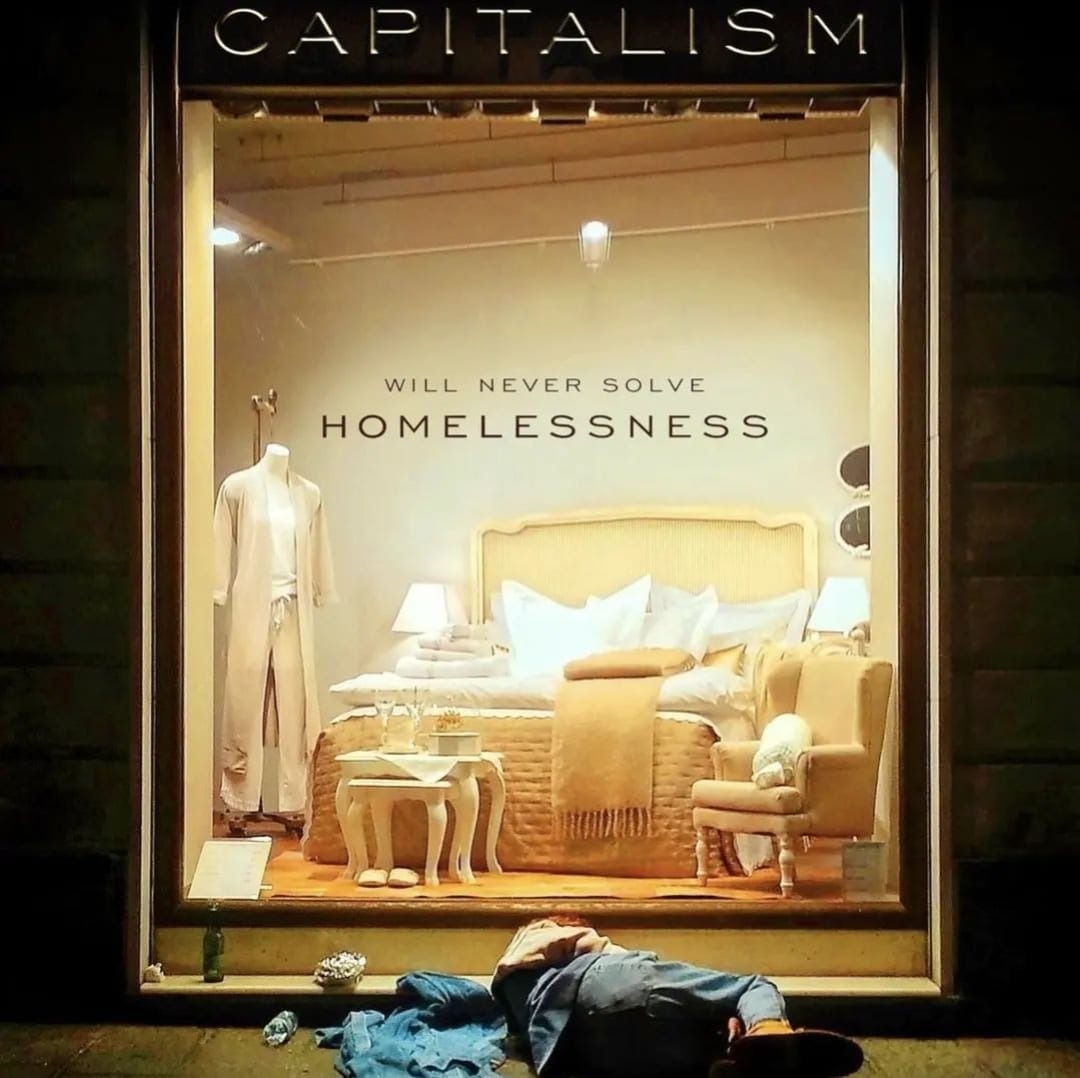
This meme humorously contrasts a luxury home store with a homeless person outside. Inside the window, a comfortable bed is displayed with the warning "WILL NEVER SOLVE HOMELESSNESS" on the wall, while a sign at the top reads "CAPITALISM". It satirizes the idea that a company selling the ultimate home can also claim that their business will never eliminate the problem of homelessness.
simple-description (llama3.2-vision_11b)
The meme is a play on the phrase "I can smell the desperation emanating from your posts" and applies it to a homeless person sleeping in front of a high-end furniture store. The text "I can smell the desperation emanating from your posts" is replaced with "I can smell the desperation emanating from your storefront" to highlight the irony of a luxury store being juxtaposed with homelessness. The image is a commentary on the stark contrast between the wealth and luxury of the store and the poverty and desperation of the homeless person.
detailed-analysis (gemma3-27b-vision)
Okay, here’s an analysis of the image, broken down into sections based on the theoretical frameworks you requested. I'll only include sections where the framework demonstrably applies to the image.
Visual Description
The image depicts a striking and stark contrast. A brightly lit shop window displays a carefully curated, aspirational domestic scene. A cream-colored bed with plentiful pillows dominates the view, suggesting comfort and luxury. Adjacent to the bed are comfortable armchairs and a small table. A mannequin in a relaxed, neutral-toned outfit stands near the bed, enhancing the illusion of inhabited domestic bliss. The window display is framed by a sign reading, “CAPITALISM WILL NEVER SOLVE HOMELESSNESS”. Below the window, on the sidewalk, a person is lying down, seemingly asleep or incapacitated, wrapped in a blanket and appearing to be unhoused. The photograph is taken at night, with the darkness emphasizing the contrast between the brightly lit shop and the person on the street. The composition positions the viewer as an observer of both worlds simultaneously.
Critical Theory
This image is a powerful example of how critical theory reveals the inherent contradictions within social systems. The display represents a manufactured desire—a lifestyle projected as attainable through consumerism—while the presence of homelessness immediately outside the window challenges that very notion.
The image exposes the constructed nature of "need" and "desire". Capitalism thrives on creating desires that are never fully satisfied, encouraging constant consumption. The pristine bed and comfortable furniture are not merely objects fulfilling a basic need for rest; they are symbols of status and belonging, designed to evoke a sense of lack in the viewer. The homeless person, lying exposed, represents the failure of this system to provide even the most basic needs.
The image challenges the notion of a "rational" economic system. Critical theory posits that systems often operate based on power dynamics and ideological structures that obscure the true costs and beneficiaries of the system. The contrast shown points to the inherent imbalance—the prosperity of a few built upon the marginalization of many.
Marxist Conflict Theory
The photograph embodies the central tenets of Marxist conflict theory. It showcases the stark class division inherent in capitalist society. The comfortable interior presented in the shop window represents the bourgeoisie (the owning class) and their ability to enjoy the fruits of labor. The person lying on the street represents the proletariat (the working class) who are exploited in the production process and, in this case, are left vulnerable and without basic necessities.
The image isn't merely a coincidence, but a symptom of the system. The surplus value extracted from labor is not distributed equitably, leading to a concentration of wealth and the creation of a class of people unable to participate in the consumer society promoted by the shop. The message on the window, "CAPITALISM WILL NEVER SOLVE HOMELESSNESS", can be interpreted as an acknowledgement of this inherent conflict—the very mechanism that creates wealth also perpetuates poverty.
The image visually represents the "means of production" (the store, the goods) being used to reinforce a system that creates an "underclass." The message suggests the system isn’t malfunctioning; it's functioning as designed, creating both abundance and deprivation.
Foucauldian Genealogical Discourse Analysis
From a Foucauldian perspective, the image isn't simply about an economic problem, but about the construction of power/knowledge. The window display isn't just about selling furniture; it’s about constructing a normative ideal of the "good life". It’s a discourse about domesticity, comfort, and belonging that implicitly defines those who do not fit that ideal (like the person on the street) as "other," "deviant," or even "invisible."
The image exemplifies how power operates through discourse. By presenting a specific lifestyle as desirable, the window display subtly reinforces existing power structures. The homeless person is not simply lacking a home; they are positioned as an “outside” to the discourse of domesticity, a reminder of the system’s failures, yet also rendered almost invisible by the stark contrast.
The message on the window itself participates in this discourse. It’s a statement that acknowledges the problem but doesn’t offer a solution, instead reinforcing a sense of inevitability. It's a power move—a claim of understanding and a simultaneous abdication of responsibility. The genealogical approach would ask how this discourse – the idea that homelessness is unsolvable within capitalism – has developed historically, and what power dynamics underpin it.
Postmodernism
The image can be interpreted through a postmodern lens as a disruption of grand narratives. The message "Capitalism will never solve homelessness" is a direct challenge to the traditional capitalist narrative of progress and universal prosperity. It deconstructs the myth that capitalism is a panacea for all social ills.
The juxtaposition of the window display and the homeless person creates a fragmented and unsettling image. The viewer is forced to confront the contradictions and inconsistencies of modern life. The image doesn’t offer a unified or coherent meaning, but rather encourages a critical and deconstructive approach to understanding social issues. It highlights the breakdown of traditional values and the rise of social fragmentation.
I hope this detailed analysis is helpful. Let me know if you would like me to expand on any of these points or explore other theoretical frameworks.
simple-description (llama3.2-vision)
The meme depicts a person lying on the ground outside a storefront with a sign reading "Capitalism" above the entrance. The storefront appears to be a high-end furniture store, with a lavish display of expensive-looking furniture. The text "Will never solve homelessness" is overlaid on the image, implying that the wealth and luxury on display are not addressing the issue of homelessness.
tesseract-ocr
Oe ay ee ee teh | ee ae er ee | | - P HOMELESSNESS | | qd me | . on i i Fi joc | | a | = mY il = Nii ital a, le