First Seen
2024-11-17T21:13:56.146398+00:00
simple-description (qwen3.5_2b-q8_0)
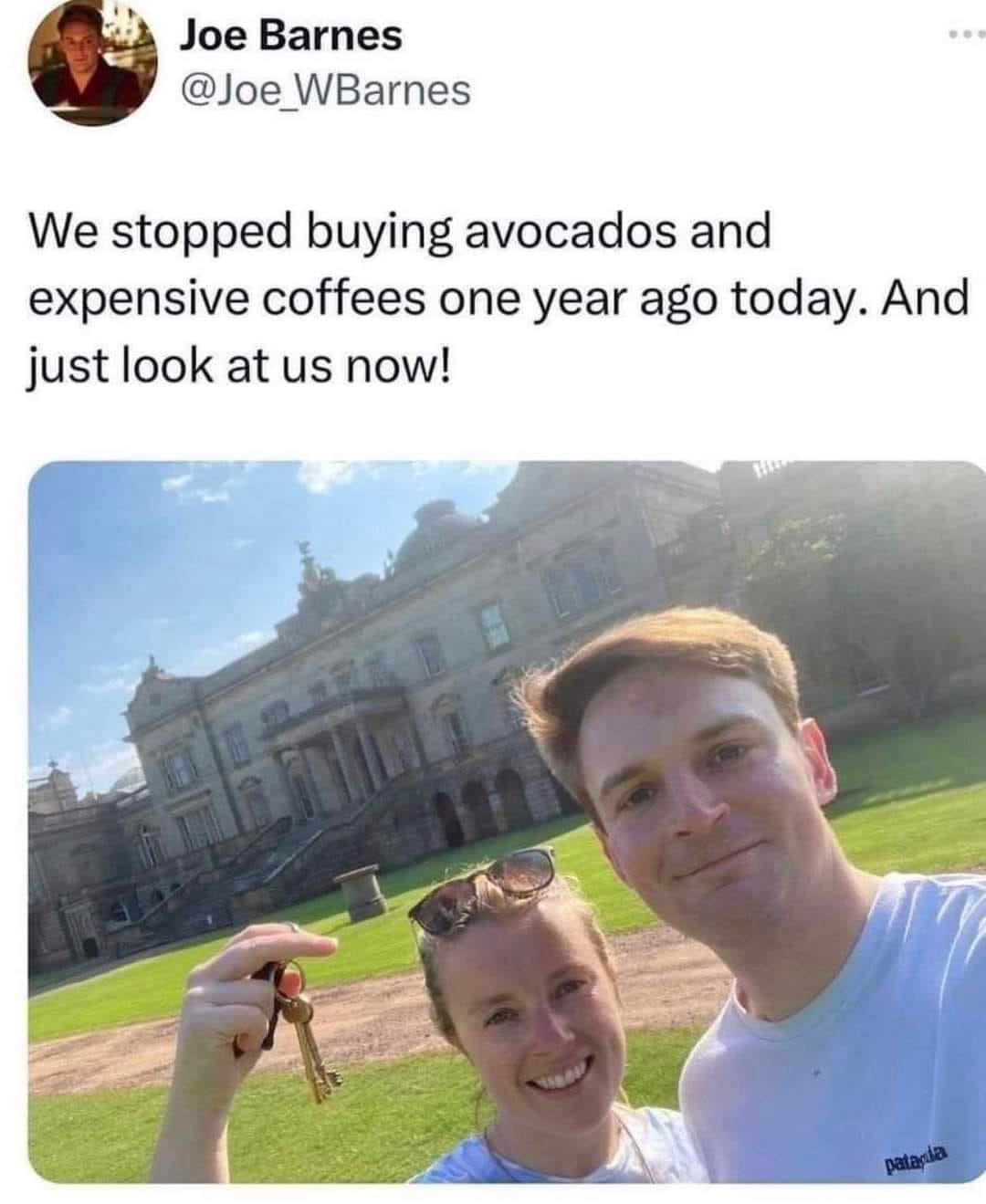
This meme satirizes the idea that buying a home is a massive financial victory that frees you from consumerism. The couple claims they stopped buying luxury items like avocados and expensive coffee because they bought a house one year ago today. The caption says: "We stopped buying avocados and expensive coffees one year ago today. And just look at us now!"
detailed-analysis (gemma3_27b-it-q8_0)
Okay, let's break down this meme from an Anti-Capitalism/Housing context, utilizing relevant theoretical frameworks.
Visual Description
The image shows two young, white individuals smiling broadly and holding a set of keys. They are positioned in front of a large, stately building, likely a house or a grand apartment building. Their clothing suggests a certain level of middle-class comfort (Patagonia shirt, sunglasses). The overall aesthetic is celebratory and suggests a recent achievement – the acquisition of property. The meme’s accompanying text states they stopped purchasing “avocados and expensive coffees” one year prior.
Marxist Conflict Theory
This meme is highly charged within a Marxist framework. It encapsulates a fundamental tension within capitalist society: the illusion of individual achievement masking systemic inequality. Here’s how it plays out:
- Commodity Fetishism: The meme highlights the absurdity of prioritizing avoiding "luxury" items like avocados and expensive coffee as a path to homeownership. Marx’s concept of commodity fetishism describes how we attribute intrinsic value to objects (like avocado toast), obscuring the exploitative labor processes that produce them and the broader structural issues that make housing unattainable. The meme appears to suggest individual sacrifice (giving up a latte) as the key to success, ignoring the real barriers.
- Class Privilege: The image implicitly reveals class privilege. The ability to even consider saving money by forgoing these relatively small purchases hinges on a baseline of economic stability. Many people don’t have that choice; they’re already struggling to afford basic necessities. The meme is tone-deaf in this regard. The assumption that "anyone can do this if they just try harder" is a core tenet of justifying capitalist inequalities.
- Housing as a Commodity: The meme centers around the acquisition of housing - which in a capitalist system, is treated as a commodity to be bought and sold for profit, rather than a fundamental human right. The meme reinforces this commodification, celebrating participation in a system that creates scarcity and unaffordability.
- False Consciousness: The couple seem to display a “false consciousness”, believing their individual choices led to this success, instead of recognizing the structures of wealth and power that allowed it to occur. They aren’t acknowledging how wealth accumulation benefits from an exploitative system.
Critical Theory
From a Critical Theory perspective, this meme is revealing in how it normalizes and reinforces capitalist ideologies.
- Ideology Critique: The meme exemplifies the power of ideology to shape our perceptions of success and failure. The idea that austerity (avoiding small pleasures) is the path to financial security serves the interests of capital by encouraging individual responsibility and minimizing demands for systemic change.
- Hegemony: It represents a hegemonic view – a dominant worldview that's accepted as natural and common sense. The narrative of individual thrift leading to homeownership is widely circulated and upheld.
- The Rationalized Life: Critical Theory often addresses how modern life is increasingly “rationalized” – measured and optimized for efficiency and productivity. The meme suggests aligning with this rationalized life (calculating every expense) in order to “succeed”.
- Domination and Control: The meme subtly reinforces the dominance of financial logic in modern life. Our desires and pleasures are framed as obstacles to our ultimate goal of achieving financial security (and, in this case, property ownership).
Foucauldian Genealogical Discourse Analysis
Applying Foucault, we can analyze how the discourse around personal finance and "lifestyle choices" constructs subjects and regulates behavior.
- Power/Knowledge: The meme is embedded in a “power/knowledge” regime where discourses about saving, budgeting, and self-discipline (fueled by financial influencers, media, and institutions) operate as forms of power. These discourses define what is considered "responsible" and "successful".
- Subjectivation: The couple have subjectivated themselves into this discourse. They have internalized the norms and expectations of a system that equates financial security with self-worth. Their identity is now tied to their achievement of homeownership through disciplined consumption.
- Genealogy: Looking at the history of this discourse, Foucault would trace the emergence of the idea that personal responsibility is the primary driver of financial success. This wasn’t always the dominant view, but it has become increasingly powerful alongside neoliberal economic policies.
Postmodernism
From a postmodern viewpoint, the meme reveals the constructed nature of reality and the instability of meaning.
- Simulacra and Simulation: The image could be interpreted as a “simulacrum” – a copy without an original. It’s a performance of success based on a pre-defined (and arguably artificial) set of criteria. The “authentic” experience of homeownership is replaced by a staged image.
- Deconstruction of Grand Narratives: The meme implicitly challenges the “grand narrative” of the American Dream (working hard = achieving homeownership). However, it does so in a way that ironically reinforces the narrative by showcasing apparent success.
- Irony and Sincerity: The meme operates on a level of irony (highlighting the absurdity of the sacrifices), but it also carries a degree of sincerity (the couple genuinely seem proud of their achievement). This blurring of irony and sincerity is a hallmark of postmodern culture.
In summary, the meme is not simply a celebratory announcement of a couple’s success. It’s a complex cultural artifact that embodies and reinforces the ideologies, power structures, and discourses that underpin capitalist inequalities, particularly in the realm of housing. It is a powerful example of how even seemingly innocuous content can be analyzed through a critical lens to reveal deeper socio-political dynamics.
simple-description (llama3.2-vision_11b)
The meme is a humorous commentary on the struggles of young adults in the housing market. It features a photo of a couple holding up a set of keys, implying they've finally bought a home, but with a tongue-in-cheek caption that highlights the absurdity of their financial priorities. The text reads: "We stopped buying avocados and expensive coffee one year ago... and just bought a house!"
detailed-analysis (gemma3-27b-vision)
Okay, let's break down this Twitter post and image through the requested theoretical lenses. It's a surprisingly rich example for such a seemingly simple image!
Visual Description
The image features two young, white men standing in front of what appears to be a grand, stately home or university building (likely in the UK given the architecture). The man on the left is smiling broadly, holding a large, ornate key. The man on the right is also smiling, although his expression is more restrained. He is wearing a Patagonia t-shirt. Both are casually dressed. The background is somewhat blurred, focusing attention on the men and the key. The overall impression is celebratory and suggests a recent acquisition of something significant – likely a property. The image is intentionally presented in a bright, cheerful, and slightly aspirational style.
Foucauldian Genealogical Discourse Analysis
This post and image offer an interesting example of how discourses surrounding self-improvement and lifestyle optimization have evolved. A Foucauldian genealogical approach would look at the historical construction of the “good life” and how it's linked to power dynamics.
- Discipline & Normalization: The post implies a narrative of "responsible" behaviour leading to reward (owning property). The act of refraining from “luxuries” (avocados, expensive coffee) is presented as a discipline. This discipline aligns with broader societal expectations of financial responsibility and the "deserving" subject. The image reinforces the normalization of homeownership as a sign of success.
- Power/Knowledge: The "knowledge" that cutting out small indulgences leads to larger gains (like buying property) is not neutral. It’s a specific way of framing success that benefits certain individuals (those who already have a level of privilege). This knowledge circulates within a discourse of self-help and financial advice, reinforcing the power structures that make property ownership inaccessible to many.
- Genealogy: Tracing the historical roots of this narrative reveals how the idea of "delayed gratification" and "responsible spending" have been linked to Victorian values of thrift, self-reliance, and social respectability. These values have morphed and adapted, but the core principle remains: sacrifice immediate pleasures for long-term gain, thereby aligning with expectations and potentially “earning” social approval.
Critical Theory
From a Critical Theory perspective, this post can be viewed as a reinforcement of dominant ideologies.
- Ideology & False Consciousness: The narrative that abandoning “luxuries” leads to the attainment of property presents a simplified and potentially misleading view of wealth accumulation. It obscures the systemic factors (wealth inequality, housing crisis, lack of social mobility, inherited wealth) that make homeownership difficult for many. It promotes the idea that individual choices are the primary drivers of success, masking the structural barriers faced by others. The tweet subtly suggests that anyone could achieve the same outcome with enough self-discipline.
- Commodification: The “luxuries” of avocados and expensive coffee are presented as disposable items, which is emblematic of consumer culture and the constant pressure to optimize one’s life. This framing serves to reinforce the commodification of even basic pleasures, and encourages a constant cycle of desiring and abstaining.
- Social Control: The message inadvertently implies that those who continue to enjoy these “luxuries” are somehow less responsible or less deserving of success, subtly exerting social control by reinforcing norms around consumption and financial behaviour.
Marxist Conflict Theory
From a Marxist lens, the post highlights class dynamics and the illusion of social mobility.
- Class Reproduction: Property ownership remains a primary means of accumulating and transferring wealth across generations. This post reinforces the notion that achieving this goal is attainable through individual effort, obscuring the fact that access to capital and inherited wealth play a significant role. It perpetuates a system where the ruling class (property owners) maintain their power and privilege.
- False Consciousness: The message promotes a “meritocratic” myth—the idea that success is based solely on individual effort and talent—which masks the fundamental class conflict inherent in capitalist societies. It encourages individuals to blame themselves for their lack of success rather than challenging the systemic structures that create inequality.
- Commodity Fetishism: The key, a symbol of property ownership, is presented as a desirable object in itself, rather than recognizing it as a product of complex economic and social relations. This obscures the exploitation and labor that went into creating the property and perpetuates the illusion that wealth is created through individual ingenuity.
Postmodernism
A postmodern reading emphasizes the constructed nature of meaning and the fragmentation of grand narratives.
- Simulation & Hyperreality: The image itself can be seen as a “simulation” of success, a carefully curated representation of a desirable lifestyle. The celebration of property ownership is divorced from the realities of debt, maintenance, and the broader housing crisis. It is a hyperreal image—a copy without an original—that reinforces a particular set of values.
- Deconstruction of Narratives: The seemingly simple narrative of "sacrifice leading to reward" can be deconstructed to reveal its inherent contradictions and power dynamics. The act of abstaining from “luxuries” is presented as a purely rational economic decision, ignoring the emotional and cultural significance of these items.
- Subjectivity & Fluidity: The post implicitly suggests a fluid and subjective understanding of success. The men are defining success on their own terms (owning property), but this definition is shaped by broader cultural norms and expectations.
Queer Feminist Intersectional Analysis
This area is where the analysis becomes a little more speculative, as the image doesn’t explicitly lend itself to these categories. However, we can still explore potential intersections.
- Privilege & Access: The ability to abstain from small luxuries and save for a down payment on a property inherently relies on a certain level of privilege. This privilege is likely intertwined with factors such as race, class, gender, and sexual orientation. It’s important to acknowledge that not everyone has the same access to economic resources or the same opportunities to accumulate wealth.
- Heteronormative Assumptions: The image of a male couple owning a home implicitly reinforces heteronormative ideals of stability and domesticity. While positive representation is valuable, it’s important to recognize that not everyone desires or has access to this traditional lifestyle.
- Intersectionality of Financial Precarity: Individuals who hold multiple marginalized identities (e.g., queer people of color, disabled women) may face unique barriers to financial stability and homeownership. The message of “cutting out luxuries” may be particularly insensitive or unrealistic for those who are already struggling to meet basic needs.
Important Note: This is just one interpretation of the image and post. Different theoretical frameworks will yield different insights. The key is to critically examine the image and its underlying assumptions, and to consider the broader social, economic, and political contexts in which it is situated.
simple-description (llama3.2-vision)
This meme is a humorous commentary on the current state of the world. It features a photo of a couple holding up a set of keys, with a caption that reads: "We stopped buying avocado and expensive coffee one year ago. And just look at us now!" The image is likely a joke about the couple's financial stability, implying that they've made significant progress in their lives.