First Seen
2023-12-17T06:04:27+00:00
simple-description (qwen3.5_2b-q8_0)
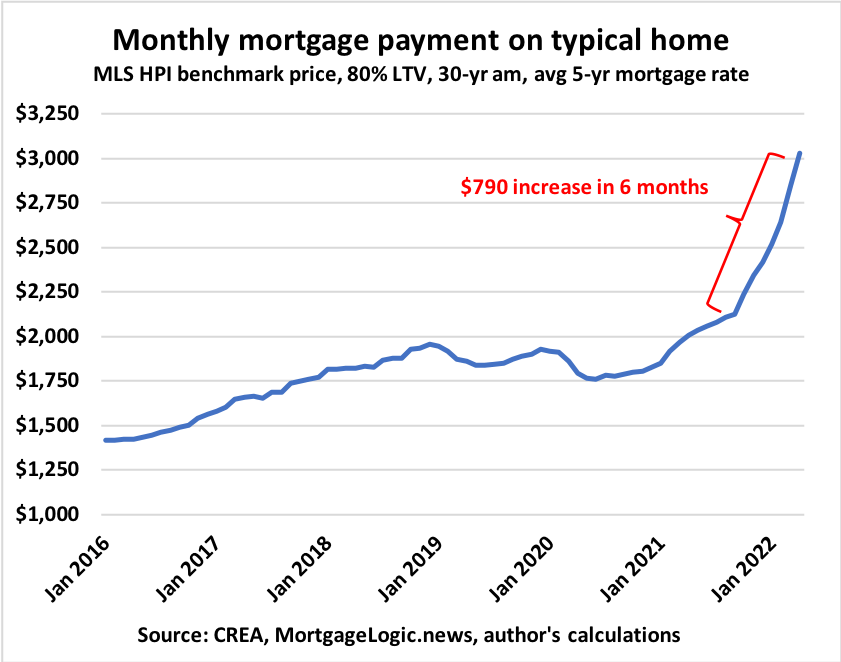
This meme illustrates the concept of "Ante-Rent Control," where housing prices rise so aggressively that monthly payments become unaffordable even without rent control laws. The graph shows a period of stability before the market crashes into exponential growth, highlighting how the average borrower is left with impossible monthly bills. It specifically points out how the monthly cost jumped by $790 in just six months, illustrating how high interest rates and speculative prices exploit the housing market.
simple-description (llama3.2-vision_11b)
The meme is a graph showing the average monthly mortgage payment in the United States, with a red line indicating the 2022 increase to $2,700. The meme is a commentary on the rising cost of housing and the burden of mortgage payments, often associated with anti-capitalist ideologies that critique the exploitation of the working class by capitalist systems.
detailed-analysis (gemma3-27b-vision)
Okay, here's an analysis of the provided graph of monthly mortgage payments, viewed through the requested theoretical lenses. I'll include sections only where the lens is applicable and useful. Given the data presented, certain perspectives will be more prominent than others.
Visual Description
The graph displays the trend of monthly mortgage payments on a typical home (based on MLS HPI benchmark price, 80% Loan-to-Value ratio, 30-year amortization, and average 5-year mortgage rate) from January 2016 to January 2022. The x-axis represents time (years and months) and the y-axis represents the monthly mortgage payment in USD.
- Overall Trend: The graph shows a generally upward trend in monthly mortgage payments from 2016 to 2020, with some fluctuations. However, a dramatic and steep increase begins in late 2021 and continues into early 2022. This increase is highlighted by a red line and annotation indicating a "$790 increase in 6 months".
- Key Observations:
- From 2016-2020, the increase is gradual and relatively smooth.
- There is a dip in payments during 2020, likely due to lowered interest rates as a response to the pandemic.
- The sharp increase in 2021-2022 is significantly more dramatic than any previous fluctuation.
- The graph suggests that housing affordability is significantly declining.
Foucauldian Genealogical Discourse Analysis
This graph can be analyzed through a Foucauldian lens by examining the discourse surrounding homeownership, debt, and financialization. Foucault's genealogy traces the historical emergence of power/knowledge formations.
- Power/Knowledge: The graph is not just about numbers; it represents the production of truth about housing affordability. The data are constructed through specific measurement techniques (HPI, LTV, amortization). These methods themselves reflect underlying assumptions and power dynamics. The "typical home" is itself a statistical construct, potentially obscuring the realities of diverse housing markets and needs.
- Disciplinary Power: The normalization of homeownership as a marker of success and stability is a form of disciplinary power. The expectation to accumulate debt to achieve this "success" shapes individual behavior. The graph illustrates how this normalization has become increasingly challenging, potentially leading to increased anxiety and precarity. The rise in payments are not just economic data, but a force that disciplines access to the "American Dream".
- Financialization: The graph clearly depicts the increasing financialization of housing. Housing is not simply a shelter but an asset to be bought, sold, and speculated upon. The dramatic increase in mortgage payments reflects the influence of financial markets and interest rate policies. It can be read as the result of a “regime of truth” promoting the idea that housing is an investment and thus subject to market fluctuations.
- Genealogical Trace: Examining the history of mortgage practices (e.g., the rise of subprime mortgages, adjustable-rate mortgages) would reveal how the current situation is not accidental but the result of specific historical developments.
Marxist Conflict Theory
The graph is readily interpretable through a Marxist lens, centering on class conflict and the exploitation inherent in the capitalist mode of production.
- Capital Accumulation: The increasing mortgage payments represent a transfer of wealth from wage earners (those paying the mortgages) to financial institutions (banks, lenders). This is a key mechanism of capital accumulation for the capitalist class.
- Commodification of Housing: Housing, a basic human need, is treated as a commodity to be bought and sold for profit. The increasing cost of housing exacerbates class inequalities and makes it more difficult for the working class to access decent living conditions.
- Exploitation of Labor: The graph demonstrates how the cost of living (housing) is increasing faster than wages, potentially squeezing the working class. This intensifies the exploitation of labor, as workers must work longer and harder to afford basic necessities.
- Capitalist Crisis: The steep increase in mortgage payments could be interpreted as a symptom of a broader capitalist crisis, characterized by financial instability and increasing inequality.
- Class Conflict: The graph illustrates how the interests of the working class (affordable housing) are in direct conflict with the interests of the capitalist class (maximizing profits). The data points to a growing divide between those who own capital and those who must rely on wage labor.
Critical Theory
Critical Theory moves beyond merely describing the problem to expose the systemic structures that perpetuate inequality and domination.
- Ideology: The "American Dream" of homeownership is a powerful ideology that obscures the material realities of housing inequality. The graph challenges this ideology by demonstrating how homeownership is becoming increasingly inaccessible for many.
- Rationalization & Bureaucratization: The financial instruments (mortgages, interest rates) that drive the trends in the graph represent the rationalization and bureaucratization of everyday life. These systems, while seemingly objective, are based on specific values and priorities that may not be universally shared.
- Domination: The increasing cost of housing represents a form of domination, as individuals are forced to allocate a larger portion of their income to shelter, limiting their agency and freedom.
- Commodification of Life: The graph points to the broader trend of commodification, where increasingly aspects of life (housing, healthcare, education) are treated as commodities to be bought and sold for profit.
- Systemic Critique: A critical theorist would argue that the problem is not simply a lack of affordable housing but a systemic issue rooted in the capitalist mode of production and the dominant ideology of consumerism.
Postmodernism
A postmodern reading would deconstruct the seemingly objective "truth" of the data and focus on the instability of meaning.
- Deconstruction of "Typical": The concept of a "typical home" is a simplification, a construct. The graph fails to capture the diversity of housing markets and individual circumstances. The "typical" is a power play, a normalization.
- Fragmentation & Instability: The dramatic fluctuations in mortgage payments demonstrate the instability of the housing market and the lack of any fixed or foundational truth.
- Simulacra & Hyperreality: The graph could be seen as a simulacrum, a representation of reality that has become detached from the real. The numbers may feel more "real" than the actual experience of housing insecurity.
- Narrative & Discourse: The story told by the graph is just one of many possible narratives. Other perspectives (e.g., from renters, marginalized communities) are marginalized.
- Relativism: The graph is not necessarily a "bad" thing. It’s a snapshot in time, and its meaning is contingent on the observer's perspective.
Important Considerations:
- Limitations of the Data: The graph is based on specific data and methodologies. It's important to acknowledge the limitations of the data and potential biases.
- Intersectionality: A truly comprehensive analysis would consider how factors such as race, gender, and class intersect to shape housing experiences.
Let me know if you'd like me to expand on any of these analyses or explore other theoretical perspectives.
tesseract-ocr
Monthly mortgage payment on typical home MLS HPI benchmark price, 80% LTV, 30-yr am, avg 5-yr mortgage rate $3,250 $3,000 $2,750 $790 increase in 6 months $2,500 $2,250 $2,000 $1,750 $1,500 $1,250 $1,000 Ss Sg gr BP gr gt s * s * * s s Source: CREA, MortgageLogic.news, author's calculations
simple-description (llama3.2-vision)
This meme is a graph showing the monthly mortgage payment for a $200,000 home, with a significant increase in 2022. The text "Inflation: 1.7%, Mortgage Interest Rates: 5.3%" appears above the graph, and "Inflation: 1.7%, Mortgage Interest Rates: 5.3%" is also written in the bottom left corner. The graph shows a steady increase in mortgage payments, but the 2022 line is a sharp spike, indicating a significant increase in mortgage interest rates.