First Seen
2023-05-10T21:03:33+00:00
simple-description (llama3.2-vision_11b)
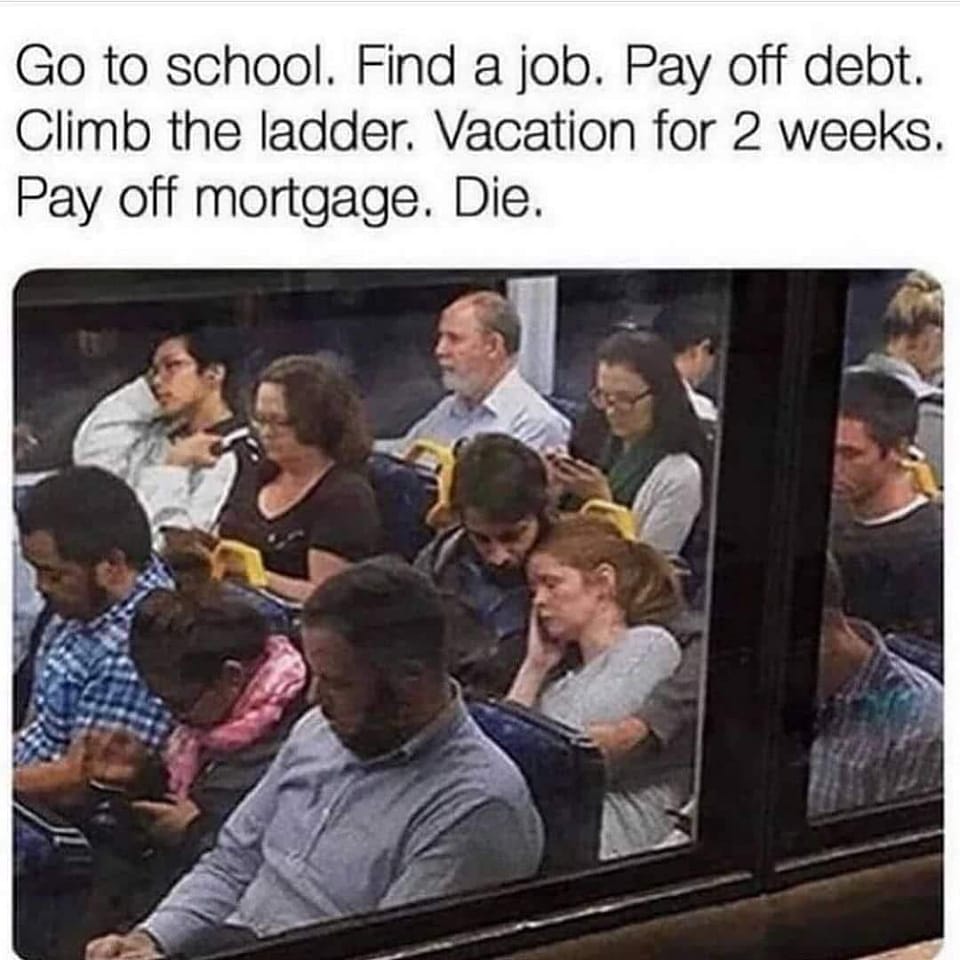
The meme is a satirical commentary on the monotony and drudgery of modern life, particularly in the context of a 9-to-5 job. The text above the image lists a series of mundane and oppressive tasks, culminating in a final and brutal "die" that suggests the exhaustion and despair of a life lived in servitude.
detailed-analysis (gemma3-27b-vision)
Okay, here's an analysis of the image and text, broken down into relevant theoretical lenses. It’s a strong, cynical meme, and many lenses do apply, so it's a bit lengthy.
Visual Description
The image depicts a crowded public transport setting – likely an airplane cabin or a train car. People are seated in rows, looking exhausted, defeated, and generally devoid of joy. Their postures are slumped, faces are grim, and many are staring blankly or are lost in their phones. The lighting is somewhat dull, contributing to a feeling of dreariness. The overall aesthetic is one of confinement, monotony, and a sense of collective fatigue. The people depicted are racially diverse. The meme's text is placed above the image, creating a jarring contrast between the aspirational yet bleak instructions and the somber visual.
Foucauldian Genealogical Discourse Analysis
This meme is powerfully illustrative of Foucault’s concepts of discipline and biopower. The text outlines a trajectory of societal expectations – “go to school, find a job…” – that function as a discourse. This discourse isn't simply a set of instructions; it's a system of knowledge and power that constructs subjects. We are made into the subjects expected to follow this path.
The sequence itself maps onto the normalization of behaviors and the creation of “docile bodies.” The emphasis on productivity (school, job, paying off debt) reflects a modern obsession with optimization and control. The "climb the ladder" component is a particularly strong metaphor for hierarchical structures and the performance of labor within them.
The stark ending, "Die," is crucial. It’s not necessarily a statement of suicidal ideation but, rather, a cynical recognition that this relentless pursuit of societal goals consumes life. It suggests that even achieving these goals doesn’t lead to genuine fulfillment, but instead to an exhaustion that negates the value of life itself. It exposes the effects of power—the draining of vitality—rather than an intentional act of oppression. Foucault would examine how this narrative has been historically constructed and maintained, and how it functions to regulate our lives.
Critical Theory (Frankfurt School)
The meme resonates strongly with Critical Theory, particularly the themes of instrumental reason and reification. The text presents life as a purely instrumental process – everything is geared towards achieving external goals (debt repayment, mortgage completion). There is little room for intrinsic joy, self-actualization, or qualitative experience. Life becomes a means to an end, rather than an end in itself.
The sequence can be seen as an example of reification – the treating of abstract concepts (success, wealth, societal norms) as concrete realities. The expectation to follow this path becomes treated as an immutable law, blinding individuals to alternative possibilities. This leads to alienation – individuals become estranged from their own potential and their own lives, becoming cogs in a larger, impersonal system.
The ending, "Die," highlights the ultimate dehumanization inherent in this system. It’s a critique of a society that prioritizes economic productivity over human well-being. The meme is a lament for a lost sense of meaning and purpose.
Marxist Conflict Theory
From a Marxist perspective, this meme is a concise expression of the alienation and exploitation inherent in capitalism. The sequence – school, job, debt, mortgage – is the lifecycle of a worker caught in the capitalist system. Education is often seen as preparing individuals to become wage laborers. The "job" is the source of exploitation, where workers produce value for others while receiving only a portion of that value in the form of wages.
Debt and mortgages are mechanisms of control. They bind individuals to the system, forcing them to continue working to satisfy financial obligations. The "climb the ladder" metaphor emphasizes the competitive, hierarchical nature of capitalist society, where individuals are constantly striving for upward mobility but often remain trapped in cycles of work and consumption.
The finality of "Die" suggests the ultimate consequence of this exploitation – a life consumed by labor with little opportunity for genuine fulfillment. It is an indictment of a system that prioritizes profit over human life. The meme illustrates the inherent conflict between the interests of the working class and the ruling class.
Postmodernism
A postmodern reading would emphasize the deconstruction of grand narratives. The text presents a seemingly straightforward, linear path to success, but the image undercuts this narrative. The exhausted faces and grim expressions reveal the emptiness and disillusionment that often lie beneath the surface.
The meme challenges the idea of a fixed, objective truth. It suggests that the "success" promised by this path is merely a social construct – a narrative imposed by dominant power structures. The cynicism and irony inherent in the meme are characteristic of postmodern thought.
The juxtaposition of text and image creates a sense of fragmentation and ambiguity. There is no easy resolution, no clear meaning. It’s a commentary on the loss of faith in traditional values and institutions.
Queer Feminist Intersectional Analysis
While not the primary focus, an intersectional lens adds another layer of meaning. The meme implicitly highlights how this “standard life path” is often prescribed through heteronormative and patriarchal structures. The pressure to conform to this sequence (school-job-debt-mortgage) is often amplified for those who do not fit into traditional gender roles or sexual orientations.
For example, women, particularly women of color, often face greater economic challenges and systemic barriers to success, making the burden of debt and the pressure to climb the ladder even more acute. LGBTQ+ individuals may face discrimination in the workplace and limited access to economic resources, further complicating their ability to follow this prescribed path.
The meme can be read as a critique of how these systemic inequalities reinforce the cycle of exploitation and exhaustion. The exhaustion in the image isn't simply a result of hard work; it’s a result of constantly navigating and resisting oppressive structures. The ending, "Die," could be seen as a metaphor for the ways in which these structures can literally and figuratively "kill" the spirit and potential of marginalized individuals. It underlines how the standard life path isn’t available—or sustainable—for everyone.
I hope this breakdown is thorough and helpful! Let me know if you’d like me to expand on any of these interpretations or explore other theoretical lenses.
simple-description (llama3.2-vision)
This meme is a humorous illustration of the monotony of daily life. At the top, it reads: "Go to school. Find a job. Pay off debt. Climb the ladder. Get married. Have kids. Get old. Die." Below, a picture shows a crowded, dimly lit, and seemingly unenthusiastic bus filled with people staring blankly ahead.
tesseract-ocr
Go to school. Find a job. Pay off debt. Climb the ladder. Vacation for 2 weeks. Pay off mortgage. Die. 7 Fs : s wy 5 ~ S- (a Jae? cae. y - Zé en =