First Seen
2023-05-10T21:03:33+00:00
simple-description (llama3.2-vision_11b)
The meme is a screenshot of a conversation between a person and Amazon's customer service, where the person is complaining about being fired from their job on a Monday. The customer service representative responds with a sarcastic and humorous tone, implying that the person's job is not a job, but a "job" of being fired on a Monday, making a joke about the person's job being a "Monday job" and the customer service representative's response is "they shot him right at his desk".
detailed-analysis (gemma3-27b-vision)
Okay, let's break down this seemingly simple screenshot of a customer service exchange with Amazon Prime Video using the requested theoretical frameworks. It's surprisingly rich for analysis.
Visual Description
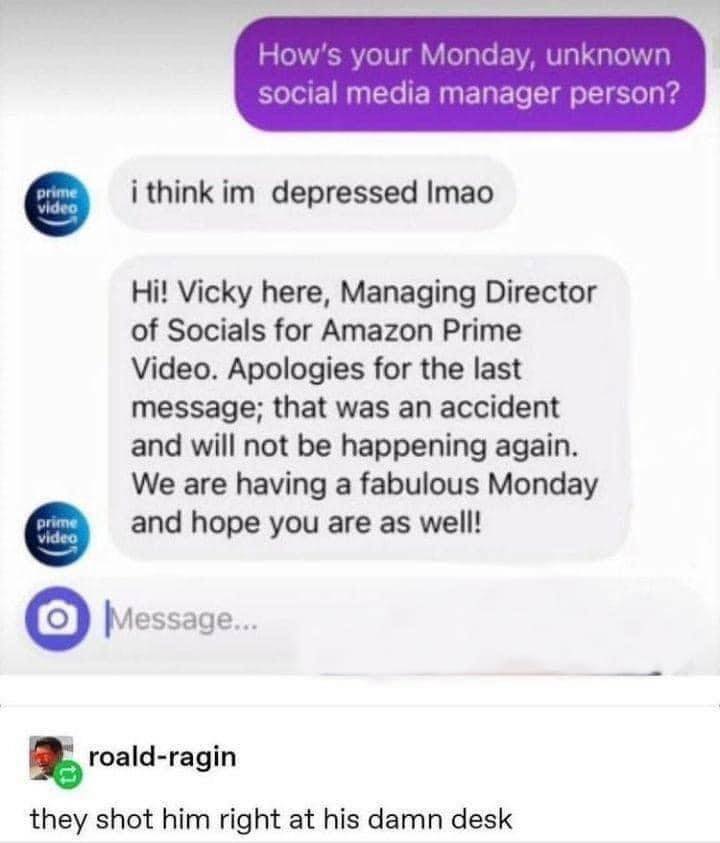
The image is a screenshot of a digital exchange. The top message, in purple, is a generic, relentlessly upbeat inquiry about the user's Monday from an unknown "social media manager." The reply is from an Amazon Prime Video account, typed in a conversational tone. The user replies "I think im depressed lmao." A third message box is displayed, with a cursor, suggesting the user is about to respond. Beneath the screenshot is a screenshot of a user, "roald-ragin," who states "they shot him right at his damn desk." The image is cropped closely, focusing entirely on the text exchange. The starkness of the interface, the overly cheerful tone of the initial message against the user's direct expression of depression, and the final dark comment create a discordant, unsettling effect. The use of "lmao" to follow a depression announcement heightens the alienation.
Foucauldian Genealogical Discourse Analysis
This exchange exemplifies the workings of power/knowledge as described by Michel Foucault. The initial message, a relentless demand for positivity ("How's your Monday?"), isn't simply friendly; it’s an exercise of disciplinary power. Amazon, as a corporation, attempts to normalize the user's experience—to bring it into alignment with the cheerful, productive ideal that underpins consumer capitalism. It's a demand for a docile body—one that conforms to the expectations of perpetual happiness and consumption.
The user’s curt reply ("I think im depressed lmao") disrupts this normalization. It’s a counter-discourse, a refusal to participate in the cheerful facade. Amazon's attempt at remediation (“Apologies…not happening again… fabulous Monday!”) is a power play; an attempt to reassert control over the discourse and steer the interaction back towards positive productivity. The apology isn't genuine concern; it’s damage control. The use of the phrase "not happening again" implies a concern for brand image and customer data, not the individual’s mental health.
The genealogy would trace the historical development of these conversational scripts. The demand for positivity is linked to the rise of "positive psychology" and marketing strategies designed to associate products with happiness. The script is a product of optimization and data analysis—designed to manage customer interactions and prevent negative publicity.
Critical Theory
From a Critical Theory perspective (drawing on thinkers like Adorno and Horkheimer), this exchange illustrates the culture industry’s role in reproducing and reinforcing capitalist ideology. The relentlessly cheerful tone of Amazon’s message is part of a broader cultural trend that equates happiness with consumption and suppresses expressions of negativity or dissent. This creates a false consciousness – a situation where individuals internalize ideologies that are not in their best interest.
The individual's statement of depression, while raw and honest, is immediately confronted with a manufactured positivity. This reinforces the idea that negative emotions are unacceptable or disruptive. The attempt to "fix" the user's emotional state with cheerful language is a form of instrumental reason – focusing solely on achieving a desired outcome (positive customer interaction) without regard for the individual’s authentic experience.
The final comment "they shot him right at his damn desk" suggests the alienation, dehumanization and exploitation within the systems that the customer is engaging with.
Marxist Conflict Theory
From a Marxist perspective, this exchange highlights the inherent class conflict embedded within consumer capitalism. The Amazon representative is not engaging with the user as a human being, but as a consumer unit. The interaction is framed entirely by economic interests—maintaining brand reputation and preventing negative impact on sales.
The user’s depression can be seen as a symptom of the alienation inherent in capitalist labor and consumption. They are reduced to a passive receiver of goods and services, stripped of agency and genuine connection.
The exchange is a micro-level illustration of the power dynamics between capital and labor. Amazon, as a massive corporation, wields significant power over the individual consumer, shaping their experience and dictating the terms of engagement. The final comment is suggesting that the worker is exploited in a manner that results in physical harm.
Postmodernism
A postmodern reading would focus on the simulation and hyperreality at play. Amazon’s cheerful message isn’t genuine; it’s a performance of friendliness, a simulation of human connection. The message is a signifier without a true signified, a superficial gesture devoid of authentic meaning.
The user's response is a disruption of this simulation, a moment of authenticity in a world of manufactured experiences. The exchange becomes a meta-commentary on the nature of online interaction and the commodification of emotions. The breakdown of communication—the failure of the scripted response to address the user’s genuine distress—reveals the inherent emptiness of the hyperreal.
Queer Feminist Intersectional Analysis
While less directly apparent, an intersectional queer feminist reading could examine how systems of power and oppression intersect in this exchange. The demand for relentless positivity and cheerful consumption could be seen as a form of emotional labor disproportionately expected of marginalized groups. Women and queer individuals are often socialized to prioritize the feelings of others and suppress their own negative emotions. The Amazon representative’s response, while seemingly innocuous, perpetuates this expectation.
The user’s depression, expressed so bluntly, could be seen as a refusal to perform this emotional labor—a reclamation of agency and authenticity. The final comment, suggesting violence, hints at potential systems of oppression that are operating on the individual.
Hopefully, this multi-layered analysis provides a robust understanding of the screenshot and the complex social and cultural forces at play within it.
simple-description (llama3.2-vision)
This meme is a screenshot of a conversation between an Amazon customer service representative and an Amazon customer. The customer is complaining about their order, but the representative responds with a sarcastic and humorous comment about the customer's complaint. The text reads: "How's your Monday, unknown social media manager person?" and the customer responds with "I think I'm depressed IMAO".
tesseract-ocr
© i think im depressed Imao Hi! Vicky here, Managing Director of Socials for Amazon Prime Video. Apologies for the last message; that was an accident and will not be happening again. We are having a fabulous Monday 3) and hope you are as well! © Message... 2, roald-ragin they shot him right at his damn desk