First Seen
2023-05-10T21:03:33+00:00
simple-description (llama3.2-vision_11b)
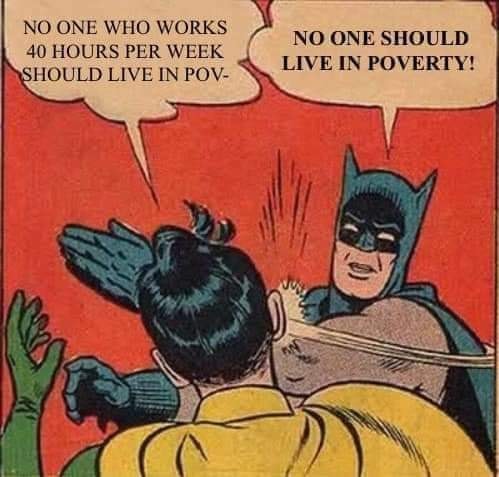
The meme features a character from a comic book or cartoon, likely Batman, who is known for his wealth and privilege. The image shows him physically attacking someone, with a speech bubble that reads: "No one who works 40 hours a week should live in poverty." This is a commentary on the issue of income inequality and the struggle to make a living wage, with the character's actions and words highlighting the need for a better system of economic justice.
detailed-analysis (gemma3-27b-vision)
Okay, here's a breakdown of the image, analyzing it through the lenses you requested. I’ll include sections only where those lenses are meaningfully applicable.
Visual Description
The image is a panel styled after classic 1960s comic book art. It depicts Batman slapping Robin across the face. The background is a solid, flat red. Batman is in a dynamic pose, arm extended, with a grim expression. Robin is recoiling from the slap, hands raised in protest. Speech bubbles contain the text “NO ONE WHO WORKS 40 HOURS PER WEEK SHOULD LIVE IN POVERTY!” emanating from Batman and an expression of shock and dismay from Robin. The art style is intentionally "retro" and references the campy aesthetic of the Adam West era Batman television show.
Foucauldian Genealogical Discourse Analysis
This image is fascinating when viewed through a Foucauldian lens. The discourse isn't simply about poverty, but constructs a specific understanding of work, worth, and deservingness.
- Power/Knowledge: The image establishes a power dynamic where Batman, as a symbol of authority, is articulating what should be considered acceptable. He’s defining what constitutes a just societal outcome – a living wage for 40 hours of work. This definition isn't neutral, it's a form of power being exercised, shaping the understanding of what's “right.”
- Genealogy of "Deservingness": A genealogical analysis would examine the historical development of the idea that work should equate to a certain standard of living. Where did this expectation come from? What historical forces, economic shifts, and social movements contributed to it? The image implicitly assumes this expectation is natural or self-evident, but a genealogical approach would show it's a constructed concept. It could trace the development of labor laws, the rise of the middle class, and the rhetoric of the "work ethic" to demonstrate how this expectation was created.
- Disciplinary Power: The slap itself acts as a disciplinary mechanism. It’s an act of violence used to enforce a norm. While seemingly shocking, it suggests that deviation from the idea that work should provide a living wage is unacceptable, even warranting physical correction. It frames the act of addressing poverty not as a matter of systemic reform, but as a matter of enforcing a moral code.
- Normalization: The fact this image has been popularised as a meme suggests the statement/sentiment is somewhat normalised.
Critical Theory
This image resonates strongly with themes from Critical Theory, particularly concerning ideology and domination.
- Ideology Critique: The image presents a seemingly self-evident "truth" – that working 40 hours should prevent poverty. However, Critical Theory would challenge the assumption that this is simply "common sense." It's an ideological statement that masks deeper systemic issues. It shifts the focus from the failures of the economic system itself (wage stagnation, wealth inequality, lack of social safety nets) to a moral failing—a lack of fairness or just compensation.
- False Consciousness: The meme potentially plays on a kind of "false consciousness." It may create the illusion that a simple moral declaration is enough to address complex structural problems. It doesn't address the power dynamics that create poverty in the first place.
- Domination & Control: The slap represents a form of symbolic violence used to reinforce an ideology. It's a direct (and jarring) assertion of a value judgment, implying that anyone who fails to see the connection between work and a living wage is somehow in the wrong.
Marxist Conflict Theory
This image is highly relevant to Marxist conflict theory, particularly regarding the exploitation of labor and the contradictions of capitalism.
- Exploitation of Labor: The statement “NO ONE WHO WORKS 40 HOURS PER WEEK SHOULD LIVE IN POVERTY!” implicitly acknowledges that this is already happening. This points to the inherent contradictions within a capitalist system where the value created by labor is not always adequately returned to the worker.
- Class Conflict: The image, while not explicitly depicting a class struggle, indirectly references it. Poverty is fundamentally a class-based issue. The statement highlights the tension between the working class (who provide the labor) and the capitalist class (who own the means of production).
- Alienation: The image hints at the alienation of labor. If someone works 40 hours and still lives in poverty, they are alienated from the fruits of their labor. They don't receive the full value of what they produce.
- False Consciousness: The meme, within a Marxist context, could be interpreted as masking the real source of poverty – the exploitative nature of capitalism – by presenting it as a matter of moral failing or inadequate compensation.
Postmodernism
While the image’s direct engagement with postmodern themes is limited, a postmodern reading is possible.
- Intertextuality & Parody: The image is itself a parody of the classic Batman comic book style. It appropriates a familiar visual trope to make a social commentary. It relies on the viewer's pre-existing knowledge of the source material to create meaning.
- Deconstruction of Grand Narratives: The image can be seen as subtly deconstructing the grand narrative of the "work ethic." While it affirms the value of work, it also reveals the inherent contradictions within that value system—the fact that work doesn't always guarantee a decent standard of living.
- Simulacra & Simulation: The meme itself is a simulacrum, a copy without an original, circulated and re-contextualised. The image of Batman slapping Robin isn't a genuine representation of a social problem but a simulation of a response to it.
Queer Feminist Intersectional Analysis
While this image doesn’t explicitly address queer or feminist issues, the intersectional lens is still relevant.
- Systemic Oppression: Poverty disproportionately impacts marginalized groups – women, people of colour, LGBTQ+ individuals, people with disabilities. The statement, while seemingly universal, doesn’t acknowledge the ways in which these intersecting identities exacerbate economic vulnerability.
- Labor of Care: Women, particularly women of colour, often perform a disproportionate amount of unpaid labor of care (childcare, eldercare, domestic work). This labor is often undervalued and contributes to economic inequality. The statement doesn’t acknowledge this.
- Gendered Wage Gap: The statement doesn’t acknowledge the gendered wage gap, which means that women often earn less than men for the same work. This contributes to higher rates of poverty among women.
- Invisibility of marginalised labour: The meme also doesn't acknowledge the value of informal labour or work that is uncompensated, disproportionately taken on by women and queer and trans people.
Hopefully, this thorough breakdown answers your request! Let me know if you'd like me to expand on any particular aspect.
simple-description (llama3.2-vision)
This meme is a humorous image featuring Batman, the iconic superhero, in a surprising and ironic situation. The image depicts Batman being hit by Robin, his trusted sidekick, with a humorous and unexpected punchline: "In a world where Batman is known for his wealth and resources, the punchline is a sarcastic commentary on the idea that even Batman, the wealthiest superhero, would still struggle to make ends meet.
tesseract-ocr
=" Y NO ONE WHO WORKS m 4 40 HOURS PER WEEK See SHOULD LIVE Ne : & \ y \ | Wi f \ . \ |} iA Do)! RS Y SSS aw Nee | Ey De : (\ \