First Seen
2023-05-10T21:03:33+00:00
simple-description (llama3.2-vision_11b)
The meme features a character from the video game "Super Mario Bros." named Toad, who is known for his cheerful and optimistic personality. In this meme, Toad is shown holding a sign that reads: "the laborer who bakes a loaf that they may eat a slice of bread, who builds a palace that they may sleep in a bed, who weaves rich fabrics that they may wear clothes, who writes books that they may read, who builds a house that they may live in, who produces everything that they may enjoy it, is not free." This is a quote from the book "The Laborer's Dilemma" by an unknown author. The meme is poking fun at the idea that people are not free because they are forced to work for a living. The text is a quote from an unknown book.
detailed-analysis (gemma3-27b-vision)
Okay, let's break down this image/meme through several critical theory lenses.
Visual Description
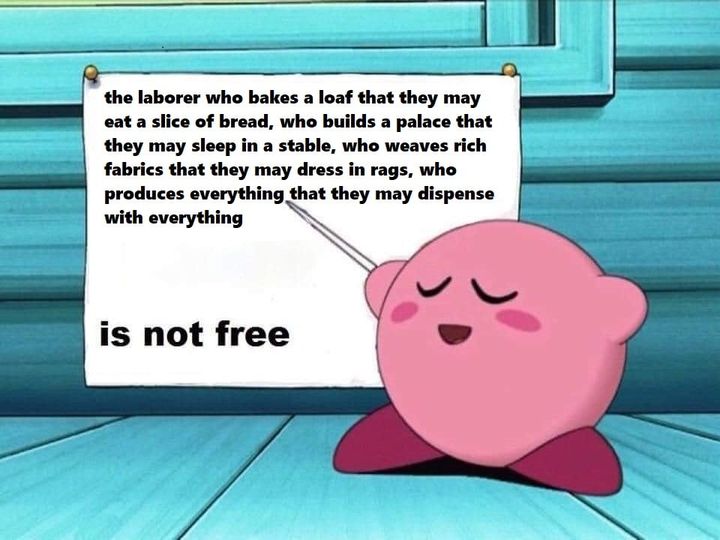
The image depicts a scene from the Kirby video game/cartoon franchise. Kirby, a pink, spherical character with a perpetually calm expression, is prominently positioned on the right. He appears to be hovering or floating. To his left, a piece of paper is affixed to the wall by a thumbtack. The paper contains a block of text followed by the words "is not free" in bold, large font. The background is a simple, cartoonish interior, suggesting a domestic or functional space. The overall aesthetic is bright and playful, which creates a striking contrast with the somber and critical text.
Foucauldian Genealogical Discourse Analysis
This image offers rich ground for a Foucauldian analysis. The text itself constructs a discourse surrounding labor and power. The repetitive phrasing ("who…") and the accumulation of actions (baking, building, weaving, producing) highlight the productive nature of labor—it isn't merely about creating goods but also about shaping the very conditions of existence for others.
Foucault would be interested in the genealogy of this discourse. What historical power structures, discourses, and institutions have shaped our understanding of labor as something inherently not free? The image implicitly asks us to trace the evolution of these systems. It points to the idea that even in ostensibly “free” societies, labor remains entangled with systems of control.
The disconnect between the playful Kirby aesthetic and the serious statement creates a disrupture in discourse. Foucault would analyze how this disruption forces a re-evaluation of our assumptions about labor and freedom. The fact that this message is delivered through a seemingly innocent medium (a children’s cartoon) is significant; it suggests that the ideology of unfreedom is deeply embedded in our culture, even in forms targeted at young audiences.
Marxist Conflict Theory
This image is almost a direct statement of Marxist principles. The text clearly articulates the alienation of labor under capitalism. The worker produces everything – bread, shelter, textiles, and ultimately, all the conditions for the enjoyment of others – yet remains not free. This highlights the central concept of surplus value. The worker’s labor generates value exceeding their own compensation, that value being appropriated by the ruling class.
The repetitive phrasing ("who...") reinforces the idea that the worker's existence is defined solely by their productive capacity. They are reduced to a function within the capitalist mode of production. The phrase "is not free" is a stark proclamation of the worker’s lack of agency and control over the fruits of their labor. It points to the inherent conflict between the interests of the worker and the capitalist class.
The Kirby image ironically subverts the typical image of consumer culture, drawing our attention back to the labor that enables that consumption. It’s a visual critique of the way capitalism obscures the exploitation inherent in production.
Postmodernism
From a postmodern perspective, the image challenges grand narratives around freedom and labor. The simple declaration "is not free" disrupts any easy assumptions about what freedom means. The seemingly innocent cartoon setting and character (Kirby) create a layer of irony and pastiche. It’s a dismantling of traditional representations of work.
The image embraces a certain level of fragmentation. The focus is on the act of production, isolated from the broader context of the economic system. It doesn't offer a solution or a clear path towards liberation, but rather a pointed questioning of existing structures. The text’s repetition and seeming lack of a direct address contribute to a sense of decenteredness and a rejection of master narratives.
The contrast between the image and text creates a simulacrum. The image presents an illusion of lightheartedness, while the text exposes the harsh realities of labor. It can be seen as a comment on the way capitalism creates illusions to mask its exploitative nature.
Queer Feminist Intersectional Analysis
While not immediately obvious, a queer feminist intersectional analysis can add layers to this interpretation. The worker described in the text is deliberately genderless and devoid of identity. This allows for a broader understanding of exploitation that extends beyond traditional gender roles.
Historically, labor has been deeply gendered, with women and other marginalized groups disproportionately subjected to exploitative conditions. The lack of specific identity in the text can be interpreted as a critique of the ways in which capitalism abstracts labor, reducing individuals to mere units of production, regardless of their gender, race, or other identities.
The phrase "is not free" can also be seen as a commentary on the ways in which societal structures limit the agency and freedom of marginalized groups. The intersection of class exploitation with other forms of oppression (gender, race, sexuality) creates a complex web of unfreedom.
The image itself, while seemingly innocuous, can be seen as a reclamation of a traditionally playful space to address serious issues. It suggests that even within seemingly apolitical contexts, it is possible to challenge dominant power structures and advocate for social justice.
Disclaimer: These interpretations are based on critical theory and are open to various interpretations. The strength of each interpretation depends on the reader’s perspective and the specific context in which the image is viewed.
simple-description (llama3.2-vision)
This meme is a humorous image that uses a character from the popular video game series "The Legend of Zelda" to poke fun at the idea of a "free" person. The image features a character named Link, who is holding a sign that reads: "The laborer who bakes a loaf that they may eat a slice of bread, who builds a palace that they may sleep in a stable, who weaves rich fabrics that they may wear in rags, who produces everything that they may dispense with everything... is not free." The text is a satirical commentary on the concept of freedom, suggesting that even those who seem to have freedom are actually just doing the same tasks as everyone else.
tesseract-ocr
the laborer who bakes a loaf that they may eat a slice of bread, who builds a palace that they may sleep in a stable, who weaves rich fabrics that they may dress in rags, who produces everything that they may dispense with everything "| is not free ~