First Seen
2023-05-10T21:03:33+00:00
simple-description (llama3.2-vision_11b)
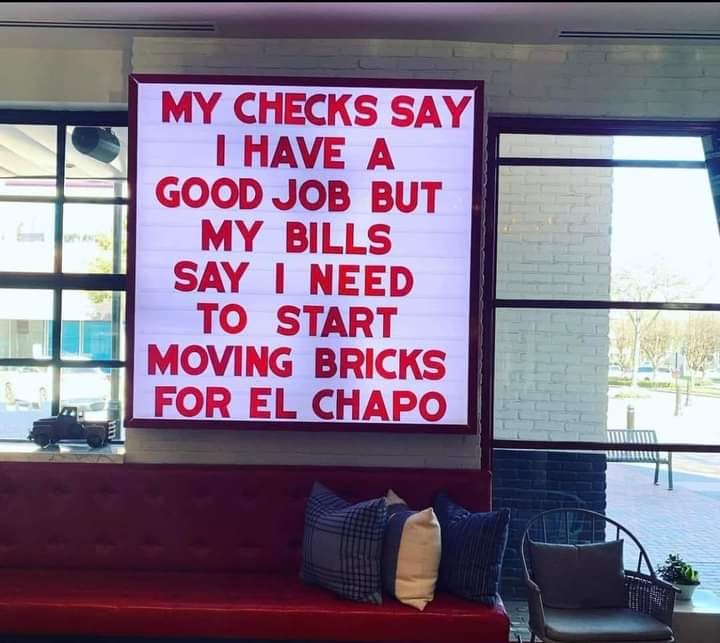
The meme is a humorous commentary on the job market and the struggles of making ends meet. It reads: "My checks say I have a good job, but my bills say I need to start moving bricks for El Chapo." This phrase is a satirical take on the idea that even with a good job, one's financial struggles can be overwhelming. The joke is that even a job with a good salary can't keep up with the expenses of living in a high-crime area like El Chapo's Mexico City.
detailed-analysis (gemma3-27b-vision)
Okay, let's break down this image, analyzing it through the requested theoretical lenses.
Visual Description
The image depicts a large, bright red poster with white text. The text reads: "MY CHECKS SAY I HAVE A GOOD JOB BUT MY BILLS SAY I NEED TO START MOVING BRICKS FOR EL CHAPO." The poster is hung on a wall within what appears to be a waiting area, visible through large windows. Beneath the poster is a low, dark-colored couch adorned with patterned pillows. Outside the window, there's a view of a sunny day with what looks like a playground or park area, and a small car. The setting looks modern and potentially commercial, perhaps a business lobby or lounge. The overall impression is intentionally provocative and uses a darkly humorous tone.
Foucauldian Genealogical Discourse Analysis
This poster is fascinating through a Foucauldian lens. It reveals a shift in discourses around labor, legitimacy, and the construction of “the good life.” The seemingly innocent statement about checks versus bills exposes a tension between the discourse of meritocracy (having a "good job" implies earned success) and the discourse of economic precarity (bills necessitate further, potentially illegal, labor).
- Power/Knowledge: The poster is not simply about economic hardship; it performs it. The reference to "El Chapo" (Joaquin Guzmán, a notorious drug lord) immediately introduces the discourse of illicit economies and the breakdown of normative power structures. It implies that even with a seemingly respectable job, individuals might be forced to participate in underground economies to survive. This connects directly to the interplay of power and knowledge. The discourse of legal work is seen as insufficient, while the power structures inherent in drug cartels become an alternative for survival.
- Genealogy: Historically, the "good job" was linked to stability, respectability, and social mobility. This poster represents a disruption of that lineage. It indicates a failure of these traditional pathways, forcing individuals to re-evaluate what constitutes "work" and "legitimacy." The genealogy of labor is being rewritten.
- Discipline & Biopower: The pressure to meet bills and the resulting desperation for any means of income can be understood as a form of discipline—a regulatory system that pushes individuals to conform to the demands of the economy, even if it means breaking the law. The "bills" exert biopower, shaping and controlling life itself.
Marxist Conflict Theory
This poster is a potent expression of Marxist conflict theory. It vividly illustrates the inherent contradictions within capitalist systems.
- Class Struggle: The statement highlights the gap between wages and the cost of living, directly representing the exploitation of labor. The individual seemingly has a job (proletariat), but the system doesn’t provide enough compensation to meet basic needs.
- Alienation: The forced resort to illegal activities (moving bricks for a drug lord) suggests a profound alienation from meaningful labor. The individual is reduced to a tool of an exploitative system, both within the legal economy (the "good job") and the illegal one (El Chapo’s organization).
- False Consciousness: The “good job” itself might be a construct of ideology, masking the true nature of exploitation. Individuals are led to believe they are successful while remaining vulnerable to economic precarity. The poster exposes this false consciousness.
- Revolutionary Potential: While seemingly humorous, the statement hints at a potential breakdown of the social order. If even those with "good jobs" are driven to participate in illegal economies, it reveals a deep systemic crisis.
Postmodernism
The image embodies several postmodern characteristics:
- Irony and Pastiche: The juxtaposition of a "good job" with illegal labor is intensely ironic. It’s a mixing of seemingly disparate elements (legitimate work vs. drug trafficking) which is a key feature of pastiche.
- Deconstruction of Grand Narratives: The poster challenges the "grand narrative" of the American Dream – the belief that hard work leads to success and stability. It demonstrates the failure of this narrative for many, particularly in contemporary economic conditions.
- Hyperreality & Simulation: The reference to "El Chapo" is a cultural signifier, a symbol of power and illicit activity. The poster blends the real (economic hardship) with the simulated (a celebrity criminal) blurring the lines between authenticity and representation.
- Fragmentation: The poster can be seen as a fragmented representation of modern life, where individuals are forced to navigate multiple, often contradictory, realities.
Critical Theory
The poster embodies elements of critical theory, especially in terms of ideology and social critique.
- Ideology Critique: The poster exposes how dominant ideologies (e.g., the American Dream, meritocracy) can mask structural inequalities and exploitation. The "good job" becomes a facade, concealing the underlying economic precarity.
- Domination and Resistance: The statement implies a form of subtle resistance. While seemingly conceding to the necessity of illegal labor, it also implicitly critiques the system that forces individuals into such desperate situations.
- Emancipation: Though the poster doesn't explicitly call for action, it suggests a need for structural change—a move away from systems that create such economic vulnerability and force individuals to compromise their morality.
- Reflexivity: The poster's self-aware and cynical tone suggests a level of critical reflection on the conditions of modern life.
Queer Feminist Intersectional Analysis (This is potentially less directly applicable, but can still be relevant)
While not central, a queer-feminist lens can add nuance:
- Precarity & Marginalization: The economic precarity described in the poster disproportionately affects marginalized groups, including women, people of color, and LGBTQ+ individuals. The intersection of these identities can exacerbate economic vulnerability.
- Criminalization of Survival: Individuals forced into illegal economies due to economic hardship (particularly those already marginalized) face increased risk of criminalization and state violence.
- Gendered labor: In many cases, precarious labor falls disproportionately on women, who are often forced to take on multiple jobs or engage in informal work to make ends meet. This can further increase their vulnerability to exploitation.
I hope this detailed breakdown is helpful! Let me know if you’d like me to elaborate on any of these points.
simple-description (llama3.2-vision)
This meme is a humorous take on a common phrase. The image shows a sign with the text "My checks say I have a good job, but my bills say I need to start moving bricks for El Chapo." The meme is poking fun at the idea that someone's financial situation is not as stable as they claim, with a humorous twist on the phrase "my checks say" and the absurdity of needing to start moving bricks for a notorious figure.
tesseract-ocr
samme MY CHECKS SAY] —|§| | HAVE A : =] Goop JOB BUT | i) my pis SAY | NEED tug TO START MOVING BRICKS teal FOR EL CHAPO Nay