First Seen
2023-05-10T21:03:33+00:00
simple-description (llama3.2-vision_11b)
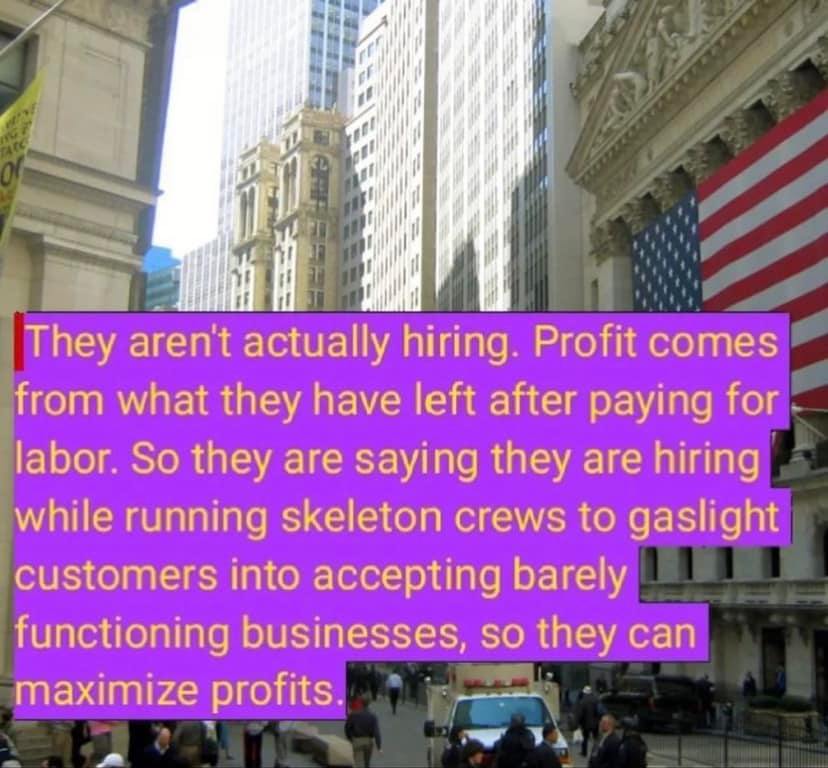
The meme is a satirical commentary on the job market, specifically highlighting the exploitation of workers by corporations. The image is a photo of a city street, but the text overlayed on it reads: "They aren't actually hiring. Profit comes from what they have left after paying for labor. So they are hiring while running skeleton crews to gaslight customers into accepting barely functioning businesses, so they can maximize profits." This text is a commentary on the exploitation of workers and the prioritization of profit over people.
detailed-analysis (gemma3-27b-vision)
Okay, here's an analysis of the image and its text, broken down into sections based on the theoretical frameworks you requested. Some frameworks don’t apply as strongly, so those sections will be briefer.
Visual Description
The image shows a bustling street scene dominated by imposing, classical architecture – likely Wall Street in New York City, or a similarly styled financial district. A very ornate building facade is prominent, along with a tall, modern skyscraper in the background. There's a large group of people walking and standing on the street, indicating a busy urban environment. Bright red, white, and blue flags are waving in the distance. A police barricade or security vehicle is in the foreground, suggesting a level of control or surveillance. The image, while showing activity, has a slightly washed-out quality, perhaps contributing to a sense of alienation or disillusionment.
The text overlaid on the image is in a bold, pink/purple font. It states: "They aren't actually hiring. Profit comes from what they have left after paying for labor. So they are saying they are hiring while running skeleton crews to gaslight customers into accepting barely functioning businesses, so they can maximize profits."
Marxist Conflict Theory
This is the most directly applicable framework. The text explicitly links to core tenets of Marxist thought.
- Exploitation of Labor: The central argument – that profit isn't generated by production but by what remains after paying labor – is a classic Marxist claim. It highlights the extraction of surplus value from workers. The text frames "hiring" as a smokescreen. It is not about expanding the workforce to improve service, but a public relations ploy while maintaining the lowest possible labor costs to maximize profit.
- Class Struggle: The text suggests a power imbalance between those who own the businesses ("they") and both the workers (who are understaffed and potentially exploited) and the customers (who are being deceived). This is a clear indication of class conflict.
- Commodification: The "barely functioning businesses" suggest a prioritization of profit over quality, effectively commodifying services and consumer experience. The customer’s satisfaction is secondary to the accumulation of capital.
- Alienation: The skeletal crews and the deception involved in the hiring announcements likely create an environment where the workers are disconnected from any sense of purpose or fulfillment, and customers feel exploited and disrespected.
Critical Theory
The image and text lend themselves well to critical theory.
- Ideology Critique: The "hiring" announcements function as part of an ideology that masks the true mechanisms of profit accumulation. It's a superficial display meant to project an image of growth and opportunity while concealing exploitation.
- Power Relations: The text reveals how power is exercised through deception and manipulation. The "gaslighting" of customers isn't simply about bad service; it’s a deliberate strategy to maintain control and extract profit.
- Systemic Critique: The text implies that this isn't an isolated incident, but a systemic pattern of behavior within a capitalist system driven by profit maximization. The critique is directed at the structure, not just individual actors.
Foucauldian Genealogical Discourse Analysis
This can be applied, though less directly than Marxism or Critical Theory.
- Discourse of “Hiring”: The text deconstructs the discourse around "hiring." It exposes how the term is used not to genuinely indicate workforce expansion, but as a rhetorical device to create a specific perception (of a thriving economy or responsible business practice).
- Power/Knowledge: The ability of "they" to control the narrative around hiring and business performance demonstrates the relationship between power and knowledge. "They" have the power to define the terms, and this definition shapes our understanding of the situation.
- Normalization of Exploitation: Over time, the practice of understaffing and deceptive marketing can become normalized. The text hints at a process through which exploitation becomes accepted as standard business practice.
Postmodernism
Postmodern themes are present, but less central than in the previous analyses.
- Deconstruction of Truth: The text challenges the assumed “truth” behind hiring announcements. It reveals that appearances can be deceiving, and that the meaning of words can be manipulated.
- Skepticism of Grand Narratives: The critique of profit-driven systems can be seen as a rejection of the "grand narrative" of economic progress. The text suggests that the promised benefits of capitalism may not be evenly distributed or even realized.
- Simulation & Hyperreality: The deceptive hiring announcements, creating a "simulation" of growth, could be seen through a postmodern lens. The "reality" of understaffed, failing businesses is obscured by a constructed image of success.
Queer Feminist Intersectional Analysis
While not immediately obvious, this framework can be applied, though it requires some interpretation.
- Vulnerability & Marginalization: The "customers" being "gaslit" can be read as a metaphor for broader forms of social vulnerability and manipulation. The text implies that those with less power are more likely to be exploited.
- Capitalist Structures & Oppression: Capitalist structures are often intertwined with other forms of oppression. The pursuit of profit can exacerbate inequalities based on gender, race, and sexuality.
- Exploitation of Labor: Historically, the most exploited workers have often been women and people of color. The text’s critique of exploitative labor practices could be extended to examine the intersection of class and other forms of marginalization. (This requires additional context about the specific businesses being referenced.)
Let me know if you'd like me to expand on any of these sections or explore a different theoretical lens.
simple-description (llama3.2-vision)
This meme is a humorous commentary on the struggles of modern employment. The image depicts a city street with a large, bolded text overlay that reads: "They're not employees, they're freelancers. They're not employees, they're contractors. They're not employees, they're temps. They're not employees, they're interns. They're not employees, they're volunteers. They're not employees, they're customers. They're not employees, they're clients. They're not employees, they're...". The text is a satirical commentary on the erosion of worker rights and the exploitation of labor in modern capitalism.
tesseract-ocr
y, . Sau’ . i (Mt, Pa ’ a a 4 y, os “ a "4 Hae | AZ Ji te | Wee ZZ , a ep ' ia ae a || Ate £4 4 ’ aH Ds iy 7 ’ j j : o i a r 4 é 1g! & 4 F ai! | it " yf . or eit i a Pg 1 uO ~ 2. be ae ©