First Seen
2023-05-10T21:03:33+00:00
simple-description (llama3.2-vision_11b)
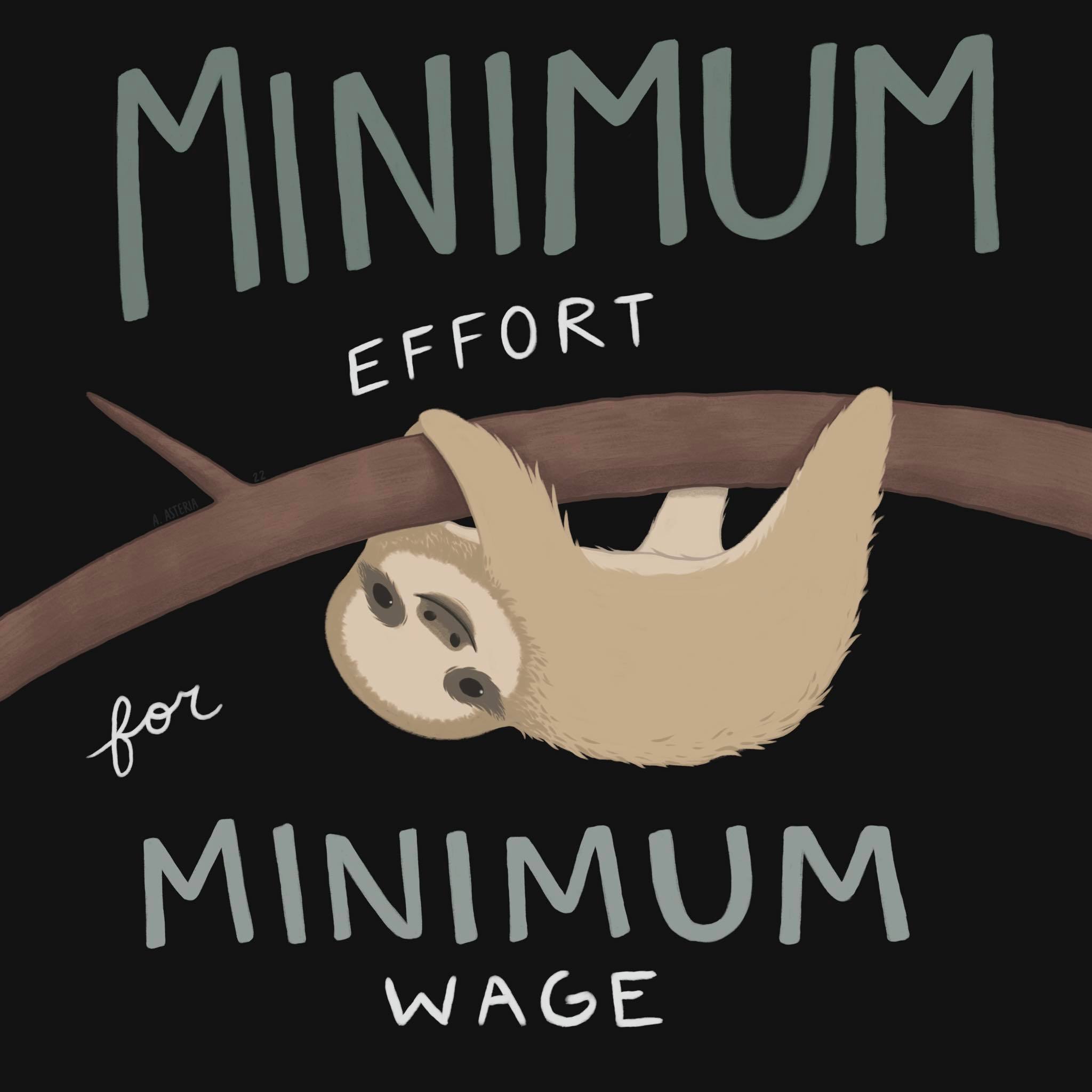
The meme is a humorous critique of the concept of a "living wage" in a capitalist society. The image features a sloth, a symbol of laziness, with a sarcastic caption "minimum effort for minimum wage" implying that the idea of a living wage is unattainable in a capitalist system where workers are exploited for their labor. The text is likely meant to be ironic, suggesting that even the most basic expectations of a living wage are impossible to achieve in a system that prioritizes profit over people.
detailed-analysis (gemma3-27b-vision)
Okay, let's break down this image through several theoretical lenses, as requested. I'll include sections only where the theory applies and is relevant to the image's message.
Visual Description
The image is a digital illustration with a simple aesthetic. It features a light brown sloth hanging upside down from a dark brown branch. The background is black. Overlaid on the image in large, slightly rounded, light green lettering are the words "MINIMUM EFFORT" at the top and "MINIMUM WAGE" at the bottom. The word "for" is written in cursive, smaller script connecting the two phrases. The style is cartoonish and somewhat whimsical, creating a visual pun/ironic juxtaposition. The sloth's expression appears sleepy or blank, reinforcing the idea of minimal exertion.
Marxist Conflict Theory
This image strongly engages with Marxist conflict theory. The core of the message directly relates to the exploitation of labor under capitalism.
- Exploitation of Labor: The phrase "Minimum Effort for Minimum Wage" encapsulates the argument that many low-wage jobs demand little genuine skill or exertion, yet are still characterized by exploitation. Employers benefit from the value created by labor, even when that labor is minimal, while workers receive only the minimum compensation. The image suggests that the level of effort aligns with the level of pay.
- Alienation: The sloth, in its lethargic state, can be interpreted as a metaphor for the alienated worker. Workers in low-wage, repetitive jobs may experience a disconnect from their work, feeling little pride or investment in the outcome. The sloth's apathy embodies this alienation.
- Class Struggle: The image implies a critique of the power dynamic between employers (who seek to maximize profit by minimizing labor costs) and workers (who struggle to earn a living wage). It can be seen as a commentary on the inherent class conflict within capitalist systems.
- Commodification of Labor: Labor itself is reduced to a commodity – something bought and sold at a minimal price. The image implicitly questions the fairness of this commodification when "minimum effort" is demanded.
Foucauldian Genealogical Discourse Analysis
A Foucauldian analysis can reveal how the ideas of "effort" and "wage" have been constructed and normalized through discourse.
- Power/Knowledge: The association of wage with effort isn't "natural" but a construction of power/knowledge. Historically, the very concept of "work" and "worth" has been shaped by those in positions of power (employers, governments) to justify unequal distribution of wealth. The image challenges this accepted 'truth'.
- Discipline and Normalization: Modern work structures impose a disciplinary regime where workers are expected to exert effort even in low-skill jobs. This expectation becomes normalized—a standard of behavior. The image, however, subtly undermines this norm by suggesting that minimal effort is appropriate for minimal wage.
- Genealogy of "Effort": Examining the historical development of the concept of "effort" reveals that it's not a fixed or objective measure. What is considered "sufficient effort" varies across cultures, time periods, and social contexts. The image forces us to question the historical and social forces that have shaped our understanding of "effort."
- The Panopticon: You could stretch this to say that minimum wage workers are constantly surveilled to ensure they're putting in 'enough' effort, even if the job fundamentally requires little.
Postmodernism
While not the primary lens, postmodern themes are present.
- Irony and Pastiche: The image relies heavily on irony. It's a playful, seemingly lighthearted image that carries a serious socio-economic critique.
- Deconstruction of Meaning: The image challenges the “natural” connection between work, effort, and wages. It deconstructs the accepted value system, suggesting that the standard of “fair exchange” is flawed.
- The End of Grand Narratives: The image indirectly questions the "grand narrative" of meritocracy, the belief that hard work always leads to success. It hints that the system is rigged, and even putting in minimal effort might be justified in a context of exploitation.
- Simulacra and Simulation: The idea of working for minimum wage can be seen as a simulation of ‘real’ work, where the value of labor is reduced to a symbolic exchange.
Let me know if you'd like me to elaborate on any of these points or explore another theoretical lens!
simple-description (llama3.2-vision)
The meme features a sloth hanging from a tree branch, with a caption that reads "Minimum effort for a minimum wage." The image is humorous because it pokes fun at the idea that someone is only putting in the bare minimum of work, despite being paid a minimum wage, which is a common complaint in the workplace. The sloth's relaxed and unenthusiastic demeanor adds to the humor, implying that they're just going through the motions.
tesseract-ocr
S =< ee a OS pee — ™ tienes epee 4 Rae aes sae % ae ns a i Pe Se an oa es a a Zz Pe areas : } a) aia e , ea pa - se i G