First Seen
2023-05-10T21:03:33+00:00
simple-description (llama3.2-vision_11b)
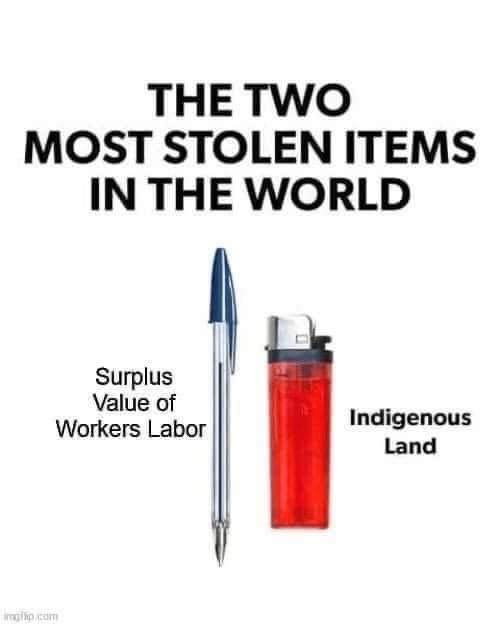
The meme is a satirical commentary on the value of labor in an anti-capitalist context. It juxtaposes the value of a worker's labor (represented by a pen) with the value of a worker's land (represented by a lighter). The text "The two most stolen items in the world" is ironic, implying that the value of a worker's labor and land are both constantly exploited and undervalued by capitalist systems.
detailed-analysis (gemma3-27b-vision)
Okay, let's break down this image through the lenses of the requested theoretical frameworks.
Visual Description
The image is a simple meme-style graphic. It features a white background with bold black text at the top proclaiming "THE TWO MOST STOLEN ITEMS IN THE WORLD." Below this text are two isolated images: a blue ballpoint pen on the left and a red lighter on the right. Each item is labeled with text directly beneath it. The pen is labeled “Surplus Value of Workers Labor,” and the lighter is labeled “Indigenous Land.” The lower corner features a watermark "imgflip.com." The aesthetic is minimalist and stark, typical of internet meme culture, relying on conceptual juxtaposition rather than visual complexity.
Marxist Conflict Theory
This image is strongly rooted in Marxist thought. The core message directly engages with central tenets of the theory.
- Surplus Value of Workers Labor: This is a fundamental Marxist concept. Marx argued that capitalists extract "surplus value" from workers – the difference between the value a worker produces and the wages they receive. This stolen value (the profits) is the basis of capitalist exploitation. The image visually equates this extraction with theft.
- Indigenous Land: The equation of Indigenous land with stolen property connects to Marxist critiques of colonialism and imperialism. Marx, while sometimes limited in his focus, recognized how European colonialism was a violent process of dispossession, forcing indigenous people off their land to benefit capitalist accumulation. This dispossession is framed as a form of theft.
- Class Conflict: The image implies a fundamental power imbalance and conflict between those who exploit labor and seize land (the capitalists/colonizers) and those who are exploited and dispossessed (the workers and Indigenous populations).
- The juxtaposition: By placing these seemingly disparate items together, the image suggests a deeper connection between the exploitation of labor and the exploitation of land. Both are depicted as essential forms of theft that fuel the capitalist system.
Critical Theory
The image aligns with critical theory's broader project of exposing power structures and challenging dominant narratives.
- Unmasking Hidden Power Relations: Critical Theory seeks to unveil the ways in which power operates through seemingly neutral systems or objects. The image performs this by transforming a pen and lighter from everyday items into symbols of systemic injustice.
- Deconstruction of Ideology: The image deconstructs the ideologically-infused narrative of capitalist 'legitimacy.' It challenges the assumption that profit and property ownership are 'earned' or 'deserved' by revealing the inherent exploitative foundations.
- Social Critique: The meme functions as a concise form of social critique, prompting viewers to question the foundations of the contemporary world and the ways in which it is built on exploitation.
Foucauldian Genealogical Discourse Analysis
Applying Foucault, we'd move beyond simply identifying 'oppression' and delve into the historical practices that construct these power relations.
- Discourse & Power/Knowledge: Foucault argues that power operates through discourse – the systems of thought, language, and knowledge that shape our understanding of the world. The image implicitly challenges the discourse of 'ownership' and 'property rights.' It questions how these concepts were constructed through historical and legal systems to legitimize the exploitation of labor and land.
- Genealogy: A genealogical analysis would trace the historical emergence of the concepts of surplus value and property ownership. How did these concepts come to be understood in the way they are today? What power relations were at play in their development? The meme hints at this, prompting a deeper historical inquiry.
- Disciplinary Power: The systems that enable the extraction of surplus value (factories, wage labor) and the control of land (colonial laws, property deeds) are forms of disciplinary power – mechanisms that regulate and control individuals and populations.
Postmodernism
Postmodern thought is perhaps less directly applicable, but we can find connections:
- Rejection of Grand Narratives: The image can be seen as a rejection of the ‘grand narrative’ of progress and economic growth. It suggests that the apparent benefits of capitalism come at a terrible cost (exploitation and dispossession).
- Deconstruction of Meaning: While the meme is relatively straightforward in its message, postmodernism’s emphasis on the instability of meaning could be applied to the image. The act of associating a pen and lighter with these complex concepts challenges conventional understandings of these objects.
- Emphasis on Difference & Power: Postmodernism highlights how power operates through language and representation, and how different groups are marginalized or silenced. The image visually emphasizes the power imbalances inherent in the systems of exploitation.
Queer Feminist Intersectional Analysis
This lens is a bit more of a stretch, as the image doesn’t explicitly address gender or sexuality, but we can still explore connections.
- Intersectional Exploitation: The exploitation of labor and land are not experienced equally. Gender, race, class, and other identities intersect to create unique forms of exploitation. For example, women and people of color are often disproportionately affected by both labor exploitation and land dispossession.
- Reclaiming Power: The meme can be seen as a form of resistance – a way of reclaiming power by naming and exposing the systems of oppression. This act of naming is particularly important for marginalized groups who have been historically silenced and invisibilized.
- Critique of Ownership: Queer and feminist thought often challenge the very concept of ownership – particularly in relation to bodies, land, and resources. The image’s critique of ownership aligns with this perspective.
- Challenging Heteronormative Capitalism: The meme could be extended to critique how capitalism relies on and reinforces heteronormative structures and expectations.
In Conclusion
This seemingly simple image is a powerful visual statement that resonates with a range of critical theoretical frameworks. It’s particularly strong within Marxist and Critical Theory, but can also be productively analyzed through Foucauldian, Postmodern, and Queer Feminist lenses. The meme’s effectiveness lies in its ability to distill complex ideas into a concise and memorable form, prompting viewers to question the fundamental structures of power that shape our world.
simple-description (llama3.2-vision)
The meme is a play on the phrase "the greatest of all time" and lists "the two most stolen items in the world" as a pen and a lighter, with the text "pen" and "lighter" above them. The text "pen" is written in a childlike scrawl, while "lighter" is in a more formal font. The image is meant to be humorous, implying that the most stolen items in the world are something as mundane as a pen and a lighter.
tesseract-ocr
THE TWO MOST STOLEN ITEMS IN THE WORLD Surplus ! 3 Workers Labor | Indigenous Land