First Seen
2023-05-10T21:03:33+00:00
simple-description (llama3.2-vision_11b)
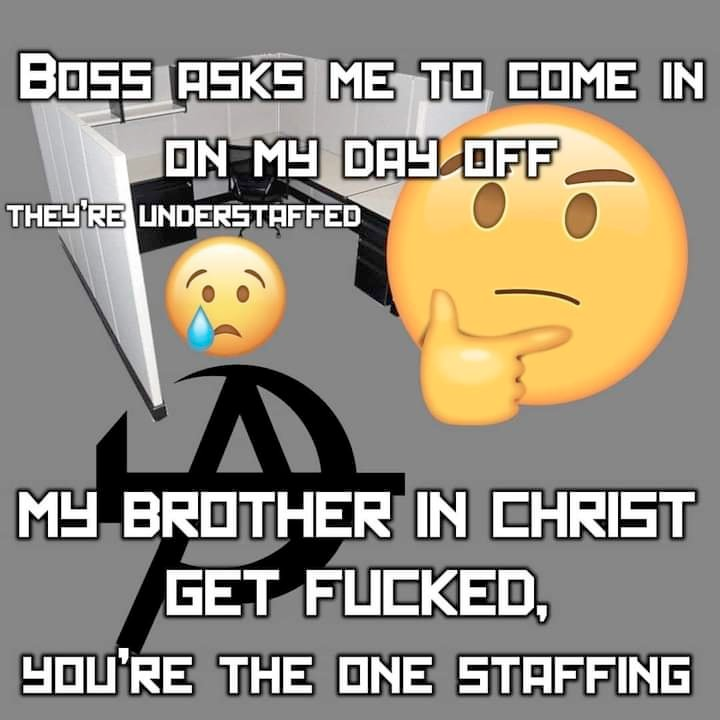
This meme is a satirical take on the struggles of working in a capitalist society. The image features a boss asking an employee to come in on their day off, with the employee responding with a series of sarcastic and profane statements, including "I'd rather die in a fire than come in to work today" and "You're the one who's going to get fired for this, not me". The meme pokes fun at the idea that employees are often forced to work long hours or come in on their days off, and that the boss is the one who will get in trouble for this.
detailed-analysis (gemma3-27b-vision)
Okay, let's break down this meme through a variety of theoretical lenses. It's a lot, and some lenses will be more fitting than others. I will section it as requested.
Visual Description
The image is a dark gray backdrop with a white and silver metallic-looking swirl pattern. The text is layered over it in a bright, outlined white font. There are two emoji: a crying face and a face with a grimace/grimace/exasperated expression. The text reads:
- “BOSS ASKS ME TO COME IN ON MY DAY OFF”
- “THEY’RE UNDERSTAFFED”
- “MY BROTHER IN CHRIST GET FUCKED, YOU’RE THE ONE STAFFING”
The aesthetic is visually jarring, relying on bold lettering and contrast to attract attention. It evokes a sense of exasperation and bitterness.
Foucauldian Genealogical Discourse Analysis
This meme is rich for a Foucault-inspired reading. The core issue isn’t simply “being asked to come in on a day off,” it’s the power dynamics that make that request possible.
- Discourse of Labor: The meme participates in a discourse around work, time, and the expectation of worker availability. This discourse assumes the boss has the right to ask, and the employee implicitly has a duty to respond (even negatively).
- Panoptic Control: While not directly literal, the "understaffed" rationale subtly invokes a form of surveillance and control. The employee knows they are being watched (performance expectations, potential consequences of saying no), and this knowledge shapes their behavior, even when not directly observed. The meme is a reaction to this internalized control.
- Genealogy of “Understaffed”: A genealogical approach would ask how "understaffed" became a justification for encroaching on worker’s time. It is framed as an inevitable, almost natural condition, absolving the employer of responsibility for poor planning or insufficient resources. This excuses a practice that benefits the employer at the expense of the worker.
- Power/Knowledge: The boss’s claim of being “understaffed” isn’t just a statement of fact; it's an exercise of power. It positions the boss as the arbiter of need and implicitly justifies the demand on the employee.
Critical Theory
Applying Critical Theory, the meme reveals underlying social structures that perpetuate exploitation and alienation.
- Instrumental Reason: The employer’s request exemplifies instrumental reason—treating the employee as a means to an end (maintaining production) rather than recognizing their inherent value and right to rest. The employee’s time off is deemed worthless in comparison to the immediate needs of the business.
- Domination and Control: The meme exposes a power imbalance where the boss holds the authority to demand, and the employee is expected to comply. This is a micro-example of broader systems of domination.
- Ideology: The “understaffed” rationale serves as an ideological justification for exploitative practices. It normalizes the expectation of worker sacrifice and obscures the underlying problems with management and resource allocation.
- Commodification of Labor: The employee’s time is treated as a commodity—something to be bought and sold according to the needs of the market (in this case, the needs of the employer).
Marxist Conflict Theory
This meme is prime material for a Marxist analysis.
- Class Struggle: The meme represents a microcosm of the ongoing class struggle between the capitalist employer and the wage laborer. The boss seeks to maximize profit by extracting more labor from the employee, even at the expense of their personal time.
- Exploitation: The employer is exploiting the worker's labor by demanding they work on their day off without likely offering adequate compensation or recognition.
- Alienation: The employee experiences alienation from their labor—their time off is not their own, but subject to the demands of the employer. They are reduced to a mere factor of production.
- False Consciousness: The "understaffed" rationale can be seen as a form of false consciousness—a justification for exploitation that obscures the true nature of the capitalist system.
Postmodernism
Postmodern readings could focus on the meme's deconstruction of meaning and the breakdown of traditional structures.
- Hyperreality and Simulation: The meme simulates a feeling of frustration and powerlessness. It’s a digital representation of a real-world experience. It's not the experience itself, but a representation.
- Deconstruction of Authority: The sarcastic and irreverent language ("get fucked") challenges traditional notions of authority. The meme subverts the power dynamic by expressing open disdain for the boss’s request.
- Irony and Parody: The meme is deeply ironic. It uses humor to expose the absurdity of the situation and the exploitative nature of the employer-employee relationship.
- Fragmentation of Meaning: The meme lacks a coherent resolution; it's simply an expression of frustration. This fragmentation mirrors the postmodern condition of uncertainty and meaninglessness.
Queer Feminist Intersectional Analysis
This is where things get trickier. Without knowing the specific demographics or experiences of the person who created the meme, this reading is more speculative. However, the meme can be interpreted through an intersectional lens:
- Gendered Expectations of Care Work: Historically, care work (often uncompensated) has been disproportionately assigned to women. The expectation that employees be "flexible" and sacrifice their time off can reinforce these gendered expectations. If the employee identifies as a woman, the request may feel particularly burdensome.
- Class and Labor: The meme highlights how those in lower socioeconomic classes (often disproportionately represented by marginalized groups) are more vulnerable to exploitation in the workplace.
- Religious Context & Internal Conflict: The phrase “My brother in Christ” adds a layer of complexity. It suggests the speaker shares a religious affiliation with the boss, which might create internal conflict. Does being a “brother in Christ” necessitate compliance with unjust demands? The sarcasm suggests the speaker rejects this expectation.
- Rejection of Normative Expectations: The blunt language and defiance of authority can be seen as a rejection of normative expectations regarding deference to authority and “playing the game.”
In conclusion: This meme is deceptively complex. It's a potent expression of frustration and exploitation that resonates with many people. The multiple theoretical lenses above reveal that the meme is not simply about a request to come in on a day off; it’s a microcosm of broader social, economic, and political issues.
simple-description (llama3.2-vision)
This meme is a humorous take on the classic "I can smell the desperation" phrase. The image shows a cartoon character with a thought bubble, where a text box says "Boss asks me to come in on my day off" and a smaller text box says "They're understaffed". The meme pokes fun at the common workplace experience of being asked to work on a day off due to staffing shortages.
tesseract-ocr
BossiAsks MS We) eal = (IN| oe) OEP . - M4_BROTHER! IN’ EHRIST GE T«<FUEKED: YOURE THE ONE: STARRING