First Seen
2023-05-10T21:03:33+00:00
simple-description (llama3.2-vision_11b)
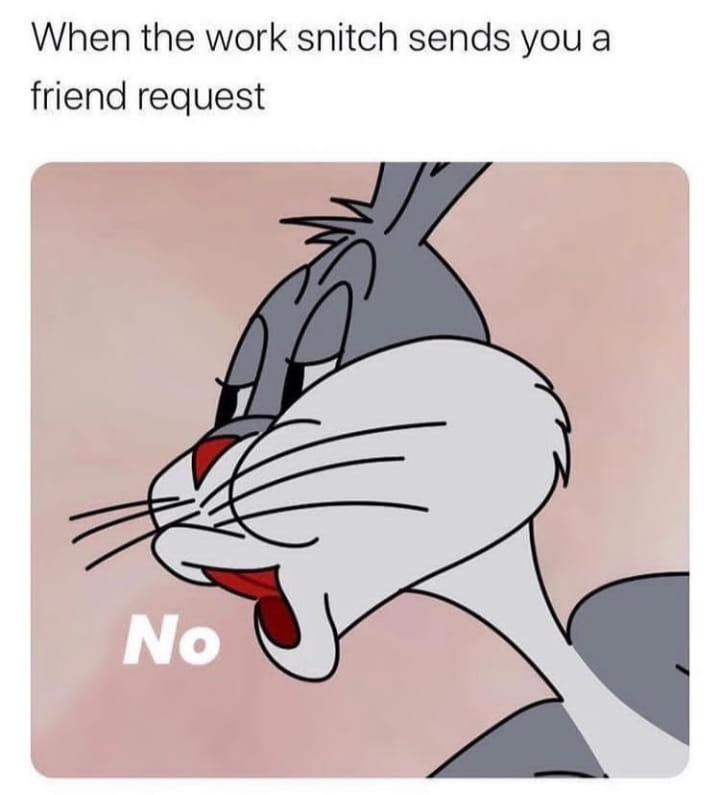
The meme is a humorous take on the concept of "snitching" in the workplace, where a colleague is being asked to report on someone else's activities. The image depicts a character from Looney Tunes, Bugs Bunny, with a "no" expression, implying that the character is refusing to comply with the request. The text "When the work snitch sends you a friend request" is a commentary on the awkwardness of being asked to report on someone's activities, and the character's "no" expression is a humorous way to express reluctance or refusal.
detailed-analysis (gemma3-27b-vision)
Okay, here's an analysis of the meme, broken down into the sections you requested, with explanations for why certain sections may not apply.
Visual Description
The meme features a still from a classic Looney Tunes cartoon. The character Bugs Bunny is shown in a moment of obvious rejection. His eyes are wide, and his mouth is pulled back in a visible "no" shape, visually communicating an emphatic refusal. The character is illustrated with smooth lines and the familiar gray, white, and black cartoon coloring, indicating a connection to a nostalgic and potentially lighthearted aesthetic. Below the image is the word "No," written in a large, simple white font. The background is a plain, muted reddish-brown color. The meme caption reads, "When the work snitch sends you a friend request."
Foucauldian Genealogical Discourse Analysis
This meme lends itself well to a Foucauldian analysis. The 'snitch' is a manifestation of panoptic power dynamics at play in the workplace. Foucault argued that power isn't just top-down, but is dispersed and operates through discourse and visibility. The 'snitch' is the extension of that disciplinary power, surveilling colleagues and reporting back to authority. The friend request is a subtle attempt to insert oneself into the observed’s sphere of visibility. It represents a micro-level power play—attempting to normalize surveillance and establish a connection for information gathering.
The meme's sharp "no" is a direct rejection of this attempt to enter the observed’s sphere of visibility and re-assert control. It signifies an understanding of the power dynamics and a refusal to participate in the snitch's disciplinary network. This refusal doesn’t just relate to the specific instance, but to the entire discourse surrounding workplace surveillance and the normalization of betrayal.
The image of Bugs Bunny is particularly apt. Bugs Bunny often subverts authority and challenges power structures with cunning and playful rebellion—acting as a historical marker that challenges norms and surveillance.
Critical Theory
From a Critical Theory perspective, this meme exposes the alienation inherent in modern work environments. The "snitch" is a symptom of a system prioritizing control and productivity over genuine human connection. The meme highlights the breakdown of solidarity amongst workers, creating an atmosphere of distrust.
The “friend request” is a false gesture of connection, a performative act of “friendship” masking the underlying motivations of control and reporting. This is seen as an insidious form of manipulation—a masking of the true power dynamics through the language of connection. The firm “no” indicates an awareness of this manipulation and a rejection of the superficiality of the "friendship" offer.
Furthermore, the meme implicitly critiques the conditions that produce the snitch—a system that incentivizes betrayal in order to maintain control. It suggests that the real problem isn’t the individual snitch, but the structures that encourage such behavior.
Marxist Conflict Theory
This meme, while seemingly simple, carries a potential connection to Marxist conflict theory. The 'snitch' can be seen as an agent of management, furthering the interests of capital by suppressing worker solidarity. In a Marxist framework, the workplace is a site of constant class struggle.
The snitch is a tool used by the bourgeoisie (management) to maintain control over the proletariat (workers). The friend request is an attempt to infiltrate the workers' network and gather information that could be used to suppress dissent.
The meme's "no" represents a refusal to cooperate with this power dynamic. It is an assertion of agency on the part of the worker, a rejection of the imposed surveillance, and a rejection of being used to further class divisions.
Postmodernism
The meme displays a degree of postmodern sensibility. The meme appropriates a classic cartoon character (Bugs Bunny) and repurposes it to comment on a contemporary issue (workplace surveillance). This blending of high and low culture is a hallmark of postmodernism.
Moreover, the meme highlights the constructed nature of "friendship" and "connection." The "friend request" isn't a genuine offer of connection, but a strategic maneuver motivated by power and control. This deconstruction of a seemingly natural concept aligns with postmodernism's skepticism toward grand narratives and essential meanings.
Queer Feminist Intersectional Analysis
While not explicitly present, a queer feminist intersectional reading is possible. Workplace dynamics are never neutral. Marginalized groups (women, people of color, LGBTQ+ individuals) may experience workplace surveillance and snitching in particularly acute ways, as they are often subjected to increased scrutiny and control. The “snitch” can become a vehicle for reinforcing existing power imbalances and maintaining oppressive structures.
The meme, in rejecting the friend request, can be read as an act of resistance against these oppressive forces. It's a refusal to be complicit in systems that seek to control and marginalize certain groups. However, this reading relies on contextualizing the meme within a broader understanding of workplace power dynamics and the experiences of marginalized individuals.
Let me know if you’d like me to expand on any of these points or analyze the meme from a different perspective.
simple-description (llama3.2-vision)
This meme features a screenshot of Bugs Bunny from the classic cartoon Looney Tunes. The image shows Bugs Bunny saying "No" with a shocked expression, as if he's just been asked to do something he doesn't want to do. The text above the image reads "When the work snitch sends you a friend request".
tesseract-ocr
When the work snitch sends you a friend request