First Seen
2023-05-10T21:03:33+00:00
simple-description (llama3.2-vision_11b)
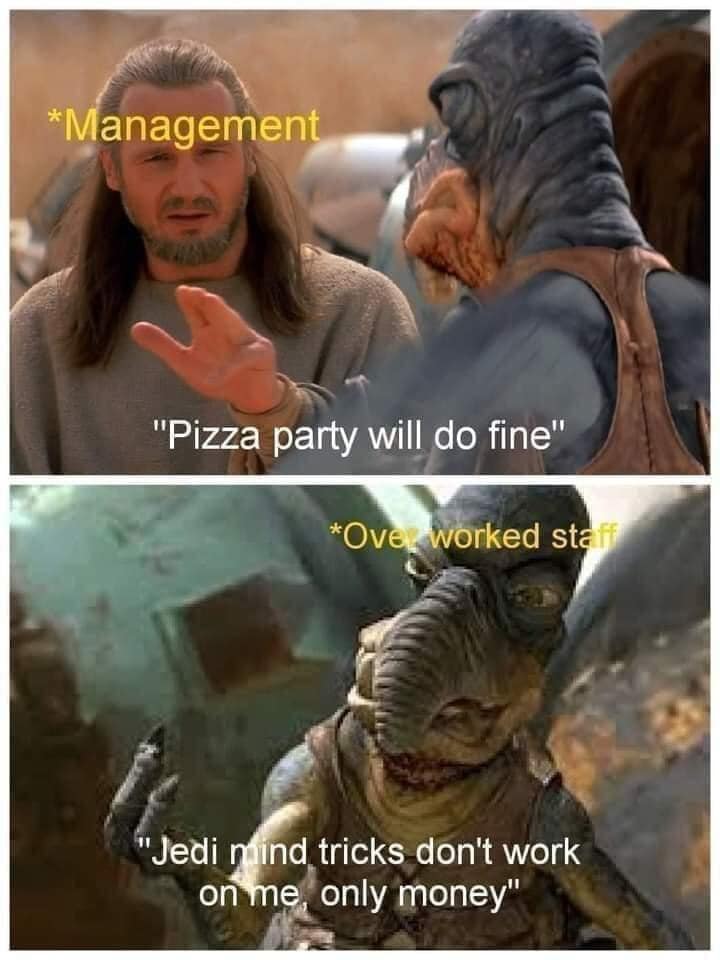
This meme is a humorous take on the frustrations of working in a job that's not fulfilling or has poor management. The image shows a character from Star Wars (Pablo) negotiating with a character from Star Wars (Pablo's character) about the lack of fun at a pizza party. The text on the image reads "Management: 'Pizza party will do fine'" and "Worker: 'Jedi mind tricks don't work on me, only money'". The meme is a commentary on the lack of fun in the workplace and the struggle to get paid for your work. It's a humorous way to poke fun at the struggles of working in a job that's not fulfilling.
detailed-analysis (gemma3-27b-vision)
Okay, here's an analysis of the meme using the requested theoretical frameworks, formatted with headings. I'll only include sections where the framework is actually relevant and can offer meaningful insight.
Visual Description
The meme uses a two-panel format based on scenes from Star Wars: Episode II – Attack of the Clones. The top panel shows Obi-Wan Kenobi, a Jedi Master, using a mind trick on a Quarren (a blue-skinned alien). The text over the panel reads "Management" and the dialogue is rendered as “Pizza party will do fine”. The bottom panel shows the Quarren, eyes narrowed, reacting to the attempt, and reads "Overworked Staff" and "Jedi mind tricks don't work on me, only money". The meme relies on the dramatic staging and expressions of the original scene for its comedic effect, juxtaposing them with the relatable context of workplace dynamics. The contrast in power dynamics between the Jedi and the Quarren is mirrored in the contrast between management and staff.
Foucauldian Genealogical Discourse Analysis
This meme offers a good illustration of Foucault's concepts of power/knowledge and discourse. The scene and its re-appropriation as a meme highlight the ways in which power operates not through overt force, but through subtle mechanisms of control and regulation.
- Discourse of Management: The "Pizza party will do fine" utterance embodies a discourse of appeasement common in many workplaces. This discourse positions the “solution” to worker dissatisfaction as superficial – a temporary “treat” rather than addressing root causes of exhaustion or exploitation. It’s a way to manage the perception of problems without enacting genuine change.
- Genealogy of Control: Tracing the history of this "pizza party" as a workplace solution reveals a genealogy of increasingly subtle methods of controlling labor. It moves away from direct, forceful methods (which are less palatable today) toward more indirect, psychological techniques.
- Resistance: The Quarren’s refusal to be swayed by the mind trick represents resistance to this discourse. The demand for "money" isn't just about material compensation; it’s a refusal to accept the symbolic gesture as a substitute for genuine valuation and fair treatment. It's a rejection of being governed through manipulation.
Marxist Conflict Theory
This meme is strongly rooted in Marxist conflict theory. At its core, it's a depiction of the inherent class struggle between the owners/managers of capital (represented by Obi-Wan) and the proletariat (represented by the Quarren).
- Exploitation: The Jedi’s attempt to placate the Quarren with a symbolic gesture (the "mind trick" equivalent of a pizza party) exemplifies the ways in which capital attempts to extract maximum value from labor while minimizing costs. It's an attempt to maintain a power imbalance by manipulating perception rather than addressing the underlying economic reality.
- False Consciousness: The mind trick itself can be interpreted as a metaphor for attempts to induce false consciousness – a state of being unaware of one's own exploitation. Management attempts to convince the worker that superficial rewards are sufficient.
- Class Consciousness & Demand for Material Value: The Quarren's response, "Jedi mind tricks don't work on me, only money," demonstrates class consciousness. The worker is recognizing their own material needs and rejecting the attempt to distract from them with empty promises. The demand for money is a demand for their labor value to be recognized. The desire for financial compensation over symbolic gestures represents a shift toward prioritizing material conditions over symbolic manipulation.
Postmodernism
The meme's use of a scene from a popular franchise and re-contextualizing it to represent contemporary workplace issues embodies some postmodern elements.
- Pastiche/Intertextuality: The meme is an example of pastiche or intertextuality; it borrows from an established cultural source (Star Wars) and blends it with a contemporary issue (employee burnout). This juxtaposition creates a new meaning that wouldn’t exist without the combination.
- Deconstruction of Authority: The meme deconstructs the assumed authority of management. By presenting a powerful Jedi as offering a superficial “solution,” it undermines the legitimacy of traditional power structures. It's saying that even a Jedi Master can’t simply “trick” workers into accepting exploitative conditions.
- Rejection of Grand Narratives: The meme subtly challenges the "grand narrative" that happy employees are simply those who are given perks. It argues for the importance of recognizing the material needs of workers and suggests that superficial rewards won't solve fundamental problems.
Let me know if you'd like me to elaborate on any of these points or apply additional theoretical frameworks!
simple-description (llama3.2-vision)
This meme is a humorous comparison between a management-style conversation and a more...unconventional one. The top image shows a manager saying "This pizza party will go fine" while the bottom image shows a character from the Star Wars prequels saying "This pizza party will go fine" in a more...unconventional way. The text at the top reads "Management: 'This pizza party will go fine'", while the text at the bottom reads "Actual worker: 'This pizza party will go fine... said no one ever'".
tesseract-ocr
ills A / \ . Ale, i poy i ' Le + of ~ ies nil aa = are 1M | . s « OM en cORE “ae ys « = E : i mf: 7 ae "Jedi ier don't work on i only money" _