First Seen
2023-05-10T21:03:33+00:00
simple-description (llama3.2-vision_11b)
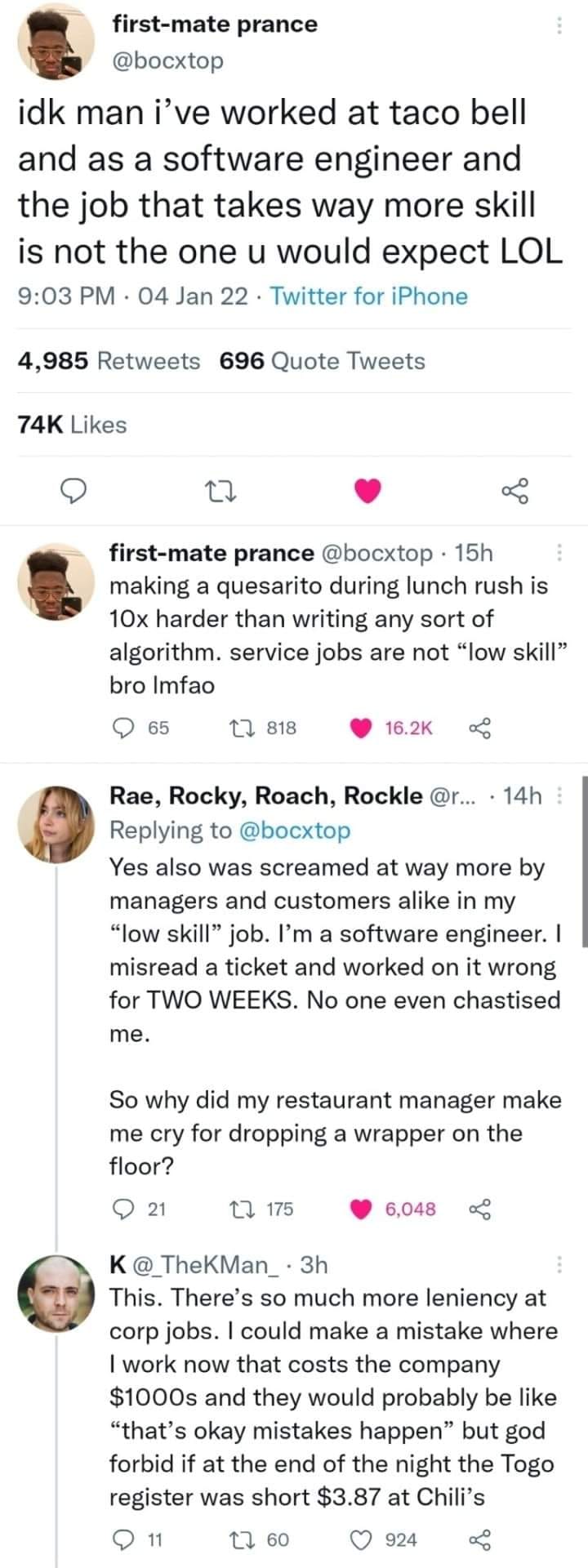
The meme is a screenshot of a Twitter conversation where a person is complaining about their job at Taco Bell, stating that they have a degree in computer science and are working as a software engineer, but are being treated poorly by their manager and are being asked to do menial tasks that are not in their job description. The conversation is full of complaints and frustrations about the job, and the person is seeking sympathy and understanding from their followers.
detailed-analysis (gemma3-27b-vision)
Okay, here's an analysis of the provided Twitter thread, broken down into sections as requested. I'll indicate when a section isn't applicable based on the content.
Visual Description
The image captures a Twitter thread consisting of four tweets. The first tweet is from the user @bocxtop, who claims they've worked at Taco Bell and as a software engineer, finding the Taco Bell job more demanding. The following three tweets are replies from other users—@RaeRock, @Roackle, and @TheKMan—echoing similar frustrations and adding points about the double standards of "skill" and accountability across different jobs. The interface shows the typical Twitter layout, including usernames, timestamps, engagement metrics (likes, retweets, replies), and profile pictures. The tone is conversational, frustrated, and pointed.
Foucauldian Genealogical Discourse Analysis
This thread exemplifies how discourses of "skill" are constructed and normalized through power dynamics.
- Discourse of Skill: The central debate revolves around what constitutes "skill." The original poster and repliers challenge the conventional assumption that "knowledge work" (like software engineering) is inherently more skilled than "service work" (like fast food). This demonstrates that skill isn't an inherent quality, but a socially constructed category.
- Power/Knowledge: The differing levels of acceptable error or lack of reprimand point to how power operates. In corporate jobs, mistakes costing significant sums are often absorbed or explained away as “mistakes happen.” In service jobs, even minor errors are met with immediate scrutiny and blame. This highlights how "knowledge" about what's acceptable is tied to power relationships, particularly between employer and employee.
- Genealogy: Tracing the history of the "skill" categorization would reveal how it arose with the rise of certain economic systems (e.g., valuing cognitive labor in the information age) and class structures. The thread implicitly challenges the genealogy of this categorization by showcasing the overlooked skills needed in service work.
- Discipline and Surveillance: The mention of getting "screamed at" and being held accountable for minor infractions in service jobs illustrates mechanisms of discipline. The lack of similar discipline in corporate jobs suggests different disciplinary regimes.
Critical Theory
This thread resonates with several themes in Critical Theory, particularly those concerning alienation and the devaluation of labor.
- Alienation: The disconnect between the perceived value of different kinds of labor is a central issue. Service workers feel undervalued and treated as easily replaceable, while white-collar workers are afforded greater leeway for mistakes. This contributes to feelings of alienation from their labor and the economic system.
- Commodification of Labor: Both fast food and software engineering are forms of commodified labor, but the social valuation differs vastly. This demonstrates that value isn’t inherent in the work itself, but is assigned by social and economic forces.
- Dominant Ideology: The thread challenges the dominant ideology that equates “skilled” with “intellectual” and devalues “manual” or “service” labor. It exposes how this ideology serves to justify inequalities in treatment and compensation.
Marxist Conflict Theory
This Twitter exchange provides a microcosm of class conflict and the exploitation inherent in capitalist systems.
- Bourgeoisie vs. Proletariat: While the specific jobs are diverse, the thread highlights the power imbalance between those in positions of authority (managers, corporations) and those performing service labor.
- Exploitation of Labor: The expectation of accepting blame for minor errors and the lack of accountability for large corporate mistakes underscores the exploitation inherent in the system. Workers (especially in service jobs) are held to a stricter standard and bear the brunt of responsibility for failures, while those in positions of power are shielded from consequences.
- False Consciousness: The normalization of different standards of accountability can be seen as a form of false consciousness, where workers accept inequalities as natural or inevitable. This thread challenges that acceptance.
Postmodernism
The thread can be viewed through a postmodern lens by focusing on the deconstruction of fixed categories and the fluidity of meaning.
- Deconstruction of "Skill": The core argument of the thread is a deconstruction of the concept of "skill." The users demonstrate that the meaning of "skill" is not fixed but is socially constructed and varies depending on context.
- Rejection of Grand Narratives: The thread implicitly rejects the grand narrative that associates intellectual labor with higher value. It argues for a more nuanced understanding of labor and value.
- Fragmentation of Meaning: The fact that the same action (making a mistake) is treated so differently in different contexts highlights the fragmentation of meaning in contemporary society.
Queer Feminist Intersectional Analysis
While not explicitly focused on queer or feminist themes, an intersectional analysis can enrich the reading. The thread highlights how pre-existing inequalities (class, occupation) intersect with expectations of labor.
- Gendered Labor: Service jobs are often disproportionately filled by women and marginalized groups. The lack of empathy or forgiveness in those positions could be seen as an extension of societal biases. The tolerance for corporate errors and dismissal of smaller errors at lower wage jobs, may reinforce existing power structures.
- Intersection of Class and Occupation: The thread demonstrates how class intersects with occupation to shape experiences of power and accountability. Those in lower-paying, service-oriented jobs often lack the social capital and resources to challenge unfair treatment.
I hope this analysis provides a comprehensive overview of the Twitter thread from these different theoretical perspectives. Let me know if you’d like me to elaborate on any specific section.
simple-description (llama3.2-vision)
This meme is a screenshot of a Twitter conversation between two users, "first-mate" and "user", where "first-mate" shares a humorous anecdote about his experience working at Taco Bell. The text reads: "I worked at Taco Bell and as a software engineer and the job that takes way more skill is not the one you would expect LOL".
tesseract-ocr
) first-mate prance @bocxtop idk man i’ve worked at taco bell and as a software engineer and the job that takes way more skill is not the one u would expect LOL 9:03 PM - 04 Jan 22 - Twitter for iPhone 4,985 Retweets 696 Quote Tweets 74K Likes QO a ~ —% . first-mate prance @bocxtop - 15h & making a quesarito during lunch rush is 10x harder than writing any sort of algorithm. service jobs are not “low skill” bro Imfao © 65 tT) 3818 16.2 < Rae, Rocky, Roach, Rockle @r... - 14h Replying to @bocxtop Yes also was screamed at way more by managers and customers alike in my “low skill” job. I’m a software engineer. | misread a ticket and worked on it wrong for TWO WEEKS. No one even chastised me. So why did my restaurant manager make me cry for dropping a wrapper on the floor? © 21 Tl 175 6048 K @ TheKMan_-: 3h This. There’s so much more leniency at corp jobs. | could make a mistake where | work now that costs the company $1000s and they would probably be like “that’s okay mistakes happen” but god forbid if at the end of the night the Togo register was short $3.87 at Chili’s On tT 60 QO 924 S