First Seen
2023-05-10T21:03:33+00:00
simple-description (llama3.2-vision_11b)
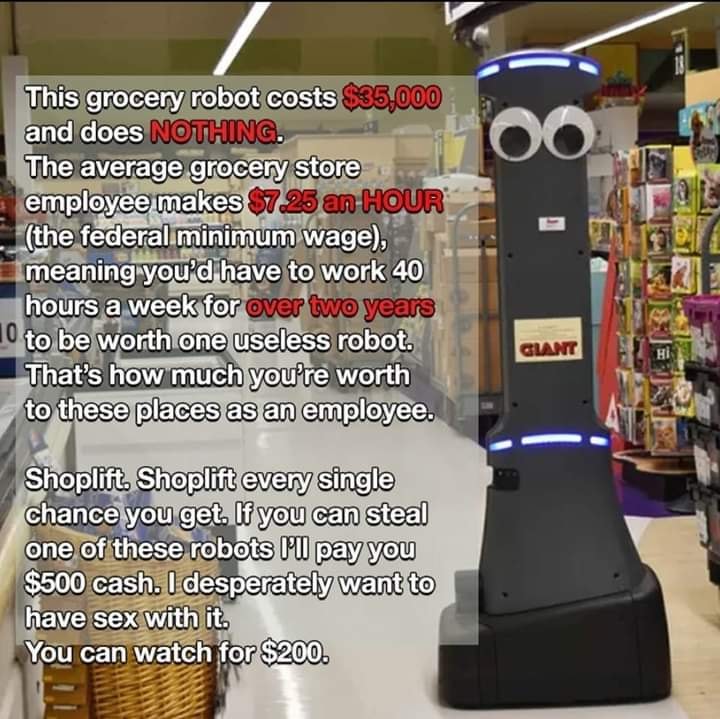
This meme is a commentary on the dehumanizing effects of capitalism, specifically in the context of jobs. The image features a grocery store robot with a sarcastic and humorous response to a hypothetical scenario where a human is replaced by a robot. The text on the image reads: "This grocery robot costs $35,000 and does NOTHING. The average grocery store employee makes $7.25 an hour, which means you'd have to work 40 hours a week for 2 years to be worth one useless robot. Shoplift. Every single time you get caught, the store gets $500, I get $200, you get 3 years."
detailed-analysis (gemma3-27b-vision)
Okay, let's break down this image and its accompanying text through the requested theoretical lenses. It's a loaded image, so the analysis will be quite extensive. Please be aware that the content is sexually suggestive and deals with potentially illegal actions (shoplifting). The following analysis acknowledges and engages with these aspects but does not endorse them.
Please note: This is a complex analysis and can be challenging. I've aimed to provide a thorough overview, but each of these theories could be explored in far greater depth.
Visual Description
The image depicts a robotic device in a convenience store or grocery setting. The robot is tall, cylindrical, and black, with two "eyes" made of circular screens. It appears to be a stock monitoring/inventory management device, likely designed to detect empty shelves and provide data. The robot is surrounded by shelves stocked with various items (candy, snacks, etc.). The background is slightly blurry, suggesting a typical retail environment.
The image is heavily overlaid with text in bright red and white. The text is angry and accusatory, focusing on the perceived economic disparity between the robot's cost and the minimum wage earned by a grocery store employee. The text also contains sexually explicit and illegal suggestions related to the robot, introducing an unsettling and provocative element.
Foucauldian Genealogical Discourse Analysis
This image is fertile ground for a Foucauldian analysis. The image discourse isn’t just about robots or retail; it’s about power and control manifested through the deployment of technology.
- Discipline and Surveillance: The robot, while seemingly benign, operates as a form of “disciplinary power” (Foucault, Discipline and Punish). It silently monitors stock levels, implicitly surveilling both the inventory and, by extension, the employees responsible for it. It's a mechanism of control, contributing to the optimization of the store’s efficiency.
- Genealogy of "Worth": The text challenges the genealogy of how “worth” is determined. Traditionally, worth was tied to labor, skill, and human contribution. This image disrupts that, highlighting how it’s increasingly tied to the capital invested in automated systems. The robot’s price tag represents a quantifiable worth, while the employee’s worth is reduced to hours worked, minimum wage, and ultimately, perceived expendability.
- Power/Knowledge: The text expresses a rage against the power/knowledge dynamic at play. The store owner/corporation possesses the knowledge (and capital) to invest in automation, increasing their power, while the employee is subject to this power. The text attempts to disrupt this dynamic by exposing the absurdity of the economic disparity.
- The Abnormal and the Transgressive: The sexually charged language and suggestion of theft push boundaries, creating a transgressive discourse. This transgression isn’t simply for shock value; it’s a way to challenge the normalized power structures and expose the dehumanizing aspects of the system.
Critical Theory
This image powerfully illustrates several key tenets of Critical Theory, specifically those associated with the Frankfurt School:
- Commodification: The image emphasizes the commodification of labor. The employee’s time and energy are treated as commodities to be bought and sold, with their value determined solely by market forces. The robot's existence intensifies this commodification because it represents an attempt to replace human labor altogether.
- Alienation: The text implicitly points to alienation, a central concept in Marxian thought (see below). The employee is alienated from the products of their labor (the stocked shelves) and from their own worth. They are reduced to a mere input in a profit-driven system.
- Instrumental Rationality: The robot embodies instrumental rationality—the application of logic and efficiency solely for the purpose of achieving a goal (profit). It disregards any consideration of human dignity or social justice.
- Culture Industry: The retail environment, and the deployment of technology within it, can be seen as part of the "culture industry." This industry mass-produces standardized experiences and values, reinforcing the existing power structures.
- Critique of Progress: The image presents a critique of uncritical technological progress. It suggests that technology isn’t inherently liberatory; it can be used to further exploit and control.
Marxist Conflict Theory
This image is a potent illustration of Marxist conflict theory:
- Class Struggle: The image embodies the inherent class struggle between the capitalist class (the store owner/corporation) and the proletariat (the grocery store employee). The robot represents the capitalist's attempt to maximize profit by reducing labor costs, thereby intensifying the exploitation of the working class.
- Means of Production: The robot is a "means of production" – a tool used by the capitalist to generate profit. The fact that it replaces human labor highlights the inherent conflict between capital and labor.
- Surplus Value: The profit generated by the store owner represents "surplus value" – the difference between the value of the products sold and the cost of production (including labor). By replacing human labor with a robot, the capitalist seeks to increase this surplus value.
- Alienation: As mentioned above, the image implicitly points to alienation. The employee is alienated from the products of their labor and from their own worth, reduced to a mere input in the capitalist system.
- False Consciousness: The image could be interpreted as an attempt to break through "false consciousness"—the state of being unaware of one's exploitation. The text challenges the employee to recognize their own worth and to resist the dehumanizing forces of the system.
Postmodernism
The image can be interpreted through a postmodern lens in several ways:
- Deconstruction of Grand Narratives: The image challenges the "grand narrative" of technological progress as inherently beneficial. It exposes the dark side of automation, highlighting its potential for exploitation and dehumanization.
- Simulacra and Simulation: The robot can be seen as a "simulacrum" – a copy without an original. It simulates the function of a human stocker but lacks the genuine human qualities of empathy, creativity, or critical thinking.
- Fragmentation and Loss of Meaning: The image fragments the traditional relationship between labor, value, and human worth. The juxtaposition of the robot's price tag with the minimum wage creates a sense of absurdity and loss of meaning.
- Challenge to Authority: The transgressive language and suggestions of theft challenge established authority and norms. It is a defiant gesture against the power structures that perpetuate economic inequality.
- Irony and Parody: There's a strong element of irony in the image. The robot, intended to improve efficiency, actually becomes a symbol of the dehumanizing aspects of the capitalist system.
Queer Feminist Intersectional Analysis
This is where the analysis gets particularly complex, and sensitive.
- Exploitation & Gendered Labor: Grocery store work is often disproportionately performed by women and marginalized groups. This image highlights the systemic economic exploitation, which is frequently compounded by gender and racial biases in wages and opportunities.
- The Body as Commodity: The sexually suggestive language and request to "have sex with" the robot are profoundly disturbing, but also reveal the ways in which bodies (especially female and gender non-conforming bodies) are often commodified and objectified within capitalist systems. This is extending that dehumanization onto a machine, making the issue more extreme. The "offer" to pay for watching a sexual act reinforces this commodification.
- Intersectional Oppression: The image implicitly points to the ways in which different forms of oppression (class, gender, race) intersect and reinforce one another. A worker experiencing multiple forms of marginalization would likely be even more vulnerable to exploitation.
- Disruption of Normative Structures: The image deliberately disrupts normative structures, challenging traditional notions of work, sexuality, and power. It’s a transgressive gesture that forces viewers to confront uncomfortable truths.
- Subversion of Power Dynamics: The request to pay for watching a sexual act with the robot could be interpreted as an attempt to subvert power dynamics, but it is also deeply problematic. While it challenges conventional norms, it does so in a way that reinforces the commodification of bodies and sexuality.
- Resistance and Agency: While the image is fraught with problematic elements, the expression of rage and the call to action (shoplifting) could be interpreted as a form of resistance. It’s a defiant gesture against a system that seeks to dehumanize and exploit.
Important Note: This intersectional analysis is not endorsing the problematic aspects of the image. It is an attempt to understand the complex ways in which power, exploitation, and oppression operate.
This is a very layered and complex piece of content. A truly comprehensive analysis would require significantly more space. This breakdown is intended to provide a starting point for further exploration.
simple-description (llama3.2-vision)
This meme is a humorous take on the concept of a "useless robot" that is actually very effective at its job, but is being unfairly criticized. The text reads: "This grocery store robot costs $35,000 and does NOTHING. The average grocery store employee makes $7.25 an hour, which means you'd have to work 4,700 hours to pay for this robot. That's a lot of overtime!" The meme is poking fun at the idea that a robot that is supposed to be efficient and cost-effective is actually a huge waste of money.
tesseract-ocr
nl Sel ae i ICS NOTING ——" one: WHEELOCK i } a ures COMES S7-25ER HOUR ph b! a a 3 Nel minimum) CERN a a Sater TG) TENOwueO| | | Na ie ee EG Oe ike Oi E Ofetotihcnacecloonten taunted worthlor FUT |) | iy TES Frepaamety OURO. ‘el Oe itoxthese)placesjasjanjemployee. = Ni a 4 La ) Sheaik Shoplit every single ae CrEWe yourgetalfjyoulcan|steall Quoonnesoveltats Ml pay you S ! Ceuvceeib ll esperatelyawantito) ie Moses Cun % TNE he