First Seen
2023-05-10T21:03:33+00:00
simple-description (llama3.2-vision_11b)
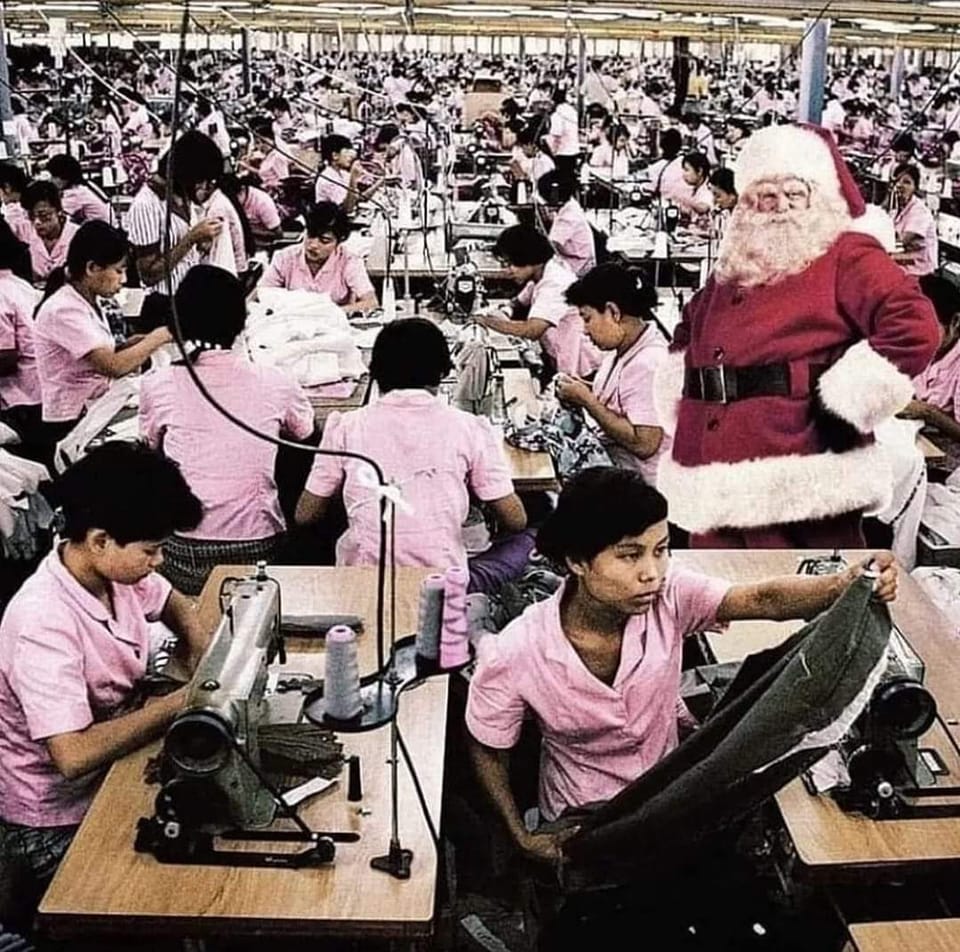
This meme is a satirical commentary on the exploitation of workers in the manufacturing industry, particularly in the context of Christmas. The image depicts a crowded factory floor where workers are laboring to meet the demands of the holiday season, with a surprise appearance by Santa Claus, who is often associated with the joy and magic of Christmas. The text "Santa's Workshop: Where the magic of Christmas is made" appears on the image, highlighting the irony of the situation, where workers are toiling in a factory that is supposed to be a place of joy and magic, but is actually a site of exploitation.
detailed-analysis (gemma3-27b-vision)
Okay, let's break down this powerful image through several theoretical lenses.
Visual Description
The photograph depicts a vast factory interior, filled with rows upon rows of workers – predominantly women – seated at sewing machines. They are engaged in meticulous, repetitive labor, likely assembling clothing. The workers are dressed identically in light pink shirts, creating a visual uniformity. The lighting is bright and institutional. The sheer scale of the factory is overwhelming, with workers extending into the depth of the image. Superimposed into the background, in a position of authority, is a large, red-suited Santa Claus. The workers are Asian, and the setting appears to be in a developing nation, due to the older equipment and the labor conditions. The color palette is dominated by the pink of the uniforms, the red of Santa Claus, and the gray of the industrial setting, creating a stark and somewhat unsettling contrast.
Marxist Conflict Theory
This image is practically a visual manifesto of Marxist conflict theory. The central tension is the exploitation of labor to generate profit. The photograph shows the clear class divide: on one side, the countless workers engaged in the monotonous, low-wage labor that produces the goods enjoyed by consumers in wealthier nations; on the other, the symbolic figure of Santa Claus—representative of the capitalist system that perpetuates this disparity.
- Alienation: The workers are alienated from the products of their labor, the labor process itself, and from each other. They are reduced to cogs in a machine, devoid of creativity or autonomy.
- Surplus Value: The image implies the extraction of surplus value: the difference between the cost of labor and the price of the finished goods. This profit accumulates in the hands of those who own the means of production, leaving the workers with only a small fraction of the value they create.
- False Consciousness: The presence of Santa Claus is particularly poignant. He's the symbol of consumerism and the "magic" of gift-giving. He obscures the real cost of these gifts—the labor of the workers—creating a false consciousness among consumers who remain unaware of the exploitative conditions that make their purchases possible.
- Class Struggle: The scene is a stark representation of the inherent class struggle within capitalism. It’s a visual argument for the need for collective action and the re-distribution of wealth.
Foucauldian Genealogical Discourse Analysis
A Foucauldian lens focuses on the power dynamics embedded within the systems that organize this factory.
- Discipline and Panopticism: The factory space itself functions as a disciplinary space. The rows of workers, the constant surveillance (implied, even if not visible), and the standardization of their work are all forms of control. While the image doesn’t explicitly show surveillance, the sheer uniformity suggests a system designed to monitor and regulate every movement. It evokes a panoptic model, where workers internalize the gaze of authority and self-regulate their behavior.
- Power/Knowledge: The organization of this factory isn't just about control; it's about the production of knowledge. The factory knows how to efficiently extract labor, to standardize production, and to maximize profit. This knowledge isn’t neutral; it’s a form of power, used to maintain the existing social order.
- Genealogy of Santa Claus: We can trace a genealogy of the figure of Santa Claus. Originally a religious figure, he was gradually secularized and commercialized, becoming a symbol of capitalist consumption. This commercialization masks the exploitative conditions of production, presenting a sanitized image of gift-giving that hides the labor and exploitation behind it. The image actively constructs the figure of Santa as an emblem of this exploitation.
- Normalization: The repetitive, dehumanizing labor is presented as "normal," a routine part of the production process. This normalization is a key mechanism of power, obscuring the inherent injustice of the situation.
Critical Theory
A critical theory lens expands on the Marxist and Foucauldian frameworks.
- Culture Industry: The image directly speaks to the concept of the culture industry. Santa Claus is a product of the culture industry, a manufactured symbol used to promote consumerism and obscure the realities of production. This image is a critique of how the culture industry reinforces existing power structures and perpetuates inequality.
- Commodification of Labor: The workers' labor is reduced to a commodity, stripped of its human dignity and intrinsic value. They are not seen as individuals, but as units of production. The focus is solely on output, not on the well-being of the workers.
- Ideology and False Consciousness: The image exposes how ideology functions to maintain the status quo. Santa Claus represents a comforting narrative of generosity and abundance that masks the exploitative realities of global capitalism. This false consciousness prevents workers from recognizing their own oppression and taking collective action.
- Critique of Modernity: The image can be read as a critique of modernity and its emphasis on efficiency, standardization, and technological advancement. These principles have created a system that prioritizes profit over people, leading to the exploitation of vulnerable workers.
Postmodernism
A postmodern perspective might approach this image in a slightly different way.
- Deconstruction of Santa Claus: The image subverts the traditional representation of Santa Claus. Instead of a benevolent figure bringing joy, he is positioned as a symbol of exploitation and oppression. This deconstruction challenges the accepted meaning of Santa Claus and reveals the underlying power dynamics at play.
- Hyperreality: The image blurs the lines between reality and representation. The idealized image of Santa Claus is superimposed onto the harsh reality of the factory, creating a sense of hyperreality where the distinction between the two becomes blurred.
- Fragmentation and Loss of Meaning: The image can be seen as a representation of the fragmentation and loss of meaning that characterize postmodern society. The traditional values of labor, community, and meaning are eroded by the forces of global capitalism.
- Critique of Grand Narratives: Postmodernism rejects universal explanations. This image highlights the complexities of the global supply chain and the impossibility of reducing it to a single narrative.
Queer Feminist Intersectional Analysis
This image particularly lends itself to a queer feminist intersectional reading, as it brings together gender, race, class, and global capitalism.
- Gendered Labor: The image highlights how low-wage, repetitive labor is often disproportionately performed by women. This gendered division of labor reinforces patriarchal structures and perpetuates economic inequality.
- Racialized Capitalism: The workers are visibly Asian, and this points to the historical and ongoing dynamics of racialized capitalism. The exploitation of labor in the Global South is often linked to colonial legacies and systemic racism.
- Intersectionality: The workers are not just women and/or Asian; they occupy multiple marginalized positions. Their gender, race, and class intersect to create unique forms of oppression. This intersectional analysis helps us understand the complex ways in which power operates.
- Commodification of Women's Bodies: The image can be interpreted as a form of commodification of women's bodies. Their labor is treated as a resource to be exploited, and their bodies are subjected to the demands of the production process.
- Challenging Dominant Narratives: The image challenges the dominant narratives of consumerism and economic progress. It exposes the hidden costs of these systems and calls attention to the ways in which they perpetuate inequality.
I hope this thorough breakdown of the image, through multiple theoretical lenses, is helpful! Let me know if you'd like me to elaborate on any specific aspect.
simple-description (llama3.2-vision)
This meme is a humorous image of a crowded factory floor where workers are toiling away at their sewing machines. In the foreground, a worker is seated at a machine with a sign that reads "1 in 3 errors are due to lack of sleep". The image is a play on the classic "1 in 3" joke, where a worker is seated at a machine with a sign that reads "1 in 3 errors are due to lack of sleep".
tesseract-ocr
= ween ees Se RAS he sg Tea). aera oe woh a rap act eo ere | a pre er CS a Gye aes Ce AG > hh a? Se 5 sac) Rt VW ru) ey Lo 4 al 40a pies os en gee a pV vt Sa | ee othe : A 2. Ee, ee core | : ier a ay Na A iy rN i ae | oy , oo eS eh . se Z aM a y Yh Ces. oe Fa ~ CS ‘= glad TEP Za i oF i = J 3 3 . Y c / A iy. ee ON A, le ELL Sig ; % 7 q S ee . ay . ead 1 7 . Beavis Ridi eg . \