First Seen
2023-05-10T21:03:33+00:00
simple-description (llama3.2-vision_11b)
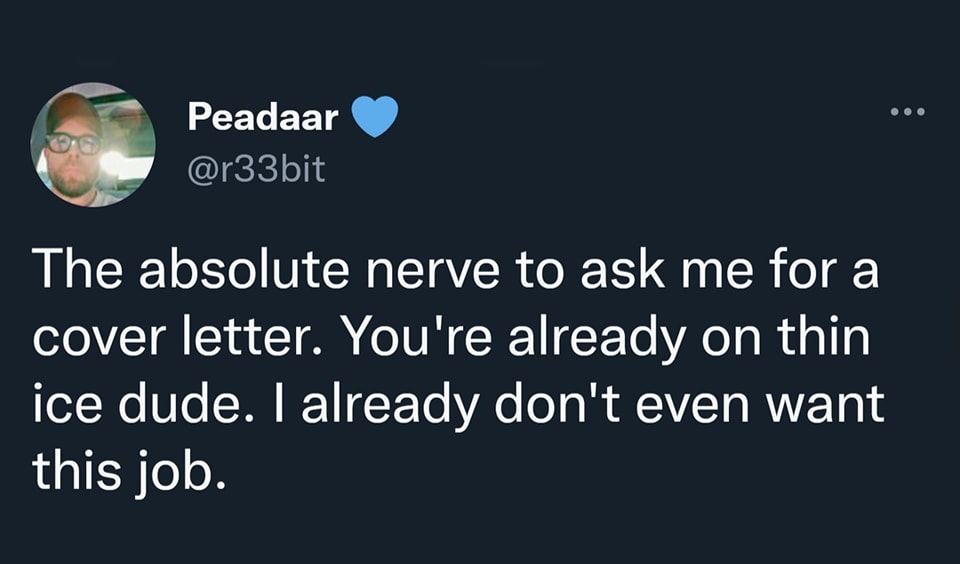
The meme is a humorous take on a job interview scenario, where the interviewer is asking for a cover letter. The text reads: "The absolute nerve to ask me for a cover letter. You're already on thin ice, dude. I already don't even want this job." The meme is poking fun at the idea that the interviewer is expecting a cover letter, but the job applicant is already unhappy with the job and doesn't want to be there.
detailed-analysis (gemma3-27b-vision)
Here's an analysis of the tweet, broken down into relevant theoretical frameworks. Note that not all sections apply, and some frameworks blend into one another.
Visual Description
The image is a screenshot of a tweet from the user @r33bit, whose profile picture is a somewhat pixelated image of a person, possibly male, with facial hair. The background is the standard dark blue of the Twitter/X platform. The tweet's text is centered and written in white.
Foucauldian Genealogical Discourse Analysis
This tweet is ripe for a Foucauldian analysis. The demand for a cover letter—and the accompanying frustration—is not merely an isolated instance of an annoying hiring practice. It's a manifestation of a discourse surrounding work, qualification, and the construction of the "ideal worker."
- Power/Knowledge: The demand for a cover letter is an act of power. The employer demands this additional labor from the applicant, positioning themselves as the evaluator and the applicant as needing to prove their worth. Knowledge isn’t neutral here; the very definition of what constitutes a “qualified” applicant is constructed and maintained by this discourse.
- Disciplinary Practices: The cover letter functions as a disciplinary practice. It’s not about the actual skill set, but about demonstrating a willingness to perform unpaid labor, to submit to the evaluation, and to conform to the expected modes of self-presentation. The tweet responds to this disciplinary power, rejecting it with a tone of defiance.
- Genealogy: A genealogical approach would look at the historical emergence of the cover letter as a standard requirement. How did this practice originate? What power dynamics were at play in its establishment? What assumptions about work ethic and "professionalism" does it reinforce?
Critical Theory
The tweet embodies key themes from Critical Theory, particularly those concerned with domination and alienation.
- Instrumental Rationality: The insistence on a cover letter, a task that often feels performative and disconnected from actual work abilities, is an example of instrumental rationality taken to an extreme. The process of application (performing the letter-writing) is prioritized over the substance of a candidate's skills.
- Alienation: The tweet highlights the alienating nature of the job application process. The applicant is reduced to a set of credentials and a performance of willingness, rather than being seen as a whole person. They feel exploited, doing extra, unpaid work that doesn’t demonstrate their capacity to do the job.
- Critique of Bureaucracy: The request for a cover letter is a hallmark of bureaucratic procedures, which can often prioritize rules and form over genuine evaluation of skill and talent.
Marxist Conflict Theory
From a Marxist perspective, the tweet reflects the inherent class conflict in the labor market.
- Exploitation of Labor: The requirement for a cover letter constitutes a form of unpaid labor. The applicant spends time and effort writing a document that directly benefits the employer (by filtering applications) but for which they receive no compensation.
- Power Imbalance: The employer holds all the power in this interaction. They dictate the terms of application, and the applicant is forced to comply if they want to be considered. The tweet expresses frustration with this power imbalance.
- Commodification of Labor: The applicant is treated as a commodity, evaluated based on their perceived value to the employer, rather than as a human being with intrinsic worth.
Postmodernism
A postmodern reading would highlight the performativity and artificiality of the application process.
- Deconstruction of Authenticity: The cover letter requires the applicant to construct a narrative of themselves that is deemed "professional" and appealing to the employer. This creates a disconnect between the "authentic self" and the "presented self." The tweet implies a rejection of this performative aspect.
- Relativism and Subjectivity: The idea of a "qualified" applicant is not objective but constructed through social and cultural norms. The tweet suggests that the employer's criteria are arbitrary and that the applicant has no inherent obligation to comply with them.
- Simulation and Hyperreality: The application process, with its emphasis on credentials and self-presentation, can be seen as a simulation, divorced from the reality of actual work.
Queer Feminist Intersectional Analysis
While the tweet itself doesn't explicitly address issues of gender, sexuality, or race, an intersectional lens helps reveal how power dynamics are amplified by these factors within the job market.
- Amplification of Disadvantage: While the author’s identity is unknown, marginalized groups (women, people of color, LGBTQ+ individuals, people with disabilities) often face additional pressures and scrutiny in the application process. They may be expected to work harder to prove their competence, to overcome stereotypes, and to navigate systemic biases.
- The performance of ‘professionalism’: The demand for a certain type of self-presentation in cover letters, and resumes, is often gendered and racialized. Standard “professional” norms often require assimilation, and may not align with the experiences, values, or cultural practices of individuals from diverse backgrounds.
- Rejection of Normative Expectations: The blunt, unapologetic tone of the tweet can be interpreted as a rejection of normative expectations around politeness, deference, and the performance of "professionalism"—a potentially empowering act for individuals who have been marginalized by these norms.
It's important to note that these analytical frameworks are not mutually exclusive. They can be used in combination to provide a richer and more nuanced understanding of the tweet.
simple-description (llama3.2-vision)
This meme is a humorous take on a job application. It features a screenshot of a job application with a cover letter that reads: "The absolute nerve to ask me for a cover letter. You're already on thin ice, dude. I already don't want to work for you." The image is likely accompanied by a sarcastic or annoyed tone, implying that the applicant is not interested in working for the company and is only applying because they need a job.
tesseract-ocr
es Peadaar @ 00¢ W @r33bit The absolute nerve to ask me for a cover letter. You're already on thin ice dude. | already don't even want this job.