First Seen
2023-05-10T21:03:33+00:00
simple-description (llama3.2-vision_11b)
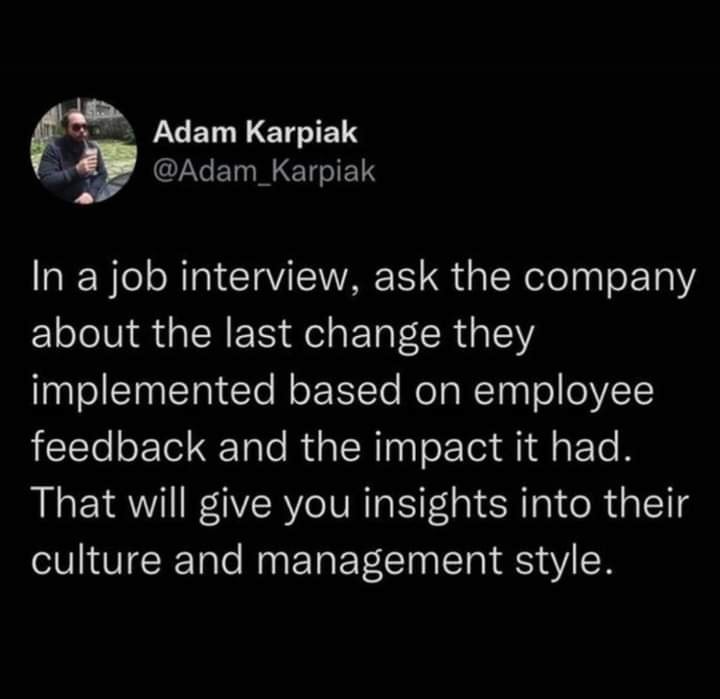
The meme is a humorous take on a job interview question. It's a screenshot of a Twitter post by @AdamKor that reads: "In a job interview, ask the company about the last change they implemented based on employee feedback and the impact it had. That will give you insights into their culture and management style."
detailed-analysis (gemma3-27b-vision)
Okay, let's break down the image/text as a social commentary, analyzing it through the lenses you requested.
Visual Description
The image is a screenshot of a social media post (likely Twitter/X) from an account named Adam Karpiak (@Adam_Karpik). It shows a profile picture of a person with a beard, wearing glasses and a green jacket, appearing as a headshot. The background is black. The majority of the image is taken up by text in white, presenting a piece of advice for job interviewees. It's a simple, clean layout meant for rapid communication in a digital space.
Foucauldian Genealogical Discourse Analysis
This advice very directly taps into Foucault's ideas about power/knowledge and discourse. The advice suggests the interviewee actively probes for the “discourses” that shape the organization.
- Power/Knowledge: The advice isn’t about “good” or “bad” company practices; it’s about understanding how power operates through discourse. The question aims to reveal how the company constructs its reality. By asking about changes based on employee feedback, you aren't just gathering information; you're trying to map the mechanisms through which the company defines "improvement," "feedback," and "impact."
- Genealogy: The question seeks to understand the history of the company's response to employee voices. The company’s process of implementing (or not implementing) changes based on feedback reveals how certain practices have become normalized and legitimized over time. It traces a lineage of power relations. What was the original impetus for gathering feedback? How has that evolved?
- Discipline & Surveillance: Asking about the impact of the change probes how the company monitors and assesses effectiveness. This gets to the heart of Foucault's ideas about how institutions create systems of discipline and surveillance, even seemingly "positive" initiatives like seeking employee input.
Critical Theory
This advice aligns with the core tenets of Critical Theory, particularly Frankfurt School thought:
- Ideology Critique: The suggestion exposes the potential for hidden ideologies within seemingly benevolent organizational practices. "Seeking employee feedback" can be presented as a positive, employee-centric value, but this question forces a deeper examination: How genuinely is feedback integrated? Whose voices are prioritized? What is the real agenda behind soliciting input?
- Emancipation/Enlightenment: The advice implicitly suggests an attempt at emancipation through knowledge. By understanding the company’s power structures, the interviewee can make a more informed decision about whether to join and, if so, how to navigate those dynamics. It's a move towards critical consciousness.
- Reason & Domination: The advice implicitly acknowledges how "rational" processes, like gathering feedback and implementing change, can be used as tools of domination. The question encourages an analysis of how these processes serve the interests of those in power.
Marxist Conflict Theory
From a Marxist perspective, this advice is a subtle form of class consciousness.
- Power Dynamics: It centers the examination of inherent power imbalances between management and employees. The question is not about whether the company tries to listen to employees, but about the actual outcomes of that listening. It’s about who benefits from the changes implemented (or not implemented).
- False Consciousness: A company’s superficial engagement with employee feedback can be seen as a way to maintain false consciousness—making employees feel heard while ultimately reinforcing existing power structures. This advice helps the interviewee pierce through that illusion.
- Class Struggle: While not explicitly framing it as "struggle," it acknowledges a fundamental tension between those who manage and those who are managed. Understanding how the company responds to dissent or suggestions is vital for understanding its relationship to its labor force.
Postmodernism
The advice fits with postmodern ideas in the following ways:
- Deconstruction: The question is implicitly about deconstructing the company’s narrative. It challenges the idea that “listening to employees” is inherently positive. It asks for the "real" story behind the official claim.
- Rejection of Grand Narratives: It rejects the idea that there is a single, universal "good" way to manage a company. It encourages the interviewee to be skeptical of all claims and to examine the local context.
- Emphasis on Discourse: The focus on how the company speaks about its practices (e.g., "impact," "feedback") highlights the role of language in shaping reality. It assumes that meaning is not inherent but is constructed through discourse.
Queer Feminist Intersectional Analysis
While not the primary focus, this advice can be viewed through a queer feminist intersectional lens:
- Power Imbalances: It recognizes that power imbalances are multiple and intersecting. The company’s response to feedback might privilege certain voices (e.g., those of dominant groups) while silencing others.
- Marginalized Voices: It implicitly encourages the interviewee to consider whose feedback is valued, and whose is ignored. This can expose patterns of discrimination or exclusion.
- Challenging Norms: Asking about the impact of changes can reveal whether the company is genuinely committed to creating an inclusive environment, or simply engaging in performative activism. It forces a reckoning with how feedback loops reinforce norms of power and privilege.
Let me know if you'd like me to expand on any of these analyses!
simple-description (llama3.2-vision)
The meme is a screenshot of a Twitter post from a user named @AdamKarlKarlKarl, who is a former employee of a company called "Karl K Karl" (a company that makes "Karl" products). The post is a humorous take on a job interview question, where the interviewer asks the candidate to explain the last change they implemented at their previous company, and the candidate responds with a joke about the company's name being a "Karl" company, implying that the company is named after a person named Karl.
tesseract-ocr
— Adam Karpiak id @Adam_Karpiak In a job interview, ask the company about the last change they implemented based on employee feedback and the impact it had. That will give you insights into their culture and management style.