First Seen
2023-05-21T17:25:17+00:00
simple-description (qwen3.5_2b-q8_0)
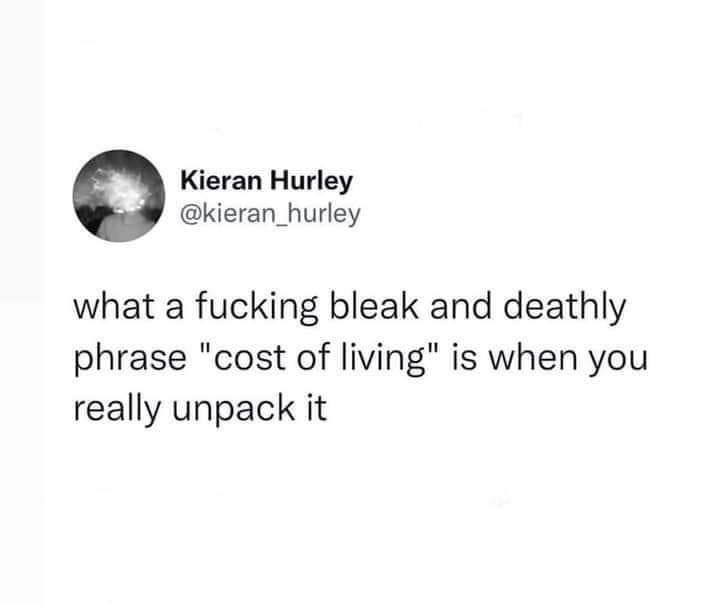
This meme serves as a dark commentary on the phrase "cost of living." As the caption reads, "what a fucking bleak and deadly phrase 'cost of living' is when you really unpack it," the joke suggests that the economic pressure behind the phrase—particularly regarding wage stagnation and job security—is deeply terrifying for workers. It implies that when you take the phrase apart and look at the reality, it reveals a grim prospect of financial hardship or the end of one's livelihood.
simple-description (llama3.2-vision_11b)
The meme is a sarcastic commentary on the struggles of working-class individuals who are forced to take on multiple jobs to make ends meet. The text "I'm not arguing, I'm just explaining why I'm not arguing" is a humorous way of saying that the speaker is overwhelmed by the demands of their job and is not willing to engage in a debate about their work-life balance. The meme is poking fun at the idea that people are expected to be grateful for the opportunity to work multiple jobs, even if it means sacrificing their personal time and energy.
detailed-analysis (gemma3-27b-vision)
Okay, here's an analysis of the image/text based on the requested theoretical frameworks. I will only include sections relevant to the content.
Visual Description
The image is a screenshot of a tweet by Kieran Hurley (@kieran_hurley). It features a profile picture in black and white depicting a person. The text of the tweet reads: "what a fucking bleak and deathly phrase 'cost of living' is when you really unpack it." The background is a simple white, typical of a social media platform like Twitter (now X).
Foucauldian Genealogical Discourse Analysis
The statement powerfully invites a genealogical analysis, as requested by the phrasing "when you really unpack it." Michel Foucault's genealogical method seeks to expose the historical contingencies and power relations that have produced seemingly natural or objective concepts.
The "cost of living" is presented not as a neutral economic indicator, but as a discourse – a system of thought, language, and practice. When "unpacked," it reveals its embedded power dynamics:
- Normalization of Precarity: The phrase frames the impossibility for many to afford basic necessities as a matter of simple economics, rather than a systemic failure. It normalizes the precarity of existence and obscures the political/economic forces creating it.
- Biopower: The concept of “cost of living” is a function of biopower. The state, through economic policy, exerts power over life itself. It regulates, controls, and manages the conditions under which people live and die. When the “cost of living” rises beyond the means of many, it operates as a form of subtle, structural violence.
- Disciplinary Power: The phrase encourages individual responsibility for navigating the financial hardship, shifting focus away from systemic issues. The “cost of living” becomes a metric against which individuals are judged (their ability to "manage" or "budget," etc.), enacting a form of disciplinary power.
- Historical Contingency: A genealogical tracing would reveal that the way we measure and talk about "cost of living" is not inherent or universal. It’s a construct of specific historical and economic circumstances.
Critical Theory
The tweet clearly resonates with the tenets of Critical Theory, especially those stemming from the Frankfurt School. The phrase "cost of living" is presented as part of a larger system of control and domination.
- Ideology: The statement suggests that the phrase itself is ideological – a way of masking the inherent contradictions and injustices of the capitalist system. By framing hardship as a matter of individual economic management, it obscures the systemic factors that cause it.
- Commodification of Life: The very concept of a "cost of living" implies that everything necessary for survival (food, shelter, healthcare) is a commodity to be bought and sold, rather than a fundamental human right. This commodification reduces human life to its economic value.
- Alienation: The tweet implicitly points to the alienation experienced under late capitalism – the separation of individuals from the means of production, from each other, and from their own labor. The "cost of living" is a measure of this alienation, reflecting the extent to which individuals are forced to participate in a system that exploits them.
Marxist Conflict Theory
From a Marxist perspective, the tweet highlights the fundamental conflict inherent in capitalist society – the conflict between the bourgeoisie (owners of the means of production) and the proletariat (working class).
- Exploitation: The “cost of living” is a direct consequence of the exploitation of labor. Profits are extracted from workers, and this profit drives up the cost of essential goods and services.
- Class Struggle: The statement implicitly calls attention to the class struggle. The rising "cost of living" disproportionately affects the working class, while the wealthy continue to accumulate capital.
- Material Conditions: Marxist theory emphasizes the importance of material conditions in shaping social consciousness. The tweet suggests that when people begin to critically examine the "cost of living," they will become aware of the systemic inequalities that are shaping their lives.
Postmodernism
The tweet’s emphasis on “unpacking” the phrase aligns with postmodern deconstruction.
- Rejection of Grand Narratives: Postmodern thought challenges universal truths or “grand narratives,” such as the idea of economic progress. The statement implies that the “cost of living” is not a neutral measure, but a constructed narrative that serves specific power interests.
- Language as Constructive: The tweet highlights the role of language in shaping reality. The phrase “cost of living” is not merely a descriptive term; it actively constructs our understanding of economic hardship.
In conclusion, the tweet is a potent commentary on the social and economic realities of late capitalism, engaging with multiple critical frameworks to expose the power dynamics embedded within seemingly neutral language.
simple-description (llama3.2-vision)
This meme is a humorous reaction to a frustrating situation. The text reads: "what a f**king bleak and deathly phrase 'cost of living' is when you really unpack it". It's a sarcastic comment on the idea that the phrase "cost of living" is actually a euphemism for the harsh reality of financial struggles. The tone is tongue-in-cheek and lightheartedly bitter.
tesseract-ocr
Kieran Hurley @kieran_hurley what a fucking bleak and deathly phrase "cost of living" is when you really unpack it