First Seen
2023-06-15T22:28:27+00:00
simple-description (qwen3.5_2b-q8_0)
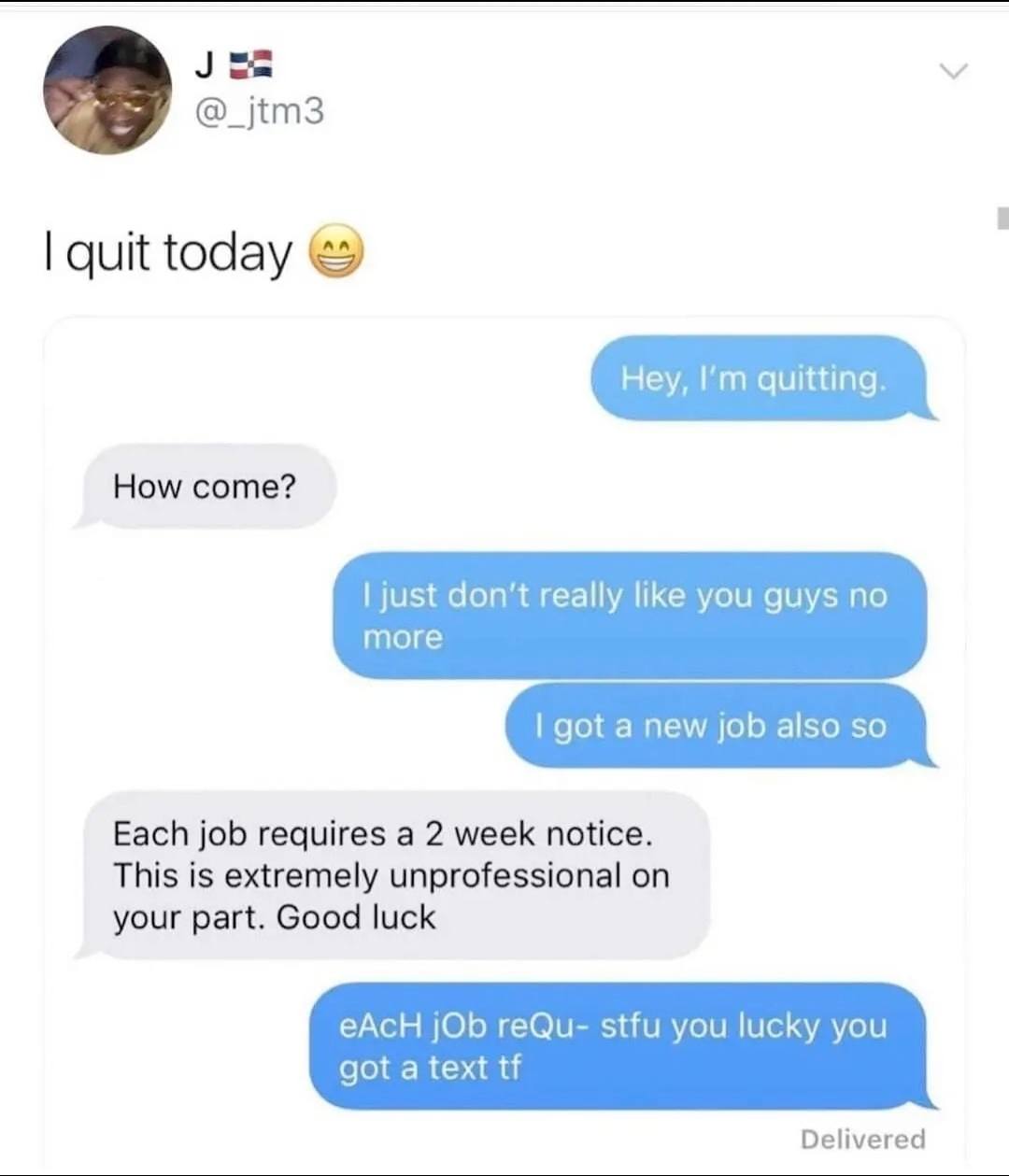
This meme illustrates the concept of mutual exploitation often found in capitalist labor systems. It depicts a worker quitting his current job to secure money for a new one (to "work"), while simultaneously calling this move "unprofessional." The text bubble at the bottom mocks the system's demand by stating, "Either job requires you to stop working," implying that leaving one job is a prerequisite for gaining a new financial one.
simple-description (llama3.2-vision_11b)
The meme is a screenshot of a Twitter conversation where a user says "I quit" and the other user responds with a sarcastic message about the user's job being unfulfilling. The user then responds with a humorous and somewhat bitter message about the job requirements, saying "I don't have time for this" and "I'm not going to be your slave".
detailed-analysis (gemma3-27b-vision)
Okay, let's break down this text exchange through several theoretical lenses. I'll provide sections only for the theories that find meaningful application here.
Visual Description
The image is a screenshot of a Twitter post displaying a text message exchange. The sender (with a profile picture) initially declares they’ve quit. The recipient requests an explanation, which is given in two phases: a blunt statement of disliking the people they worked with, and confirmation of a new job. The recipient then points out the requirement of a two-week notice period, calling the sender’s action "unprofessional," and wishes them "good luck." The sender’s response is a deliberately misspelled and abbreviated outburst (“eAcH jOb rEqu- stfu lucky you got a text tf”). The conversation is overlaid on a Twitter background, indicating it’s a public share. The tweet’s profile includes a flag emoji, suggesting a national identity. The overall presentation is informal and suggests a level of exasperation or conflict.
Foucauldian Genealogical Discourse Analysis
This text exchange is rich for a Foucauldian analysis. The core of the conflict centers around power dynamics and disciplinary mechanisms operating within the workplace.
-
Discourse of Professionalism: The recipient's response ("Each job requires a two-week notice. This is extremely unprofessional...") isn't simply a statement of policy, but performs a discourse of professionalism. This discourse is a historical construct, not a natural one. It creates norms about acceptable behavior, establishes hierarchies, and seeks to discipline the individual (the sender) by invoking expectations of conduct. The "unprofessional" label isn't about objective error, but about a deviation from the power-laden norms enforced by the institution of work.
-
Genealogy of Notice Periods: A genealogical approach would trace the history of the two-week notice period. Where did this practice originate? What purposes did it serve? (e.g., maintaining production, allowing for training of a replacement, protecting the employer from disruption). This history would reveal how the requirement isn’t inherently ‘reasonable,’ but a power strategy solidified over time.
-
The Sender’s Resistance: The sender's bluntness, spelling, and ultimately the aggressive “stfu” response can be read as a resistance to this disciplinary discourse. They refuse to conform to the expected modes of polite resignation. It is an insurrection of subjectivity against the expectations placed upon them. Their refusal to engage in the expected language of workplace etiquette signifies a disruption of the power structure.
Critical Theory
This exchange exemplifies a tension between rationalization and subjectivity highlighted by critical theorists.
-
Rationalized Workplace: The insistence on a two-week notice represents the rationalization of the workplace, a core theme in Max Weber’s work. The workplace is treated as a system governed by rules and procedures, divorced from personal feelings or individual circumstances. The recipient's response treats the sender as a mere cog in this system.
-
Subjective Experience vs. Systemic Demands: The sender’s initial statements ("I just don’t really like you guys no more") prioritize subjective experience – the feeling of dislike – over the objective demands of the workplace. They are refusing to subsume their feelings under the dictates of professional conduct.
-
Alienation: While not fully apparent, there's a subtle undercurrent of alienation. The sender's curtness suggests a detachment from the work and the people associated with it, potentially indicating a sense of meaninglessness or lack of fulfillment in their job.
Queer Feminist Intersectional Analysis
While this is a brief exchange, some aspects lend themselves to this analysis.
- Subversion of Expectations: The sender's aggressive response, employing deliberately misspelled internet slang, can be viewed as a rejection of expected communication norms – traditionally those associated with politeness and deference. This rejection of normativity can align with queer and feminist approaches that challenge established power structures. It is a refusal to perform the "good worker" who politely navigates conflict.
- Power Dynamics & Gender: The response lacks explicit gender dynamics, but within workplace interactions, asserting boundaries and disrupting polite communication often carry different implications for women and gender-nonconforming individuals, who may be penalized more harshly for similar behavior. Without further context, this remains speculative.
- Refusal to "Be Nice": The sender's directness could be read as a rejection of the expectation that individuals (especially women) must prioritize being “nice” or accommodating, even at the expense of their own needs or boundaries.
It's important to remember that any single interpretation is limited. These theoretical frameworks offer lenses through which to analyze the text, revealing potential complexities and power dynamics that might not be immediately apparent.
simple-description (llama3.2-vision)
This meme is a screenshot of a conversation between two people, where one person is quitting their job and the other person is responding with a sarcastic and dismissive tone. The text "I quit" is followed by a series of ridiculous and unprofessional responses, including "I'm leaving" and "I'm done". The conversation ends with a humorous and absurd exchange, with the second person trying to convince the first person to stay and offering a series of ridiculous reasons to stay, including "I love you" and "I need you".
tesseract-ocr
Jo v @_jtm3 . E | quit today «) How come? | just don't really like you guys no more | got a new job also so Each job requires a 2 week notice. This is extremely unprofessional on your part. Good luck eAcH jOb reQu- stfu you lucky you got a text tf Delivered