First Seen
2023-07-12T04:41:23+00:00
simple-description (qwen3.5_2b-q8_0)
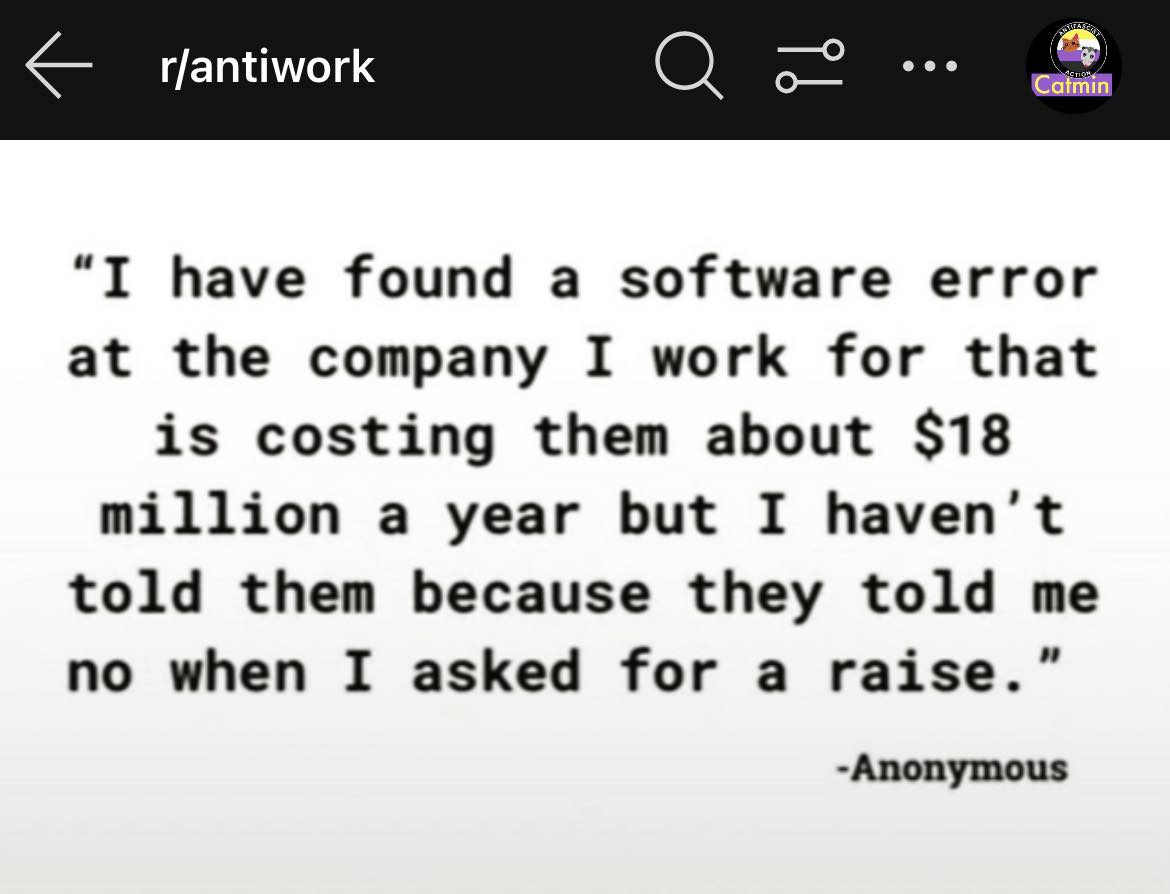
This meme features a quote that illustrates the cynical reality of corporate layoffs and corporate greed. The text reads:
"I have found a software error at the company I work for that is costing them about $18 million a year but I haven't told them because they told me no when I asked for a raise."
From an anti-capitalist and workplace perspective, this highlights how companies often prioritize profit over fixing mistakes. The creator suggests that an employee is willing to fix a $18 million error for free, but they are rejected for a raise. This implies that the company will never fix the error because they don't want to pay for it, and the employee is being sacrificed as a replacement for their own labor.
simple-description (llama3.2-vision_11b)
The meme is a screenshot of a Reddit comment from a user who claims to have been asked to work on a project that is expected to make the company millions of dollars, but is only being paid a small fraction of that amount. The user is expressing frustration and resentment towards the company's profit-driven approach to business, implying that the company is prioritizing profits over employee well-being. The comment text reads: "I have a 'software engineer' job that is supposed to make the company 18 million dollars a year but I get paid 40k a year. How is this even legal?"
detailed-analysis (gemma3-27b-vision)
Okay, let's break down this image/post within the frameworks you've provided.
Visual Description
The image is a screenshot of a post from the subreddit r/antiwork. It's a simple black text field on a white background. The text states: "I have found a software error at the company I work for that is costing them about $18 million a year but I haven’t told them because they told me no when I asked for a raise." The author is listed as "Anonymous". The subreddit's banner is visible at the top, and there are a few interaction icons visible, and what appears to be a small "Calmin" icon.
Marxist Conflict Theory
This post is highly relevant to Marxist conflict theory. The core concept here is the inherent conflict between labor and capital.
- Exploitation: The worker has identified a significant loss for the company—$18 million annually—that they could easily resolve. This highlights the potential for value creation that exists within the labor of the worker, which the company is unknowingly losing. The worker is essentially holding the means to increase profit, but is being denied a share of that potential gain.
- Alienation: The worker’s refusal to share the knowledge is a clear act of resistance against the alienation inherent in capitalist systems. They are not motivated by the company's success, but by their own unmet needs (a fair wage). They've become alienated from the company's goals because their own needs are not recognized.
- Class Conflict: The scenario illustrates the fundamental conflict between the worker’s interest (a raise) and the company’s interest (maximizing profit). The denial of the raise, coupled with the worker’s withholding of critical information, demonstrates a breakdown in the supposed harmonious relationship between employer and employee.
- Power Dynamics: The company holds the power to grant or deny compensation, creating an imbalance that fuels the conflict. The worker’s refusal to cooperate is a subtle attempt to reassert some power by demonstrating their value.
Foucauldian Genealogical Discourse Analysis
This post can be analyzed through a Foucauldian lens by examining the "discourse" surrounding work, value, and compensation.
- Power/Knowledge: The worker possesses knowledge that holds economic power. The company's refusal of the raise is a demonstration of power, defining the terms of the employment relationship. The worker’s withholding of information is a counter-exercise of power, demonstrating that knowledge is not neutral but is intrinsically linked to power dynamics.
- Discipline and Control: The refusal of the raise can be seen as a form of disciplinary power, reinforcing the company’s control over the worker. The refusal isn't necessarily about the worker's performance, but about maintaining the existing hierarchy and power structures.
- Genealogy of Compensation: Historically, compensation has been tied to notions of "worth" and "value". This post challenges that notion by demonstrating that the worker's value isn’t solely measured by their job description, but also by their ability to identify and resolve critical problems.
- Normalizing Practices: The practice of denying raises while simultaneously expecting (or assuming) employee loyalty and dedicated problem-solving is a normalizing practice that perpetuates a power imbalance.
Critical Theory
This post resonates strongly with critical theory, particularly the Frankfurt School’s critique of instrumental reason and the domination of the individual within late capitalism.
- Instrumental Reason: The company views the worker as a means to an end (profit maximization), rather than recognizing their intrinsic worth as a human being. The denial of the raise prioritizes profit over the employee's needs, demonstrating a cold, rational calculation.
- Domination: The power dynamics at play—the company’s control over wages and the worker’s vulnerability—reflect broader patterns of domination within capitalist systems. The worker is subject to the whims of the employer, and their agency is limited.
- False Consciousness: The worker’s initial impulse to continue working diligently despite the denial of the raise could be seen as a form of false consciousness, where they internalize the values of the company and prioritize its success over their own well-being. However, their subsequent action of withholding information signals a break from this consciousness.
Postmodernism
Postmodern aspects are somewhat present, but not as central as in the other frameworks.
- Deconstruction of Value: The post deconstructs the conventional notion of “value” in the workplace. The worker's knowledge is more valuable to the company than the salary they are being paid. This highlights the arbitrary nature of assigning value based on traditional metrics.
- Subjectivity of Truth: The company's “truth” about what constitutes a fair wage is challenged by the worker’s subjective experience of being undervalued. The post illustrates that there is no objective standard for determining worth, only competing narratives.
- Rejection of Grand Narratives: The post implicitly rejects the grand narrative of capitalism—that hard work and loyalty will be rewarded—by demonstrating that these values are often not reciprocated.
Queer Feminist Intersectional Analysis
This is the least directly applicable framework, but some analysis is possible:
- Power dynamics: A Queer Feminist Intersectional analysis would highlight the intersection of power dynamics within the workplace and how these dynamics are influenced by systems of oppression. While the post does not explicitly mention gender, sexuality, or race, these factors would likely shape the worker’s experience and the company’s decision to deny the raise. A person of color, LGBTQ+ person, or woman may face additional barriers in negotiating for fair compensation.
- Labor and care: The worker's act of withholding information could be interpreted as a form of self-care—a refusal to provide unpaid labor (problem-solving) to an employer who doesn't value their contributions.
- Challenging norms: The worker is subverting the expectation that employees should be loyal and dedicated to their employers, even when they are being treated unfairly. This can be seen as a form of resistance to the dominant norms of the workplace.
Let me know if you'd like me to elaborate on any of these analyses or explore additional perspectives.
simple-description (llama3.2-vision)
This meme is a screenshot of a Reddit comment on the r/antiwork subreddit. The text reads: "I have found a software error at the company I work for that is costing them about $18 million a year. But I haven't told them yet because I want to see how long it takes for them to figure it out."
tesseract-ocr
“I have found a software error at the company I work for that is costing them about $18 million a year but I haven't told them because they told me no when I asked for a raise.” -Anonymous