First Seen
2023-08-29T19:46:44+00:00
simple-description (qwen3.5_2b-q8_0)
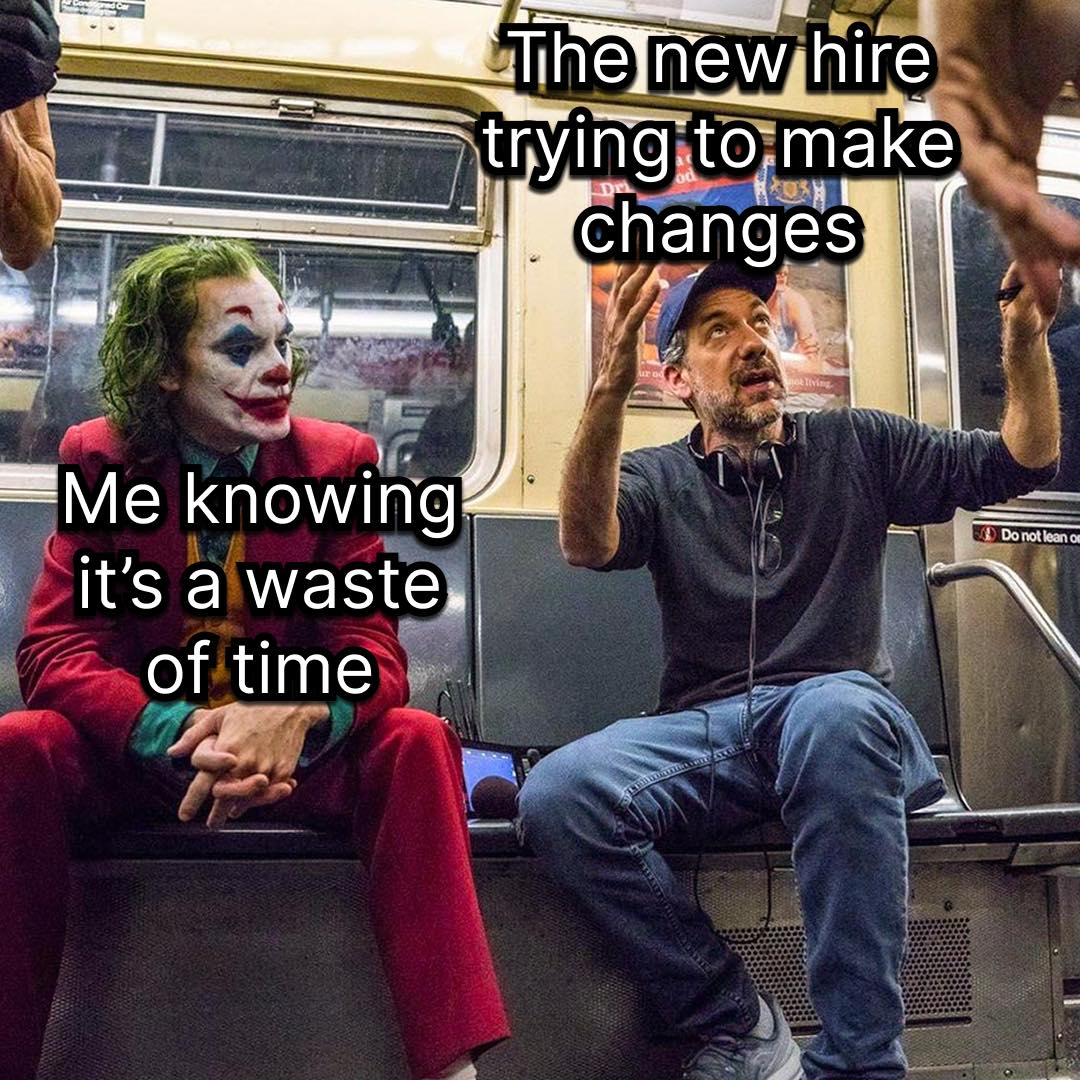
The meme satirizes the absurdity of corporate leaders forcing creative professionals into roles they are not naturally suited for, just to keep the business running. It features a director (David Fincher) who is being told by a corporate executive to "try to make changes," while the text notes he knows it's a "waste of time." This humor comes from the irony of a creative mind being forced to justify an unwanted job role by claiming he understands the business better than the executives, which aligns with anti-capitalist critiques of treating labor simply as a commodity to be manipulated for profit.
simple-description (llama3.2-vision_11b)
The meme is a photo of a person sitting next to a train conductor, with the person looking confused and the conductor saying "I'm not a conductor, I'm a train engineer. I'm not a train engineer, I'm a train conductor." The text overlays the image, with the person saying "I'm not a train conductor, I'm a train engineer" and the conductor responding with "I'm not a train engineer, I'm a train conductor." This meme is used to describe the feeling of being overwhelmed and unsure of one's role in a job, particularly in a corporate setting where job titles and responsibilities can be confusing.
detailed-analysis (gemma3-27b-vision)
Okay, let's break down this meme image through several theoretical lenses. It's a strong visual with layers ripe for analysis.
Visual Description
The image features a split composition within a subway car. On the left, a figure in full Joker makeup and costume sits with a deflated, slumped posture, arms resting on knees, looking down. The expression appears defeated or cynical. On the right, a man sits with arms raised in animated speech, likely expressing ideas or attempting to rally support. His posture is energetic but potentially frustrated. Text overlays the image: "Me knowing it’s a waste of time" is positioned under the Joker figure, and "The new hire trying to make changes" is over the man. The overall atmosphere is one of resigned cynicism juxtaposed with energetic futility. The setting, a subway car, suggests a transient, public, and often impersonal space.
Foucauldian Genealogical Discourse Analysis
This meme speaks powerfully to themes of power, knowledge, and discourse. The Joker figure, a symbol of chaos and rejection of societal norms, represents a counter-discourse. They have already disengaged from the expectations and systems the "new hire" is attempting to address. The "new hire," despite their enthusiasm, is caught within the episteme – the underlying assumptions and rules that govern the organization.
A Foucauldian approach would explore how the "new hire's" attempts at change are likely to be disciplined or normalized by the existing power structures. The meme suggests that the organization has a history of stifling initiative, and that the "new hire" is unknowingly operating within a system designed to absorb or neutralize any challenges to the status quo. The "Joker's" resignation isn’t simply apathy, it's a knowledge produced by repeated encounters with this disciplinary power. The meme implicitly questions what knowledge is considered legitimate within the organization – the "Joker" knows the attempts will fail, based on previous experiences.
Critical Theory
From a Critical Theory perspective (rooted in the Frankfurt School), the meme speaks to the alienation and disillusionment experienced within bureaucratic systems. The "new hire" represents an idealist who believes in the possibility of positive change through reason and effort. However, the "Joker" embodies a more cynical, realist understanding of power dynamics.
The meme implies that the organization itself is a tool of domination, designed to maintain the status quo. The “new hire’s” attempts at change will be absorbed, co-opted, or simply ignored, reinforcing the existing power structure. This reflects a critique of instrumental reason – the belief that rational thought and technical expertise can solve all problems, ignoring the underlying social and political forces at play. The meme suggests that the organizational culture has eroded individual agency and fostered a sense of powerlessness. It can be seen as a commentary on the failure of meritocracy and the pervasive feeling of being trapped in a system that does not value genuine innovation or improvement.
Marxist Conflict Theory
From a Marxist perspective, the meme highlights the inherent class conflict within organizations. The "new hire" can be seen as representing those who genuinely believe in the potential for change, while the "Joker" embodies the proletariat – those who have been alienated and disillusioned by the exploitative nature of the system.
The "new hire’s" initiatives might be seen as attempts to alleviate some of the symptoms of exploitation, but ultimately, they do not challenge the fundamental power dynamics. The "Joker’s" resignation suggests a recognition that any attempts at reform within the existing structure will be futile. There's a subtle suggestion of false consciousness in the "new hire's" actions – believing they can achieve positive change through individual effort, while ignoring the systemic forces that perpetuate inequality and exploitation. The subway car setting itself can be seen as a microcosm of capitalist society, where individuals are transient and disposable.
Postmodernism
A postmodern reading of the image might focus on the deconstruction of grand narratives and the fragmentation of meaning. The meme rejects the notion that change is necessarily possible or even desirable.
The “new hire” represents a naive attempt to impose a singular, coherent vision on a complex and chaotic system. The “Joker” embodies a rejection of such totalizing narratives. They have embraced the inherent ambiguity and instability of the world. The meme implicitly questions the very idea of “progress” or “improvement.” Is change always positive? Is it even possible to define a “better” outcome? The image embraces a sense of irony and playfulness, suggesting that the search for meaning and purpose is ultimately futile. The lack of a clear “solution” or “message” reinforces the postmodern rejection of closure and certainty.
Queer Feminist Intersectional Analysis
This lens is a bit more subtle, but potentially present. The "Joker" figure, through their subversive appearance and rejection of norms, can be read as embodying a rejection of dominant power structures. A queer feminist reading would focus on how the "new hire's" initiatives might inadvertently reinforce existing inequalities. For example, the "new hire's" vision of change might be based on a patriarchal or heteronormative framework, further marginalizing those who do not fit the dominant mold.
The “Joker's” resignation could be interpreted as a refusal to participate in a system that perpetuates oppression. Their expression conveys a weariness from constantly having to navigate and challenge these systems. From an intersectional perspective, the subway car can be seen as a space where different forms of power and oppression intersect. The "new hire" might be oblivious to the ways in which their initiatives could disproportionately impact certain groups, while the "Joker" has a deeper understanding of these dynamics. The “Joker” represents a refusal to participate in a system built on domination and control.
Let me know if you’d like me to elaborate on any of these analyses or explore other theoretical frameworks.
simple-description (llama3.2-vision)
This meme features a photo of two characters from the movie "Joker" (2019) sitting on a train. The Joker (played by Joaquin Phoenix) is sitting next to a director (played by Robert De Niro) who is explaining something to him. The text on the meme reads: "The new hire: 'I have no idea what I'm doing.' Director: 'It's okay, it's a learning experience.'"
tesseract-ocr
S i ——__ Tho maWitlo we Sf Fihyingito;makely & es —— = = a ce) ao i a ecciwamaliad Ye et _ f r : wel MNate\uiinc} i nn a Fr) ee é |: i ] Oe) ee. \ ale i <n yf vee. . a Sa <Gay ‘ pee ‘aaa eo i * sy oye si