First Seen
2023-09-22T04:17:43+00:00
simple-description (qwen3.5_2b-q8_0)
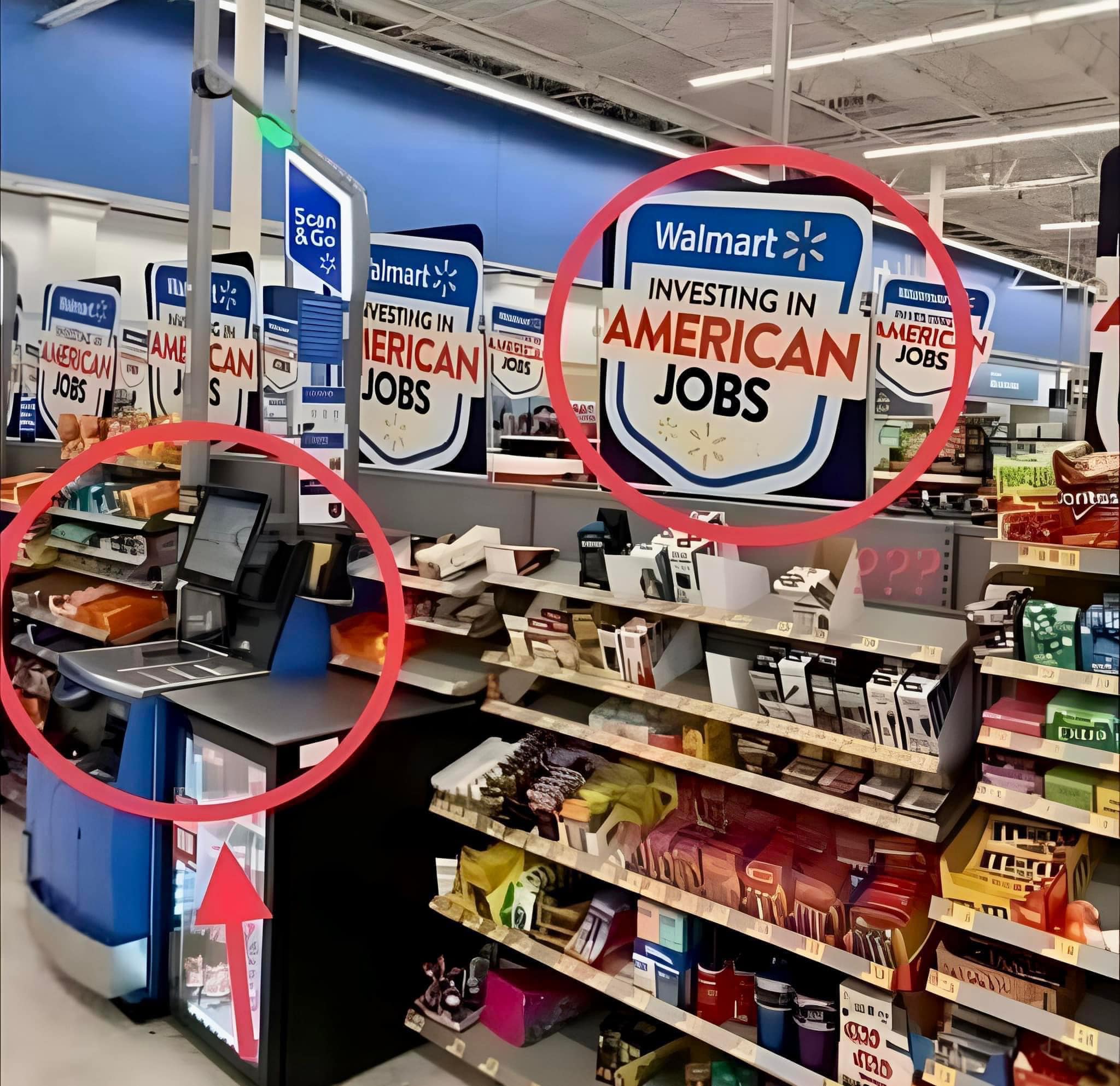
The meme highlights the ironic contrast between corporate propaganda and the reality of modern retail infrastructure. It points out the "Walmart Investing in American Jobs" sign hanging over the checkout area while simultaneously mocking the utilitarian nature of the self-service kiosk, which is famously cheap and features a small attached freezer to go with it. In political circles, this often serves as a commentary on how corporations might use slogans like "Investing in American Jobs" to distract from the reality of self-service technology that replaces retail workers.
simple-description (llama3.2-vision_11b)
The meme shows a Walmart store with a sign that reads "Walmart: Investing in American Jobs". The image is likely meant to be ironic or satirical, as Walmart is a large corporation known for outsourcing jobs and prioritizing profits over worker welfare. The sign's message is likely meant to be humorous or hypocritical, implying that Walmart is not actually investing in American jobs.
detailed-analysis (gemma3-27b-vision)
Okay, here's an analysis of the image, broken down into sections as requested. I'll focus on areas where the image lends itself to deeper theoretical engagement. Some of these sections will be shorter than others, as not every lens applies strongly.
Visual Description
The image depicts an aisle within a Walmart store. The aisle is stocked with a variety of canned goods and boxed foods. Prominent in the image are large, circular signs proclaiming “Walmart: Investing in American Jobs.” These are strategically placed at the ends of aisles and repeated throughout. The merchandise is arranged on metal shelving, some shelves appearing partially depleted (or at least not fully stocked). There’s a self-checkout station visible in the foreground. The lighting is bright and fluorescent, typical of a large retail environment. The overall aesthetic is functional and designed for efficient consumption. There is a red arrow pointing to a product, possibly a promotional display.
Foucauldian Genealogical Discourse Analysis
The “Investing in American Jobs” signage is crucial to a Foucauldian reading. This isn’t simply a statement of fact. It's a discourse, a way of talking about Walmart’s relationship to labor and national identity. A genealogical analysis would trace the historical emergence of this discourse.
- Power/Knowledge: The phrase links economic practice (Walmart's purchasing decisions) with a seemingly benevolent nationalistic narrative. This creates a power/knowledge nexus: Walmart claims to be doing something good for America (power), and simultaneously shapes how we understand what constitutes “good” (knowledge).
- Disciplinary Power: The constant repetition of the phrase functions as a subtle form of disciplinary power. It attempts to normalize the idea that consumer purchases at Walmart contribute to American jobs – framing consumption as patriotic.
- Normalizing Judgement: This discourse constructs a normative framework. If you don't buy from Walmart, is it implied you're not investing in American jobs, and therefore less patriotic? This is a subtle form of social control.
- Historical Shift: Examining the history of Walmart’s branding reveals a shift. Early marketing focused on “everyday low prices.” This “Investing in American Jobs” messaging is a strategic re-positioning, possibly in response to criticisms of outsourcing and labor practices.
Critical Theory
The image exemplifies several key concepts within Critical Theory, particularly those related to the culture industry and the commodification of ideology.
- The Culture Industry: Adorno and Horkheimer's idea of the culture industry is relevant. Walmart isn't simply selling goods; it’s selling a lifestyle – one that links consumption with national pride and economic responsibility. The signage turns a commercial enterprise into a vehicle for ideology.
- Commodification of Ideology: The image demonstrates how ideology (in this case, the idea that consumerism equates to patriotism) is itself commodified and used to drive sales. It’s not about genuine investment in American workers; it’s about making consumers feel good about their purchases.
- False Consciousness: The messaging could be seen as contributing to "false consciousness." Consumers may believe they are making a positive contribution to the economy through their purchases, while remaining unaware of the broader systemic issues surrounding labor exploitation, wealth inequality, and the true impact of Walmart’s business practices.
- Rationalization: The presentation of the goods on the shelf, the clean lines of the store, and the efficiency of the self-checkout all contribute to a sense of rationalization and standardization – a key feature of modern capitalist society.
Marxist Conflict Theory
From a Marxist perspective, the image highlights the inherent contradictions and power imbalances within the capitalist system.
- Exploitation of Labor: The “Investing in American Jobs” claim masks the reality of labor conditions within Walmart’s supply chain, the pressure on suppliers to cut costs (often at the expense of workers), and the potentially low wages and limited benefits paid to Walmart employees themselves.
- Class Struggle: The image represents a symbolic battlefield in the ongoing class struggle. Walmart is attempting to create a positive image and secure consumer loyalty, while simultaneously perpetuating a system that benefits the owners of capital at the expense of workers.
- Commodity Fetishism: The focus on the “American Jobs” aspect distracts from the actual value of the goods being sold – the labor and resources that went into producing them. This is an example of commodity fetishism – attributing value to the commodity itself rather than the social relations of production.
- Ideological Hegemony: Walmart is attempting to establish ideological hegemony – a dominant worldview that justifies the capitalist system. The “Investing in American Jobs” messaging is part of this effort to normalize and legitimize the status quo.
Postmodernism
A postmodern reading would focus on the image’s self-referentiality and the blurring of boundaries between commerce, ideology, and representation.
- Hyperreality: The “Investing in American Jobs” signage can be seen as contributing to a hyperreal environment. The sign is a simulation of investment, a representation that becomes more real than the actual investment.
- Simulacra and Simulation: The sign doesn’t necessarily refer to a “real” investment, but to a simulation of it. It’s a sign pointing to another sign, ultimately detached from any underlying reality.
- Deconstruction of Meaning: A postmodern analysis might deconstruct the phrase “Investing in American Jobs.” What does “investing” actually mean? Whose jobs are being invested in? The ambiguity of the language allows Walmart to control the narrative.
- Fragmented Narrative: The image itself is fragmented – a snapshot of a larger consumer landscape. It reflects the fragmented, dispersed nature of postmodern experience.
Queer Feminist Intersectional Analysis
This lens is more challenging to apply directly, but can be considered:
- Gendered Labor: The products on the shelves likely have a significant amount of labor performed by women in both production and in the store. Where are the signs highlighting investment in women’s jobs? The absence reveals a gender bias in how value is recognized.
- Intersection of Class and Gender: Women are disproportionately represented in low-wage retail and service jobs. The “Investing in American Jobs” rhetoric doesn't address the specific challenges faced by women workers.
- Commodification of Identity: By linking consumption with patriotism, Walmart is subtly reinforcing dominant ideologies about national identity and citizenship. This can exclude or marginalize those who don’t conform to these norms.
- Representation & Lack Thereof: Consider who is represented in the images used for advertising (not visible in the picture, but implied by the brand). Is there representation of diverse genders, sexualities, races, and abilities? The absence of diversity perpetuates systemic inequalities.
I hope this detailed analysis is helpful! Let me know if you'd like me to expand on any of these sections, or if you have further questions.
tesseract-ocr
ee ea | =>. / ee || ee, _ me, | >t se - 5 } ~~ . = ~ > pe Re ies : ar ee i = es ———— , i aie 25 _ ——— < — on — } we r { Pi h (cE (c mee * INVESTING IN ye (Ca rr cu eS | EDI IN a ny / LAZTRim, , | TAMER A <. Lo NAME ess ERIC A ay tMteez RENT '}| JOBS |). —— |SUgQ, WN} ou id CAN Qq a wh 1015 : Rees aa] rN P| VS ps alons 0 | JOBS | Sj a é w o a - 5 a _~_N Bi i eee a x ce ———— ===. ——_ a EE — ih = 1 a=) eo ee ae 4 : | oti x -< : oy a. —_— = al LE ee ie ~ SS ae i rs mh = heal = 6 ) 5 —_ i eo me mea |\\ NN y sey ae! . 5 : a + i) - _— : | Ps / ri => =e was vg mol wg ; ab a 1 ¥ \v) - = , = = | Ni Pp tile Sis Oye f : oS Noi “AG: = t i tat ie = & . yy : ‘ —_ == Qo, 7 = ~—e a = : Ry ine a
simple-description (llama3.2-vision)
This meme is a photo of a Walmart store with a sign in the background that says "Investing in American Jobs" with a typo, reading "Investing in American Jobs" with a red "J" instead of a "J" in "Jobs". The sign is likely meant to be a patriotic message, but the typo makes it humorous. The image is likely meant to be ironic or sarcastic, poking fun at the idea of a company trying to be patriotic while making a simple mistake.